 Back
Chapter 2: The Chemistry of Life – Structured Study Notes
Study Guide - Smart Notes
 Tailored notes based on your materials, expanded with key definitions, examples, and context.
Chemistry of Life
Overview of Molecules and Atoms
The foundation of biology is chemistry, as all living things are composed of matter, which consists of atoms and molecules. Understanding the chemical basis of life is essential for grasping biological processes.
Matter: Anything that occupies space and has mass. Exists in three states: solid, liquid, and gas.
Atoms: The smallest units retaining the properties of their element. Atoms bond to form molecules.
Molecules: Groups of atoms bonded together, forming the chemical basis of life.
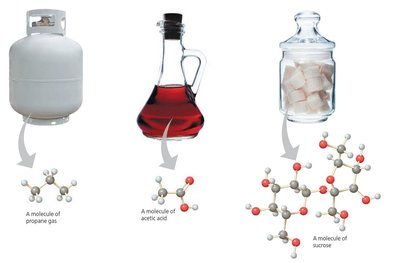
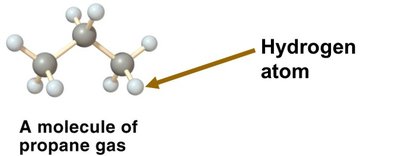
Example: Water (H2O), carbon dioxide (CO2), and glucose (C6H12O6) are common biological molecules.
Matter is Composed of Elements
Elements are pure substances that cannot be broken down by chemical means. Each element is made of one type of atom.
Element: A basic substance (e.g., sodium, Na).
Compound: Substance formed when two or more elements combine (e.g., sodium chloride, NaCl).
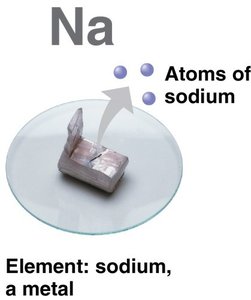
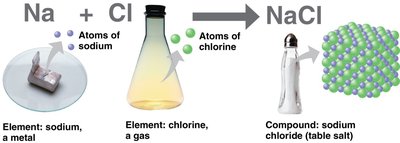
Example: Table salt (NaCl) is a compound formed from sodium (Na) and chlorine (Cl).
Chemical Reactions
Chemical reactions rearrange matter by breaking and forming bonds, but do not create or destroy matter.
Reactants: Substances present before the reaction.
Products: Substances formed as a result of the reaction.
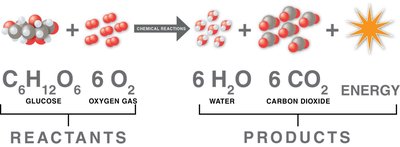
Equation Example: Cellular respiration:
The Periodic Table and Elements Essential to Life
The Periodic Table
The periodic table organizes all known elements by atomic number and properties. It is a fundamental tool for understanding chemical behavior.
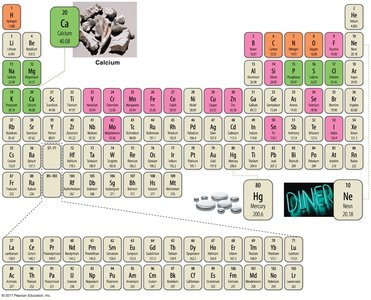
Key Points:
Elements are arranged by increasing atomic number.
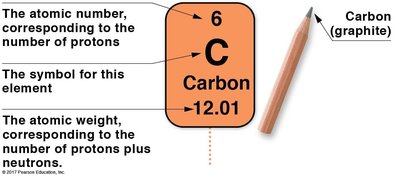
Each element has a unique symbol, atomic number, and atomic weight.
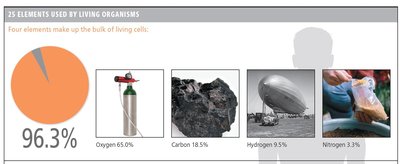
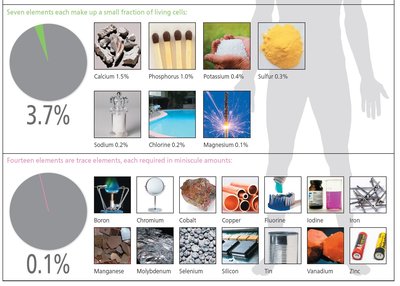
Example: Oxygen, carbon, hydrogen, and nitrogen make up 96% of living cells.
Atom Composition
Structure of Atoms
Atoms consist of three subatomic particles: protons, neutrons, and electrons.
Protons: Positive charge, located in nucleus, determine element identity.
Neutrons: No charge, located in nucleus, determine isotope.
Electrons: Negative charge, orbit nucleus, determine chemical reactivity and ion state.
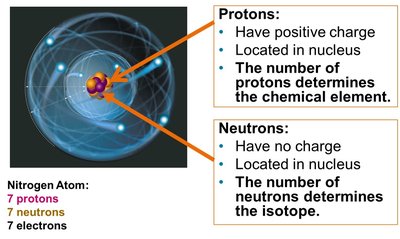
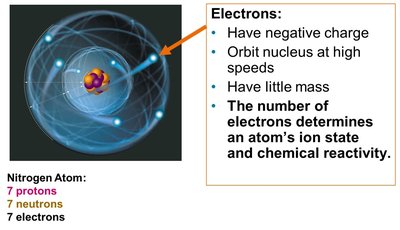
Example: Nitrogen atom: 7 protons, 7 neutrons, 7 electrons.
Isotopes and Ions
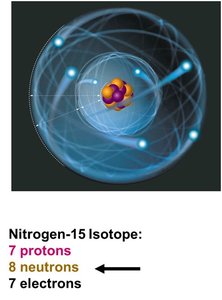
Isotopes are atoms of the same element with different numbers of neutrons. Ions are atoms that have gained or lost electrons, resulting in a charge.
Isotope: Same number of protons, different number of neutrons (e.g., Nitrogen-15).
Ion: Atom with a net electrical charge due to electron gain or loss.
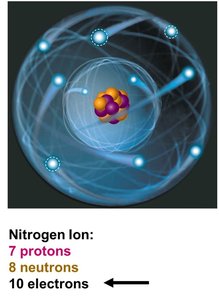
Example: Nitrogen ion: 7 protons, 8 neutrons, 10 electrons (negatively charged).
Chemical Bonds
Types of Chemical Bonds
Atoms are held together by chemical bonds, which are essential for forming molecules.
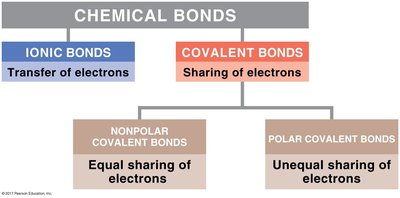
Ionic Bonds: Transfer of electrons from one atom to another, resulting in oppositely charged ions.
Covalent Bonds: Sharing of electrons between atoms. Can be single, double, or triple bonds.
Nonpolar Covalent Bonds: Equal sharing of electrons.
Polar Covalent Bonds: Unequal sharing of electrons, leading to partial charges.
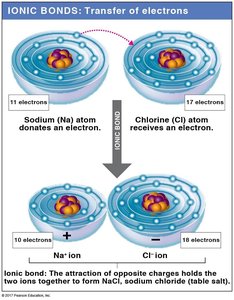
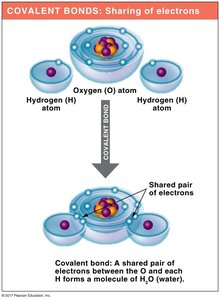
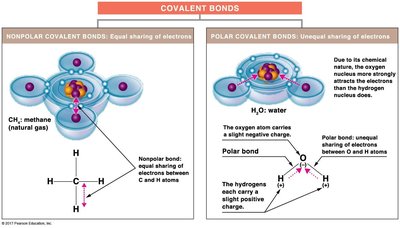
Example: Water (H2O) contains polar covalent bonds.
Properties of Water
Water's Unique Properties
The structure and polarity of water molecules give rise to several properties essential for life.
Hydrogen Bonds: Weak bonds between water molecules, but collectively strong enough to form liquid water.
Ice Floats: Stable hydrogen bonds hold water molecules apart, making ice less dense than liquid water.
Solvent Ability: Water dissolves many substances, forming solutions.
Temperature Regulation: Water absorbs and releases heat slowly, moderating temperature.
Cohesion and Surface Tension: Water molecules stick together, creating surface tension.
Example: Water's ability to dissolve salts and sugars is vital for biological processes.
pH and Acidity
pH Scale and Its Biological Importance
The pH scale measures the acidity or basicity of a solution, which is crucial for maintaining life processes.
Acid: Releases H+ ions in water; pH 0–7.
Base: Removes H+ ions; pH 7–14.
Buffer: Minimizes changes in pH by accepting or donating H+ ions.
Equation:
Example: Blood uses buffers to maintain a stable pH.
Life is Based on Carbon
Carbon's Versatility
Carbon atoms can form up to four bonds, allowing for large, branched, and diverse molecules. Most biological molecules are organic compounds containing carbon.
Organic Compounds: Molecules containing carbon bonded to other elements.
Functional Groups: Sets of atoms attached to carbon skeletons, influencing chemical reactivity.
Example: Chains and rings of carbon form the backbone of sugars, proteins, and fats.
Polymers and Macromolecules
Biological Macromolecules
Most biological macromolecules are polymers, made by joining monomers through dehydration synthesis and broken down by hydrolysis.
Polymer: Large molecule made of repeating monomer units.
Dehydration Synthesis: Links monomers by removing water.
Hydrolysis: Breaks polymers by adding water.
Example: Digestion breaks down starch (polymer) into glucose (monomer).
Carbohydrates
Structure and Function
Carbohydrates are a primary source of energy and structural material in living organisms.
Monosaccharides: Simple sugars (e.g., glucose, fructose).
Disaccharides: Two monosaccharides joined (e.g., sucrose).
Polysaccharides: Many monosaccharides joined (e.g., starch, cellulose, glycogen, chitin).
Example: Starch in plants, glycogen in animals.
Lipids
Types and Functions
Lipids are hydrophobic molecules essential for energy storage, membrane structure, and hormone regulation.
Phospholipids: Form cell membranes.
Cholesterol: Maintains membrane fluidity and is a precursor for steroid hormones.
Triglycerides: Main form of dietary fat and energy storage.
Steroids: Lipids with four fused rings, including hormones like estrogen and testosterone.
Example: Saturated fats (solid at room temperature), unsaturated fats (liquid at room temperature), trans fats (unhealthy).
Proteins
Structure and Function
Proteins are polymers of amino acids and perform a wide variety of functions in cells.
Amino Acids: Building blocks of proteins; 20 types.
Polypeptide: Chain of amino acids.
Protein Function: Determined by amino acid sequence and shape.
Example: Enzymes, structural proteins, transport proteins.
Enzymes
Role in Metabolism
Enzymes are proteins that speed up chemical reactions by lowering activation energy. Each enzyme is specific to its substrate.
Metabolism: Sum of all chemical reactions in an organism.
Enzyme: Protein catalyst; not consumed in reaction.
Inhibitors: Molecules that prevent enzyme function (competitive or noncompetitive).
Example: Amylase speeds up starch breakdown; lactase breaks down lactose.
Additional info: Gene mutations can alter enzyme shape, leading to conditions like lactose intolerance.
