 Back
38 pt 1Chemical Communication and Hormonal Control in Animals
Study Guide - Smart Notes
 Tailored notes based on your materials, expanded with key definitions, examples, and context.
Chemical Control of the Animal Body: The Endocrine System
Communication Between Animal Cells
Animal cells must communicate to coordinate the functions of the organism. Communication occurs across various distances and involves different mechanisms, each suited to specific physiological needs.
Direct Communication: Cells exchange signals through gap junctions, allowing ions and small molecules to pass directly between adjacent cells.
Synaptic Communication: Nerve cells transmit electrical signals rapidly, releasing neurotransmitters that cross synapses and bind to receptors on target cells, eliciting a response.
Paracrine Communication: Local hormones act on nearby cells, with effects limited by rapid degradation or uptake. Examples include histamine, cytokines, and nitric oxide.
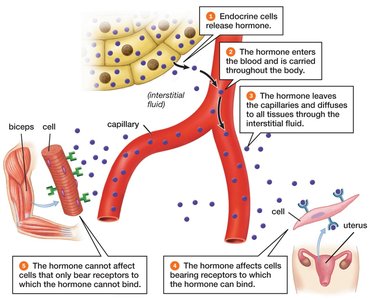
Endocrine Communication: Hormones are secreted by endocrine glands and travel through the bloodstream to distant target cells.
Hormones and Receptors
A hormone is a chemical messenger secreted by a cell and carried by interstitial fluid or blood to other cells. Only cells with the appropriate receptors can respond to a hormone, making them target cells. Receptors are specialized proteins located on the cell surface or inside the cell.
Cells without the correct receptors do not respond to the hormone.
Different cell types may respond differently to the same hormone.
Example: Oxytocin stimulates uterine muscle contraction during childbirth, but does not affect other muscles lacking oxytocin receptors.
Local Hormones: Prostaglandins
Prostaglandins are modified fatty acids secreted by cells throughout the body, with diverse effects depending on cell type. During childbirth, they cause cervical dilation and stimulate uterine contractions. Drugs like aspirin inhibit prostaglandin synthesis, providing relief from pain and inflammation.
Effects of Endocrine Hormones
Classes of Vertebrate Endocrine Hormones
Vertebrate endocrine hormones are classified into three main types:
Steroid hormones: Synthesized from cholesterol; lipid-soluble.
Peptide hormones: Chains of amino acids; water-soluble.
Amino acid derived hormones: Composed of one or two modified amino acids; mostly water-soluble.
Hormone-Receptor Binding and Cellular Effects
Hormone binding to its receptor (lock and key mechanism) causes two major effects:
Regulation of gene transcription, altering protein synthesis.
Stimulation of metabolic changes by activating or inhibiting enzymes.
Steroid Hormone Action
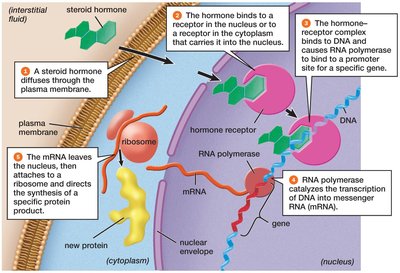
Steroid hormones diffuse through the plasma membrane and bind to intracellular receptors. The hormone-receptor complex enters the nucleus, binds to DNA, and activates transcription of specific genes. The resulting mRNA directs protein synthesis.
Peptide and Amino Acid Derived Hormone Action
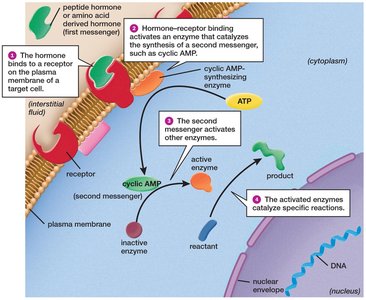
These hormones bind to receptors on the cell surface. The binding activates enzymes that produce second messengers (e.g., cyclic AMP), which in turn activate other enzymes and catalyze specific cellular reactions.
Regulation of Hormone Release: Feedback Mechanisms
Hormone release is regulated by feedback mechanisms:
Negative feedback: The response to a change counteracts the change. Example: After water loss, ADH is released to conserve water; when water balance is restored, ADH secretion stops.
Positive feedback: The response enhances the change. Example: During childbirth, uterine contractions stretch the cervix, triggering oxytocin release, which causes further contractions. Positive feedback stops after delivery.
Summary Table: Methods of Cell Communication
Method | Distance | Messenger | Example |
|---|---|---|---|
Direct | Adjacent cells | Ions, small molecules | Gap junctions |
Synaptic | Short | Neurotransmitters | Nerve cells |
Paracrine | Local | Local hormones | Histamine, cytokines |
Endocrine | Long | Hormones | Thyroid, pituitary glands |
Summary Table: Classes of Endocrine Hormones
Class | Structure | Solubility | Receptor Location |
|---|---|---|---|
Steroid | Cholesterol-derived | Lipid-soluble | Intracellular |
Peptide | Amino acid chains | Water-soluble | Cell surface |
Amino acid derived | Modified amino acids | Mostly water-soluble | Cell surface or intracellular |
Key Equations
Hormone action often involves gene transcription:
Second messenger pathway (e.g., cyclic AMP):
Additional info: The notes expand on the original content by providing definitions, examples, and summary tables for clarity and completeness.
