 Back
Chemical Control of the Animal Body: The Endocrine System
Study Guide - Smart Notes
 Tailored notes based on your materials, expanded with key definitions, examples, and context.
Chemical Control of the Animal Body: The Endocrine System
Communication Between Animal Cells
Animal cells must communicate to coordinate the functions of the organism. Communication occurs over various distances and involves different mechanisms, including direct contact, local signaling, and long-distance signaling via hormones.
Direct Communication: Cells exchange signals through gap junctions or direct contact.
Synaptic Communication: Nerve cells transmit electrical signals and release neurotransmitters to stimulate nearby target cells. The response duration varies depending on the target cell.
Paracrine Communication: Local hormones act on nearby cells and are quickly degraded or taken up. Examples include histamine, cytokines, and nitric oxide.
Endocrine Communication: Hormones are secreted by endocrine glands and travel through the bloodstream to distant target cells.
Hormones and Receptors
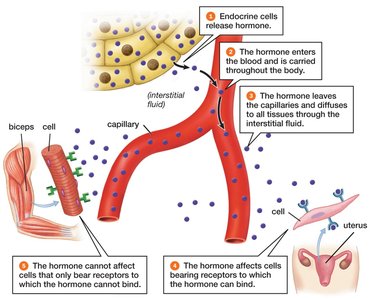
Hormones are chemical messengers secreted by cells and carried by interstitial fluid or blood to other cells. A cell responds to a hormone only if it has a matching receptor, which defines the target cell. Receptors are specialized proteins located on the cell surface or inside the cell.
Cells without the correct receptors cannot respond to the hormone.
Different cell types may respond differently to the same hormone.
Prostaglandins and Local Hormones
Prostaglandins are modified fatty acids with diverse effects depending on the cell type. For example, they cause cervical dilation and uterine contractions during childbirth. Drugs like aspirin inhibit prostaglandin synthesis to relieve symptoms.
Endocrine Glands
Endocrine glands are specialized structures whose main function is hormone secretion. Examples include the thyroid, pituitary, pancreas, ovaries, and testes. Some glands are clusters of cells within organs with multiple functions.
Effects of Endocrine Hormones
Classes of Vertebrate Endocrine Hormones
There are three main classes of vertebrate endocrine hormones:
Steroid hormones: Synthesized from cholesterol; lipid-soluble.
Peptide hormones: Chains of amino acids; water-soluble.
Amino acid derived hormones: Composed of one or two modified amino acids; mostly water-soluble.
Hormone-Receptor Binding and Cellular Effects
Hormone-receptor binding acts as a lock-and-key mechanism, causing two major effects:
Regulation of gene transcription, changing protein synthesis.
Stimulation of metabolic changes by activating or inhibiting enzymes.
Steroid Hormones
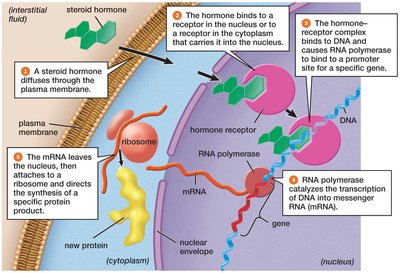
Steroid hormones usually bind to intracellular receptors and diffuse through plasma membranes. The hormone-receptor complex activates transcription of specific genes.
Peptide and Amino Acid Derived Hormones
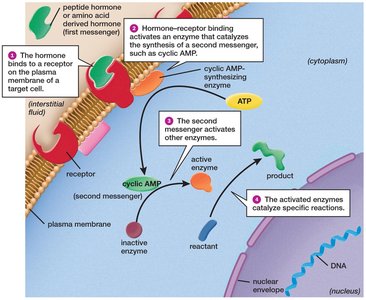
These hormones bind to receptors on the cell surface. Most are water-soluble and cannot cross the plasma membrane. Binding activates second messengers (e.g., cyclic AMP), which trigger enzyme activity and cellular responses.
Regulation of Hormone Release
Hormone release is regulated by feedback mechanisms:
Negative feedback: The response counteracts the change, maintaining homeostasis. Example: ADH release regulates water balance.
Positive feedback: The response enhances the change, but only temporarily. Example: Oxytocin release during childbirth increases uterine contractions.
The Mammalian Endocrine System: Structures and Functions
Major Endocrine Glands and Organs
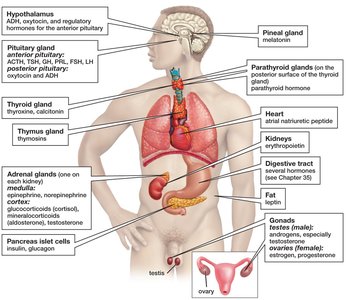
The mammalian endocrine system includes:
Hypothalamus–pituitary complex
Thyroid gland
Pancreas
Sex organs (testes and ovaries)
Adrenal glands
Other organs: pineal gland, thymus, kidneys, digestive tract, fat cells, heart
Hormones of the Hypothalamus and Pituitary Gland
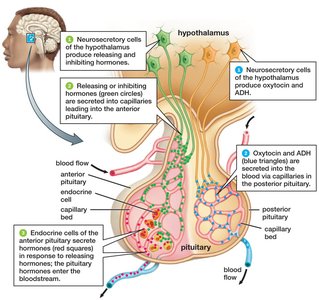
The hypothalamus contains neurosecretory cells that synthesize, store, and release peptide hormones. These hormones regulate many body functions by stimulating or inhibiting hormone release from the anterior pituitary.
Thyroid Gland and Hypothyroidism
The thyroid gland produces thyroxine, which regulates metabolism, growth, and development. Hypothyroidism can result from an iodine-deficient diet, leading to reduced thyroxine production and enlargement of the thyroid (goiter).

Pancreas: Digestive and Endocrine Functions
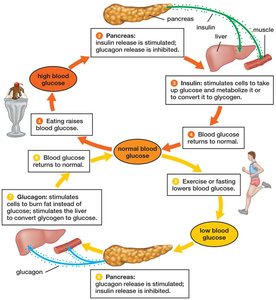
The pancreas has both digestive and endocrine roles. Its endocrine portion consists of islet cells that produce insulin and glucagon, which regulate blood glucose levels.
Diabetes Mellitus
Diabetes results from defective insulin control:
Type 1 diabetes: Autoimmune destruction of insulin-secreting cells.
Type 2 diabetes: Insulin resistance in target cells, despite adequate insulin production.
Sex Hormones and Puberty
Puberty begins when the hypothalamus increases secretion of releasing hormones, stimulating the anterior pituitary to release LH and FSH. These hormones promote production of sex hormones in the testes and ovaries.
Testosterone: Stimulates male secondary sexual characteristics and sperm production.
Estrogen: Stimulates female secondary sexual characteristics and egg maturation.
Progesterone: Prepares the reproductive tract for fertilization and pregnancy.
Summary Table: The Mammalian Endocrine System
The following table summarizes the major endocrine glands, their hormones, chemical types, and principal functions:
Endocrine Gland | Hormone | Type of Chemical | Principal Function |
|---|---|---|---|
Hypothalamus | Releasing/Inhibiting Hormones | Peptide | Regulate anterior pituitary hormone release |
Anterior Pituitary | FSH, LH, TSH, ACTH, PRL, GH | Peptide | Stimulate growth, reproduction, metabolism |
Posterior Pituitary | ADH, Oxytocin | Peptide | Water balance, uterine contraction, milk ejection |
Thyroid | Thyroxine, Calcitonin | Amino acid derivative, Peptide | Metabolism, calcium regulation |
Parathyroid | Parathyroid hormone | Peptide | Increase blood calcium |
Pancreas | Insulin, Glucagon | Peptide | Regulate blood glucose |
Testes | Testosterone | Steroid | Male sexual development |
Ovaries | Estrogen, Progesterone | Steroid | Female sexual development, pregnancy |
Adrenal Cortex | Glucocorticoids, Mineralocorticoids | Steroid | Metabolism, salt balance |
Adrenal Medulla | Epinephrine, Norepinephrine | Amino acid derivative | Fight-or-flight response |
Pineal Gland | Melatonin | Amino acid derivative | Sleep-wake cycles |
Thymus | Thymosin | Peptide | T cell maturation |
Kidney | Erythropoietin | Peptide | Red blood cell synthesis |
Digestive Tract | Secretin, Gastrin, etc. | Peptide | Digestive regulation |
Fat Cells | Leptin | Peptide | Appetite, immune function |
Heart | ANP | Peptide | Blood pressure regulation |
Additional info: The notes include expanded explanations, definitions, and examples to ensure completeness and academic quality for introductory biology students.
