 Back
Energy and Metabolism: Foundations of Cellular Function
Study Guide - Smart Notes
 Tailored notes based on your materials, expanded with key definitions, examples, and context.
Energy and Metabolism
Introduction to Energy in Biology
All living organisms require a constant flow of energy to sustain life processes. Energy is essential for growth, movement, reproduction, and cellular maintenance. In biological systems, energy transformations underpin metabolism and the ability of cells to perform work.
Forms and States of Energy
Kinetic Energy: The energy of motion. Examples include a moving muscle or a falling object.
Potential Energy: Stored energy due to position or structure, such as energy stored in chemical bonds or a stretched spring.
Other Forms: Mechanical, heat, sound, electric current, light, and radioactivity are all forms of energy relevant to biological systems.
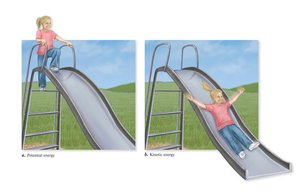
Example: A child at the top of a slide has potential energy, which is converted to kinetic energy as she slides down.
Measurement and Flow of Energy
Calorie: The amount of heat required to raise 1 gram of water by 1ºC. In biology, energy is often measured in calories.
Energy Source: The sun is the primary energy source for life on Earth. Photosynthetic organisms capture solar energy and store it in chemical bonds.
Redox Reactions (Oxidation-Reduction)
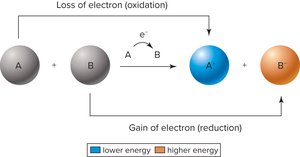
Redox reactions are chemical processes that transfer energy by moving electrons between molecules. These reactions are fundamental to cellular energy transformations.
Oxidation: Loss of electrons from an atom or molecule.
Reduction: Gain of electrons by an atom or molecule. The reduced form has a higher energy level than the oxidized form.
Redox reactions always occur in pairs: one molecule is oxidized while another is reduced.
Laws of Thermodynamics
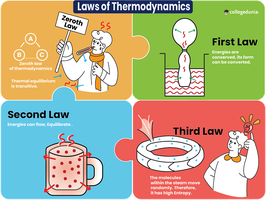
Thermodynamics is the study of energy changes. Biological systems obey the laws of thermodynamics, which govern energy transformations and the direction of metabolic processes.
First Law: Energy cannot be created or destroyed, only transformed from one form to another. The total energy in the universe remains constant.
Second Law: Energy transformations are not 100% efficient; some energy is always lost as heat. Entropy (disorder) in the universe is always increasing.
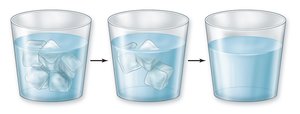
Example: When ice melts in water, the system becomes more disordered, illustrating the increase in entropy.
Free Energy and Chemical Reactions
Free energy (G) is the energy available to do work in a system. The change in free energy (ΔG) determines whether a reaction is spontaneous.
Equation: Where is enthalpy (total energy), is temperature in Kelvin, and is entropy.
Change in Free Energy:
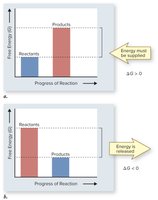
Endergonic Reactions: ; require energy input; products have more free energy than reactants.
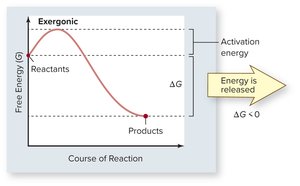
Exergonic Reactions: ; release energy; products have less free energy than reactants; spontaneous.
Activation Energy
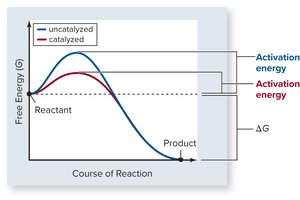
Activation energy is the extra energy required to initiate a chemical reaction by destabilizing existing bonds. Even exergonic reactions need activation energy to proceed.
Reactions with higher activation energy proceed more slowly.
Reaction rates can be increased by providing activation energy (e.g., heat) or by lowering activation energy (e.g., using a catalyst).
ATP: The Energy Currency of the Cell
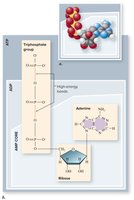
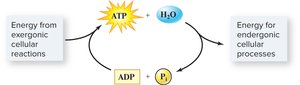
Adenosine triphosphate (ATP) is the primary energy carrier in cells. It consists of ribose (a 5-carbon sugar), adenine (a nitrogenous base), and three phosphate groups. The bonds between phosphate groups are unstable and store significant energy.
ATP hydrolysis releases energy by breaking the bond between the second and third phosphate groups, forming ADP or AMP.
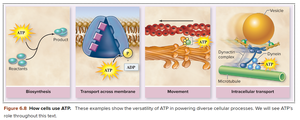
ATP is used to drive endergonic reactions and is regenerated continuously in cells.
Catalysts and Enzymes
Catalysts are substances that lower the activation energy of a reaction, increasing its rate without being consumed. Enzymes are biological catalysts, mostly proteins (some are RNA), that speed up metabolic reactions by stabilizing the transition state.
Enzymes do not alter the overall free energy change (ΔG) of a reaction.
They cannot make an endergonic reaction spontaneous.
Enzyme Structure and Function
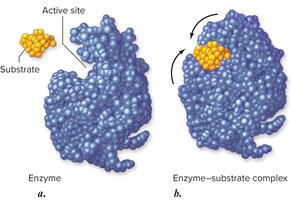
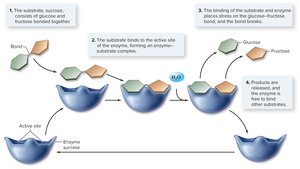
Active Site: The region on the enzyme where the substrate binds. The enzyme-substrate complex forms here, and the enzyme induces a fit that stresses specific bonds, lowering activation energy.
Enzymes are not changed or consumed during the reaction.
Enzyme Localization and Complexes
Enzymes may be free in the cytoplasm or associated with membranes and organelles.
Multienzyme Complexes: Groups of enzymes that work together, allowing efficient substrate transfer and regulation.
Nonprotein Enzymes and Cofactors
Ribozymes: RNA molecules with catalytic activity, capable of catalyzing reactions on themselves (intramolecular) or on other molecules (intermolecular).
Cofactors: Nonprotein chemical components that assist enzyme function. These include metal ions and organic molecules called coenzymes (often derived from vitamins).
Regulation of Enzyme Activity
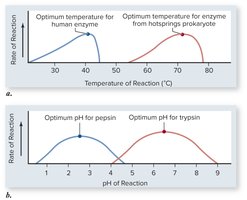
Enzyme activity is influenced by temperature, pH, and regulatory molecules.
Extreme conditions can denature enzymes, altering their three-dimensional structure and function.
Enzyme Inhibition and Activation
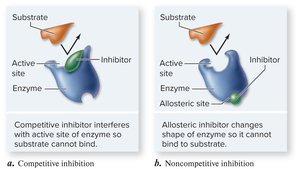
Inhibitors: Substances that decrease enzyme activity.
Competitive Inhibitors: Compete with the substrate for the active site.
Noncompetitive Inhibitors: Bind to an allosteric site, changing the enzyme's shape and preventing substrate binding.
Allosteric Enzymes: Exist in active and inactive forms, regulated by allosteric inhibitors (decrease activity) or activators (increase activity).
Metabolism and Biochemical Pathways
Metabolism is the sum of all chemical reactions in an organism. It includes:
Anabolic Reactions (Anabolism): Build complex molecules from simpler ones, requiring energy input.
Catabolic Reactions (Catabolism): Break down complex molecules, releasing energy.
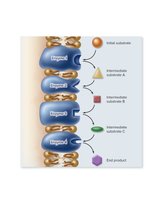
Biochemical pathways organize reactions into sequences, where the product of one reaction becomes the substrate for the next. Many pathways are compartmentalized within organelles.
Feedback Inhibition
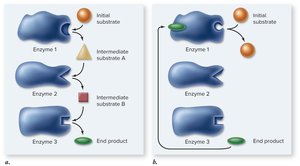
Feedback inhibition is a regulatory mechanism where the end product of a pathway inhibits an enzyme involved early in the pathway, preventing the overproduction of products and conserving resources.
Additional info: This guide covers the foundational concepts of energy and metabolism, including the laws of thermodynamics, ATP function, enzyme structure and regulation, and the organization of metabolic pathways. These principles are essential for understanding cellular respiration, photosynthesis, and other metabolic processes discussed in later chapters.
