 Back
BackFundamentals of Biology: Chemistry of Life, Cell Structure, and Communication
Study Guide - Smart Notes
 Tailored notes based on your materials, expanded with key definitions, examples, and context.
Chemistry of Life
Elements Essential for Life
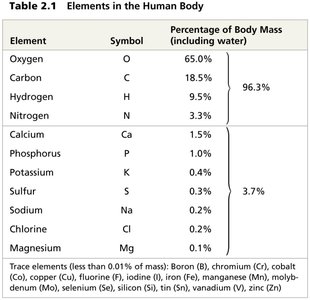
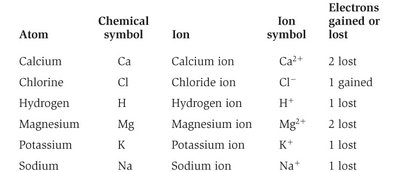
Living organisms are composed of a limited set of elements, with only about 24 elements making up all life. The most abundant elements in the human body are oxygen, carbon, hydrogen, and nitrogen, which together account for over 96% of body mass. Other elements, such as calcium, phosphorus, potassium, sulfur, sodium, chlorine, and magnesium, are present in smaller amounts but are still critical for biological functions.
Element: A substance made up of one type of atom.
Major elements: O, C, H, N.
Minor elements: Ca, P, K, S, Na, Cl, Mg.
Atomic Structure and Subatomic Particles
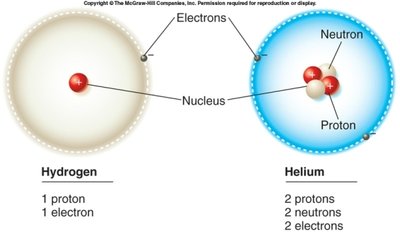
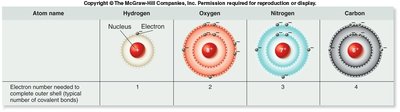
Atoms are the basic units of matter and consist of three types of subatomic particles: protons (positively charged), neutrons (neutral), and electrons (negatively charged). The nucleus contains protons and neutrons, while electrons occupy orbitals around the nucleus.
Protons: Determine the atomic number and identity of the element.
Neutrons: Contribute to atomic mass and can vary, creating isotopes.
Electrons: Involved in chemical bonding and energy transfer.
Electron Shells and Orbitals
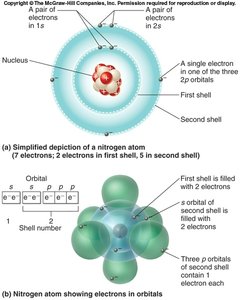
Electrons are arranged in shells and orbitals. The first shell holds up to two electrons, while subsequent shells can hold more. The arrangement of electrons determines how atoms interact and bond with each other.
Valence electrons: Electrons in the outermost shell, involved in bonding.
Orbitals: Regions where electrons are likely to be found.
Chemical Bonds
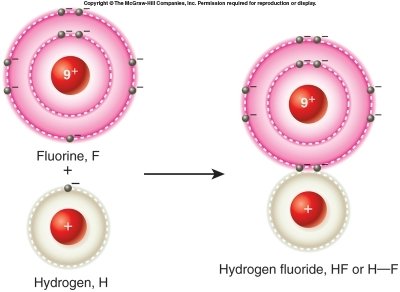
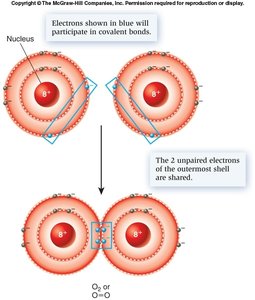
Atoms form molecules by bonding through electron interactions. The main types of chemical bonds are covalent, polar covalent, ionic, and hydrogen bonds.
Covalent bonds: Electrons are shared equally between atoms.
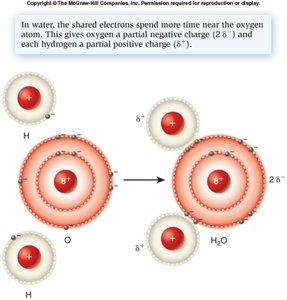
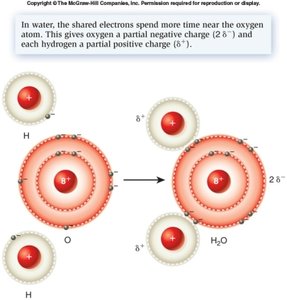
Polar covalent bonds: Electrons are shared unequally, creating partial charges.
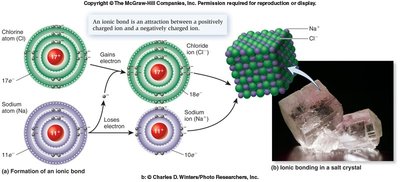
Ionic bonds: Electrons are transferred, resulting in charged ions that attract each other.
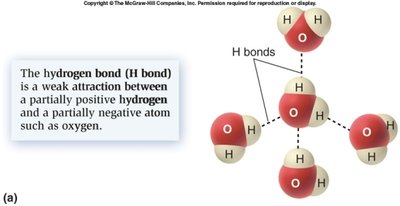
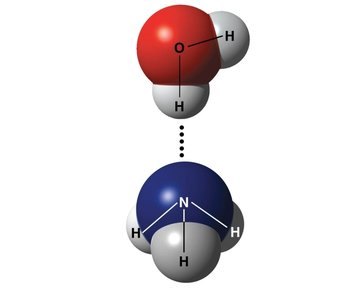
Hydrogen bonds: Weak attractions between partially positive hydrogen and partially negative atoms (usually O or N).
Polar Covalent Bonds and Water
Water is formed by polar covalent bonds between hydrogen and oxygen. The unequal sharing of electrons gives oxygen a partial negative charge and hydrogen a partial positive charge, making water a polar molecule.
Polarity: Leads to unique properties such as cohesion, adhesion, and solvent ability.
Ionic Bonds and Salts
Ionic bonds form when electrons are transferred from one atom to another, creating ions. These ions are attracted to each other, forming compounds called salts. For example, sodium chloride (NaCl) is formed by the transfer of an electron from sodium to chlorine.
Cation: Positively charged ion (e.g., Na+).
Anion: Negatively charged ion (e.g., Cl-).
Hydrogen Bonds
Hydrogen bonds are weak individually but strong in large numbers. They are crucial for the structure of water and biological molecules like DNA and proteins.
Hydrogen bonds: Form between partial charges on different molecules.
Properties of Water
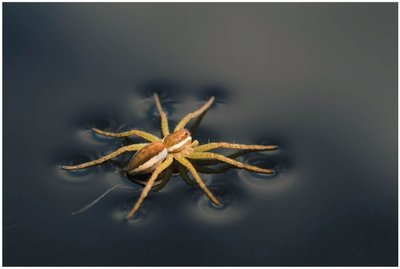
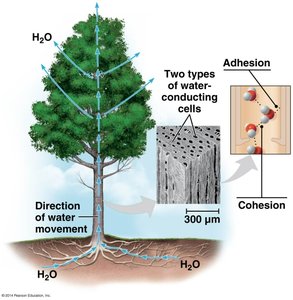
Water's unique properties are essential for life. These include cohesion (binding between like molecules), adhesion (binding between unlike molecules), high surface tension, and its ability to act as a solvent.
Cohesion: Water molecules stick together.
Adhesion: Water molecules stick to other substances.
Surface tension: Allows small organisms to walk on water.
Solvent ability: Dissolves many substances due to polarity.

Density and Phases of Water
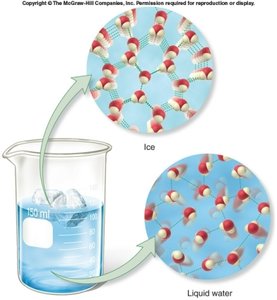
Water is denser as a liquid than as a solid, which is why ice floats. This property is due to hydrogen bonding forming an open crystal structure in ice.
Ice: Less dense than liquid water.
Liquid water: Molecules are packed more closely.
Acids, Bases, and pH
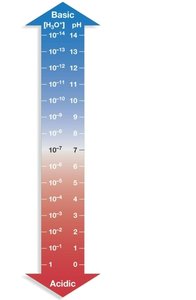
Acids increase the concentration of H+ ions, while bases increase the concentration of OH- ions. The pH scale measures the acidity or basicity of a solution, defined as:
pH = -log10[H+]
Acidic: pH < 7
Basic: pH > 7
Neutral: pH = 7
Energy and Chemical Reactions
Energy is the capacity to do work or supply heat. Chemical reactions involve reactants and products, and can be endothermic (absorb heat) or exothermic (release heat). The spontaneity of a reaction is determined by Gibbs free energy:
ΔG < 0: Spontaneous (exergonic)
ΔG > 0: Non-spontaneous (endergonic)
ΔG = 0: Equilibrium
Equation:
Carbon and Molecular Diversity
Carbon's Versatility
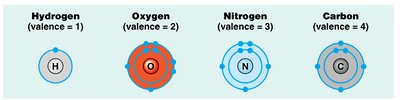
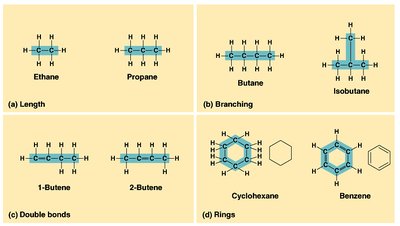
Carbon is the most versatile atom, capable of forming four covalent bonds. This allows for a wide variety of molecular shapes and structures, including chains, branches, and rings.
Carbon skeletons: Form the backbone of organic molecules.
Functional groups: Attachments that determine chemical behavior.
Isomers and Enantiomers
Isomers are compounds with the same molecular formula but different structures. Enantiomers are mirror images of each other and can have different biological activities.
Structural isomers: Differ in covalent arrangement.
Enantiomers: Mirror images, often only one is biologically active.
Macromolecules: Structure and Function
Carbohydrates
Carbohydrates include sugars and polymers. Monosaccharides are simple sugars, disaccharides are double sugars, and polysaccharides are polymers of monosaccharides.
Monosaccharides: Glucose, fructose (fuel for cells).
Disaccharides: Sucrose, maltose (transport and storage).
Polysaccharides: Starch, glycogen, cellulose, chitin (energy storage and structural support).
Proteins
Proteins are polymers of amino acids and perform a wide range of functions, including structural support, transport, signaling, movement, and catalysis (enzymes).
Amino acids: 20 types, each with a unique R group.
Levels of structure: Primary (sequence), secondary (alpha helix, beta sheet), tertiary (3D folding), quaternary (multiple polypeptides).
Nucleic Acids
Nucleic acids (DNA and RNA) are polymers of nucleotides. DNA stores genetic information, while RNA is involved in gene expression and protein synthesis.
Nucleotide: Sugar, phosphate, nitrogenous base.
DNA: Double helix, complementary base pairing (A-T, G-C).
RNA: Single-stranded, uses uracil instead of thymine.
Lipids
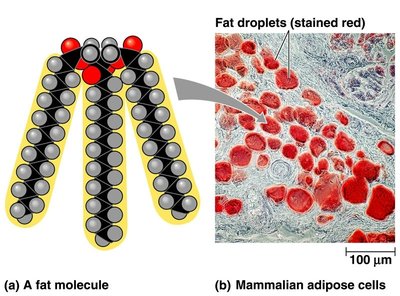
Lipids are hydrophobic molecules that include fats, phospholipids, and steroids. They are important for energy storage, membrane structure, and signaling.
Fats: Energy storage, insulation, cushioning.
Phospholipids: Major component of cell membranes, amphipathic.
Steroids: Signaling molecules, membrane structure (cholesterol).
Cell Structure and Function
Prokaryotic vs. Eukaryotic Cells
All cells share basic features: plasma membrane, cytosol, chromosomes, and ribosomes. Prokaryotes lack a membrane-bound nucleus, while eukaryotes have a nucleus and extensive internal membranes.
Prokaryotes: Bacteria and Archaea, small, simple structure.
Eukaryotes: Plants, animals, fungi, protists; larger, complex, compartmentalized.
Organelles and Their Functions
Eukaryotic cells contain organelles that perform specialized functions:
Nucleus: Information storage and retrieval.
Ribosomes: Protein synthesis.
Endoplasmic Reticulum (ER): Protein and lipid synthesis.
Golgi Apparatus: Protein processing and sorting.
Lysosomes: Waste processing.
Mitochondria: ATP production.
Chloroplasts: Photosynthesis (plants and algae).
Cytoskeleton: Structural support, movement.
Cell Communication
Homeostasis and Feedback Mechanisms
Homeostasis is the maintenance of a stable internal environment. Negative feedback mechanisms counteract changes, while positive feedback amplifies them.
Components: Receptor, control center, effector.
Example: Regulation of blood calcium levels by parathyroid hormone and calcitonin.
Cell Signaling
Cells communicate through signaling molecules that bind to receptors and trigger responses. Types of signaling include direct intercellular, contact-dependent, autocrine, paracrine, and endocrine.
Reception: Signal molecule binds to receptor.
Signal transduction: Sequence of changes inside the cell.
Response: Alteration of enzyme activity, structural protein function, or gene expression.
Types of cell surface receptors: Enzyme-linked, G-protein coupled, ligand-gated ion channels.
Second messengers: Molecules like Ca2+ amplify the signal inside the cell.
*Additional info: Academic context was added to clarify and expand on brief points, ensuring completeness and self-contained explanations for exam preparation.*
