 Back
Introductory Biology: DNA Structure, Replication, and Information Flow
Study Guide - Smart Notes
 Tailored notes based on your materials, expanded with key definitions, examples, and context.
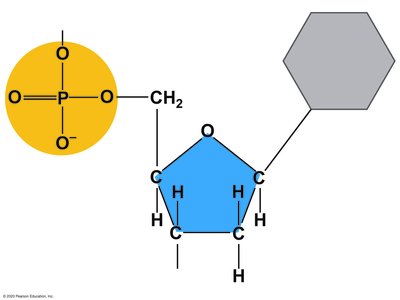
Q1. Complete the following diagram that illustrates the structure of a nucleotide by labeling its components.
Background
Topic: DNA Structure
This question is testing your understanding of the basic building blocks of DNA, specifically the structure of a nucleotide. Nucleotides are the monomers that make up DNA and RNA.
Key Terms and Formulas:
Nucleotide: The basic unit of DNA, consisting of three parts: a phosphate group, a five-carbon sugar (deoxyribose in DNA), and a nitrogenous base.
Phosphate group: Provides the negative charge and is involved in forming the backbone of DNA.
Deoxyribose: The five-carbon sugar found in DNA.
Nitrogenous base: One of four bases (adenine, thymine, cytosine, guanine) in DNA.
Step-by-Step Guidance
Examine the diagram and identify the three main components: the yellow circle (phosphate group), the blue pentagon (sugar), and the gray hexagon (base).
Recall that the phosphate group is attached to the 5' carbon of the sugar, and the base is attached to the 1' carbon.
Label the yellow circle as the phosphate group, the blue pentagon as deoxyribose (the sugar), and the gray hexagon as the nitrogenous base.
Think about how these components connect: the phosphate group links to the sugar, and the sugar links to the base.
Try solving on your own before revealing the answer!
Final Answer:
The yellow circle is the phosphate group, the blue pentagon is deoxyribose (the five-carbon sugar), and the gray hexagon is the nitrogenous base. These three components together make up a nucleotide, the basic unit of DNA.
Labeling these correctly helps you understand how DNA is built from repeating nucleotide units.
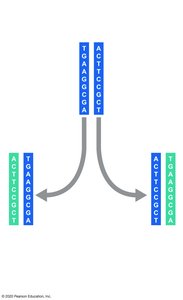
Q2. Complete the following diagram, which illustrates the nature of DNA replication. Be sure to label the original DNA molecule, the new copies of DNA, and the new versus original strands in the copies.
Background
Topic: DNA Replication
This question is testing your understanding of how DNA is copied during cell division. DNA replication is a semi-conservative process, meaning each new DNA molecule contains one original strand and one new strand.
Key Terms and Formulas:
Original DNA strand: The template strand used for replication.
New DNA strand: The strand synthesized during replication.
Semi-conservative replication: Each new DNA molecule has one old strand and one new strand.
Step-by-Step Guidance
Observe the diagram and identify the original DNA molecule (the starting strand).
Notice how the original DNA splits into two strands, each serving as a template for a new strand.
Label the original strands in each new DNA molecule, and indicate which strands are newly synthesized.
Remember that after replication, each DNA molecule consists of one original strand and one new strand.
Try solving on your own before revealing the answer!
Final Answer:
The original DNA molecule is the starting strand. After replication, each new DNA molecule contains one original strand (from the parent DNA) and one new strand (synthesized during replication). This demonstrates the semi-conservative nature of DNA replication.
Labeling the strands helps visualize how genetic information is preserved and passed on during cell division.
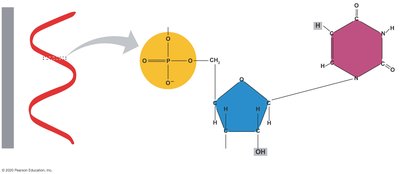
Q3. Is the following diagram a nucleotide of DNA, RNA, or could it be either one? Briefly explain your answer.
Background
Topic: Nucleotide Structure in DNA and RNA
This question is testing your ability to distinguish between DNA and RNA nucleotides based on their structural features.
Key Terms and Formulas:
DNA nucleotide: Contains deoxyribose sugar and one of four bases (A, T, C, G).
RNA nucleotide: Contains ribose sugar and one of four bases (A, U, C, G).
Deoxyribose vs. Ribose: Deoxyribose lacks an oxygen atom at the 2' carbon compared to ribose.
Step-by-Step Guidance
Examine the sugar in the diagram. If the sugar has an -OH group at the 2' carbon, it is ribose (RNA); if it has only an H, it is deoxyribose (DNA).
Look at the base attached to the sugar. If it is uracil, it is RNA; if it is thymine, it is DNA. Adenine, cytosine, and guanine can be found in both.
Check the phosphate group, which is present in both DNA and RNA nucleotides.
Compare the features in the diagram to the characteristics of DNA and RNA nucleotides.
Try solving on your own before revealing the answer!
Final Answer:
This diagram could represent either a DNA or RNA nucleotide, depending on the identity of the sugar and the base. If the sugar is deoxyribose and the base is not uracil, it is DNA. If the sugar is ribose and the base is uracil, it is RNA. The diagram shows a sugar, phosphate, and base, which are common to both types of nucleotides.
Careful examination of the sugar and base is needed to distinguish between DNA and RNA.
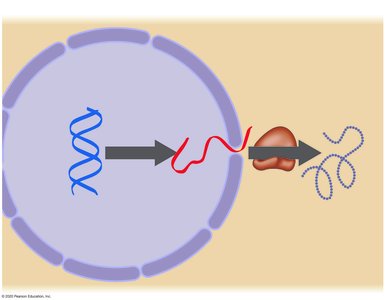
Q4. Complete the following illustration, which represents the flow of genetic information in a cell.
Background
Topic: Central Dogma of Molecular Biology
This question is testing your understanding of how genetic information flows from DNA to RNA to protein within a cell.
Key Terms and Formulas:
Transcription: The process of copying DNA into RNA.
Translation: The process of converting RNA into protein.
Central Dogma: DNA → RNA → Protein
Step-by-Step Guidance
Identify the three main stages in the illustration: DNA (blue), RNA (red), and protein (brown).
Label the arrows to indicate the processes: transcription (DNA to RNA) and translation (RNA to protein).
Recognize that this flow of information is fundamental to gene expression in all cells.
Think about how each stage is catalyzed by specific enzymes: RNA polymerase for transcription, ribosome for translation.
Try solving on your own before revealing the answer!
Final Answer:
The illustration should be labeled as follows: DNA (blue) is transcribed into RNA (red), which is then translated into protein (brown). The arrows represent transcription and translation, showing the central dogma of molecular biology.
This flow is essential for understanding how genes control cellular functions.
