 Back
Mastering the pH Scale, Acids, Bases, and Related Calculations
Study Guide - Smart Notes
 Tailored notes based on your materials, expanded with key definitions, examples, and context.
Q1. Solution A has a pH of 2. Solution B has a pH of 6. How is solution A 10,000 times more acidic than solution B?
Background
Topic: pH Scale and Acidity
This question tests your understanding of how the pH scale relates to acidity and the logarithmic nature of pH differences.
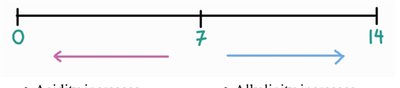
Key Terms and Formulas:
pH: A measure of hydrogen ion concentration, calculated as
Each unit change in pH represents a tenfold change in acidity.
Acidity difference:
Step-by-Step Guidance
Identify the pH values: Solution A (), Solution B ().
Recall that a lower pH means higher acidity.
Calculate the difference in pH: .
Set up the formula for acidity difference: .
Try solving on your own before revealing the answer!
Final Answer: Solution A is 10,000 times more acidic than solution B.
Because the pH scale is logarithmic, a difference of 4 units means a 10,000-fold difference in acidity.
Q2. Solution A has a pH of 9. Solution B has a pH of 11. How is solution B 100 times more alkaline than solution A?
Background
Topic: pH Scale and Alkalinity
This question tests your understanding of how pH relates to alkalinity and the logarithmic relationship between pH values.
Key Terms and Formulas:
Alkalinity increases as pH increases.
Each unit change in pH represents a tenfold change in alkalinity.
Alkalinity difference:
Step-by-Step Guidance
Identify the pH values: Solution A (), Solution B ().
Calculate the difference in pH: .
Set up the formula for alkalinity difference: .
Try solving on your own before revealing the answer!
Final Answer: Solution B is 100 times more alkaline than solution A.
Each pH unit increase means a tenfold increase in alkalinity, so a difference of 2 units is a 100-fold increase.
Q3. Solution A has a pH of 3, whereas solution B has a hydroxide ion concentration, [OH-], of M. Which solution is more acidic, and how many times is it more acidic than the other?
Background
Topic: Relationship between pH, pOH, and ion concentrations
This question tests your ability to compare acidity using pH and [OH-] values, and to calculate relative acidity.
Key Terms and Formulas:
Relative acidity:
Step-by-Step Guidance
Find the pOH of solution B: .
Calculate the pH of solution B: .
Compare pH values: Solution A (), Solution B ().
Set up the formula for acidity difference: .
Try solving on your own before revealing the answer!
Final Answer: Solution B is 1,000 times more acidic than solution A.
Solution B has a lower pH, so it is more acidic by a factor of 1,000.
Q4. There are moles of hydroxide ions in 400 ml of solution A. How many moles of hydrogen ions are in 800 ml of the said solution?
Background
Topic: Ion concentration calculations
This question tests your ability to use the relationship between [OH-] and [H+] in water, and to scale concentrations based on volume.
Key Terms and Formulas:
(at 25°C)
Concentration:
Step-by-Step Guidance
Calculate the concentration of OH- in solution A: (since 400 ml = 0.4 L).
Use the relationship to find .
Calculate the moles of H+ in 800 ml (0.8 L) using the concentration found.
Try solving on your own before revealing the answer!
Final Answer: moles of hydrogen ions in 800 ml.
By calculating the concentration and scaling for volume, you find the total moles of H+ present.
Q5. Solution A is 10 times more acidic than solution B. If solution B has a pH of X, what is the pOH of solution A?
Background
Topic: pH and pOH relationship
This question tests your understanding of how changes in acidity affect pH and pOH, and the mathematical relationship between them.
Key Terms and Formulas:
pH difference:
Step-by-Step Guidance
Since A is 10 times more acidic, its pH is one unit lower than B: .
Calculate pOH of A: .
Try solving on your own before revealing the answer!
Final Answer: The pOH of solution A is .
By lowering the pH by 1 unit, you increase the pOH by 1 unit, so .
Q6. There are moles of hydrogen ions in 400 ml of solution A, and moles of hydroxide ions in 600 ml of solution B. Which solution is more acidic, and how many times is it more acidic than the other?
Background
Topic: Comparing acidity using ion concentrations
This question tests your ability to calculate pH from ion concentrations and compare acidity between solutions.
Key Terms and Formulas:
Relative acidity:
Step-by-Step Guidance
Calculate the concentration of H+ in solution A: .
Calculate the pH of solution A using .
Calculate the concentration of OH- in solution B: .
Calculate the pOH of solution B, then find pH using .
Compare pH values and set up the formula for acidity difference.
Try solving on your own before revealing the answer!
Final Answer: Solution B is 10 times more acidic than solution A.
By calculating pH for both, you find that B has a lower pH and is 10 times more acidic.
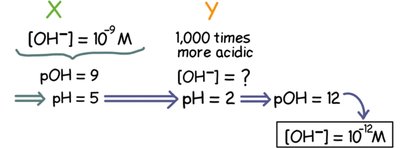
Q7. Solution X has an [OH-] of M. What is the [OH-] of solution Y, which is 1,000 times more acidic than solution X?
Background
Topic: Ion concentration and acidity relationship
This question tests your ability to relate changes in acidity to changes in ion concentration.
Key Terms and Formulas:
Acidity difference: times more acidic means pH decreases by units.
Step-by-Step Guidance
Find the pOH of solution X: .
Since Y is 1,000 times more acidic, its pH is 3 units lower than X.
Calculate the new pOH for Y and set up the formula for [OH-].
Try solving on your own before revealing the answer!
Final Answer: [OH-] of solution Y is M.
By decreasing pH by 3 units, pOH increases by 3 units, so [OH-] decreases by a factor of 1,000.
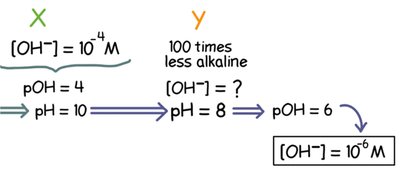
Q8. Solution X has an [OH-] of M. Solution Y is one hundred times less alkaline than solution X. What is the [OH-] of solution Y?
Background
Topic: Alkalinity and ion concentration
This question tests your ability to relate changes in alkalinity to changes in [OH-].
Key Terms and Formulas:
Alkalinity difference: times less alkaline means pOH increases by units.
Step-by-Step Guidance
Find the pOH of solution X: .
Since Y is 100 times less alkaline, its pOH is 2 units higher than X.
Set up the formula for [OH-] in solution Y.
Try solving on your own before revealing the answer!
Final Answer: [OH-] of solution Y is M.
By increasing pOH by 2 units, [OH-] decreases by a factor of 100.
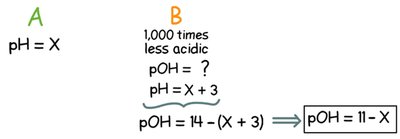
Q9. Solution A has a pH of X. What is the pOH of solution B, which is 1,000 times less acidic?
Background
Topic: pH and pOH relationship
This question tests your ability to relate changes in acidity to pH and pOH values.
Key Terms and Formulas:
Acidity difference: times less acidic means pH increases by units.
Step-by-Step Guidance
Since B is 1,000 times less acidic, its pH is 3 units higher than A: .
Calculate pOH of B: .
Try solving on your own before revealing the answer!
Final Answer: The pOH of solution B is .
By increasing pH by 3 units, pOH decreases by 3 units, so .
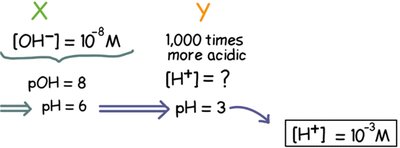
Q10. Solution X has an [OH-] of M. What is the [H+] of solution Y, which is one thousand times more acidic than solution X?
Background
Topic: Relationship between [OH-] and [H+]
This question tests your ability to convert between [OH-] and [H+] and relate changes in acidity to ion concentrations.
Key Terms and Formulas:
Acidity difference: times more acidic means pH decreases by units.
Step-by-Step Guidance
Find the pOH of solution X: .
Calculate pH of solution X: .
Since Y is 1,000 times more acidic, its pH is 3 units lower: .
Calculate [H+] for solution Y: M.
Try solving on your own before revealing the answer!
Final Answer: [H+] of solution Y is M.
By decreasing pH by 3 units, [H+] increases by a factor of 1,000.
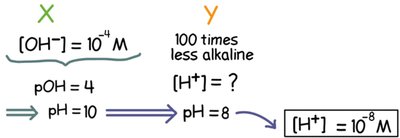
Q11. Solution X has an [OH-] of M. Solution Y is one hundred times less alkaline than solution X. What is the [H+] of solution Y?
Background
Topic: Alkalinity and [H+] concentration
This question tests your ability to relate changes in alkalinity to [H+] concentration.
Key Terms and Formulas:
Alkalinity difference: times less alkaline means pOH increases by units.
Step-by-Step Guidance
Find the pOH of solution X: .
Calculate pH of solution X: .
Since Y is 100 times less alkaline, its pOH is 2 units higher: .
Calculate pH of solution Y: .
Calculate [H+] for solution Y: M.
Try solving on your own before revealing the answer!
Final Answer: [H+] of solution Y is M.
By increasing pOH by 2 units, [H+] increases by a factor of 100.
