 Back
Membrane Structure and Function: Study Notes for Introductory Biology
Study Guide - Smart Notes
 Tailored notes based on your materials, expanded with key definitions, examples, and context.
Membrane Structure and Function
Overview of Membrane Transport
The plasma membrane regulates the movement of substances into and out of the cell, maintaining cellular homeostasis. Transport mechanisms include passive transport, active transport, and bulk transport.
Passive transport: Movement of small molecules without energy input; may require transport proteins.
Active transport: Movement of molecules against their concentration gradient, requiring energy and transport proteins.
Bulk transport: Movement of large molecules via exocytosis or endocytosis.
Fluid Mosaic Model of Membrane Structure
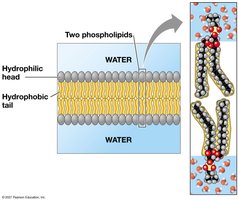
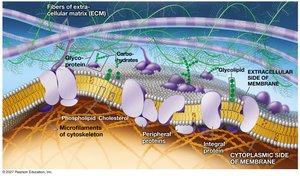
Cellular membranes are composed primarily of lipids and proteins, with carbohydrates also playing important roles. The fluid mosaic model describes the membrane as a dynamic structure with proteins embedded in a fluid bilayer of phospholipids.
Phospholipids: Amphipathic molecules with hydrophobic tails and hydrophilic heads.
Proteins: Not randomly distributed; often grouped for specific functions.
Carbohydrates: Important for cell recognition and identification.
Membrane Fluidity
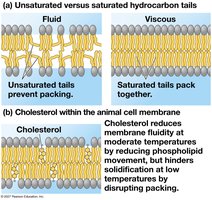
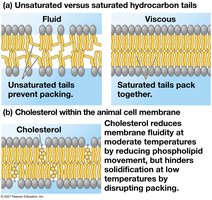
Membrane fluidity is essential for proper function, affecting permeability and protein movement. Fluidity is influenced by lipid composition and temperature.
Hydrophobic interactions: Hold the membrane together.
Lipid movement: Most lipids and some proteins move laterally; rare flip-flop between layers.
Adaptations: Organisms in extreme temperatures adjust membrane lipid composition.
Membrane Proteins and Their Functions
Membrane proteins are classified as peripheral or integral, with transmembrane proteins spanning the bilayer. They perform diverse functions essential for cell survival.
Peripheral proteins: Bound to membrane surface.
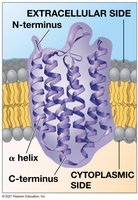
Integral proteins: Penetrate the hydrophobic core; transmembrane proteins span the membrane.
Hydrophobic regions: Often composed of nonpolar amino acids in α helices.
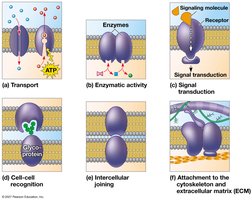
Functions of membrane proteins:
Transport
Enzymatic activity
Signal transduction
Cell-cell recognition
Intercellular joining
Attachment to cytoskeleton and extracellular matrix (ECM)
Membrane Carbohydrates and Cell-Cell Recognition
Membrane carbohydrates are crucial for cell recognition. They are often attached to lipids (glycolipids) or proteins (glycoproteins), serving as markers for cell identification.
Glycolipids: Carbohydrates bonded to lipids.
Glycoproteins: Carbohydrates bonded to proteins.
Diversity: Enables specific cell identification and communication.
Selective Permeability of Membranes
The plasma membrane exhibits selective permeability, allowing some substances to cross more easily than others. This property is explained by the fluid mosaic model.
Hydrophobic molecules: Pass rapidly through the lipid bilayer.
Hydrophilic molecules: Passage is impeded; may require transport proteins.
Transport Proteins
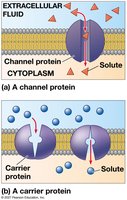
Transport proteins facilitate the movement of hydrophilic substances across membranes. They are classified as channel proteins and carrier proteins.
Channel proteins: Provide hydrophilic channels for molecules or ions.
Carrier proteins: Bind and change shape to shuttle molecules across.
Passive Transport: Diffusion
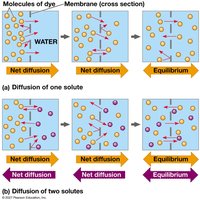
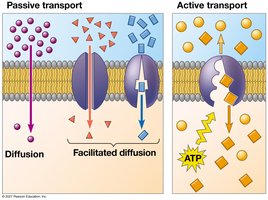
Diffusion is the passive movement of particles from regions of higher concentration to lower concentration. It does not require energy input and leads to dynamic equilibrium.
Concentration gradient: Represents potential energy driving diffusion.
Membrane permeability: Influences the rate of diffusion.
Osmosis and Water Balance
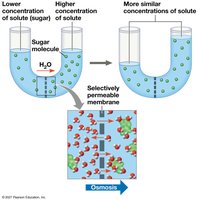
Osmosis is the diffusion of free water across a selectively permeable membrane. Water moves from regions of lower solute concentration to higher solute concentration until equilibrium is reached.
Tonicity: Ability of a solution to cause a cell to gain or lose water.
Plant cells: Turgor pressure maintains cell firmness; plasmolysis occurs in hypertonic environments.
Facilitated Diffusion
Facilitated diffusion is a form of passive transport where transport proteins speed the movement of molecules across the membrane. Channel and carrier proteins are involved.
Active Transport
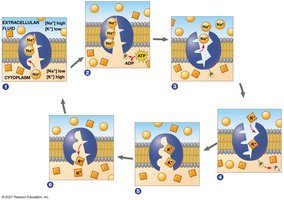
Active transport moves solutes against their concentration gradients using energy, typically from ATP. This process is essential for maintaining cellular concentrations of ions and other substances.
Sodium-potassium pump: A specific example of active transport in animal cells.
Membrane Potential and Ion Pumps
Membrane potential is the voltage across a membrane, created by differences in ion distribution. Ion pumps maintain this potential, which is crucial for cellular function.
Electrochemical gradient: Combination of chemical and electrical forces driving ion diffusion.
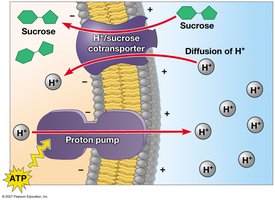
Electrogenic pumps: Generate voltage across membranes; sodium-potassium pump in animals, proton pump in plants, fungi, and bacteria.
Cotransport
Cotransport involves the coupled transport of two substances by a membrane protein. For example, sodium and glucose uptake in the intestine is facilitated by cotransporters.
Bulk Transport: Exocytosis and Endocytosis
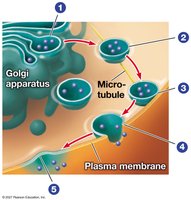
Bulk transport moves large molecules across the plasma membrane via vesicles. Exocytosis exports materials, while endocytosis imports them.
Exocytosis: Vesicles fuse with the membrane to release contents outside the cell.
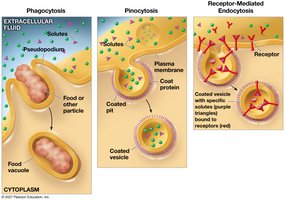
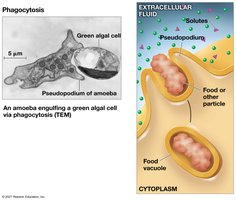
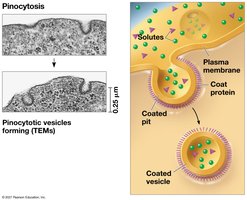
Endocytosis: Includes phagocytosis (cellular eating), pinocytosis (cellular drinking), and receptor-mediated endocytosis.
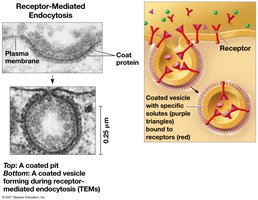
Summary Table: Types of Membrane Transport
Type | Energy Required | Transport Protein | Direction | Example |
|---|---|---|---|---|
Passive (Diffusion) | No | No | Down gradient | O2, CO2 |
Facilitated Diffusion | No | Yes | Down gradient | Glucose, ions |
Active Transport | Yes (ATP) | Yes | Against gradient | Na+/K+ pump |
Bulk Transport (Exocytosis/Endocytosis) | Yes | No | Variable | Proteins, polysaccharides |
Key Equations
Osmosis: Water moves to equalize solute concentrations across a membrane.
Membrane potential: Where V is voltage, Q is charge, and C is capacitance. Electrochemical gradient: Where \Delta G is free energy change, R is gas constant, T is temperature, [C]_i and [C]_o are internal and external concentrations, z is ion charge, F is Faraday constant, and \Delta \Psi is membrane potential.
Additional info:
Membrane structure and function are foundational concepts in cell biology, underlying processes such as signaling, transport, and energy conversion. Understanding these mechanisms is essential for further study in physiology, biochemistry, and molecular biology.
