 Back
Mendelian Genetics: Principles, Laws, and Patterns of Inheritance
Study Guide - Smart Notes
 Tailored notes based on your materials, expanded with key definitions, examples, and context.
Mendelian Genetics
Genetics Terminology
Genetics is the study of heredity and variation in organisms. Understanding key terms is essential for grasping Mendelian genetics.
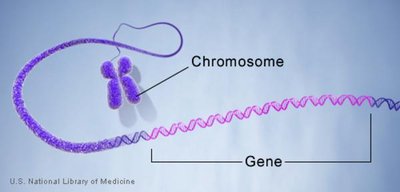
Gene: A segment of DNA that codes for a protein or functional RNA.
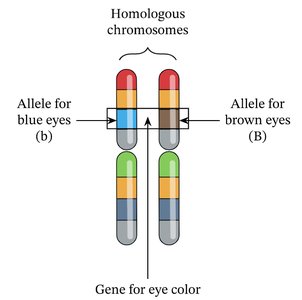
Locus: The specific location of a gene on a chromosome.
Allele: Alternate forms of a gene found at the same locus.
Genotype: The genetic makeup of an organism; the set of alleles it possesses.
Phenotype: The observable physical or physiological traits of an organism, determined by its genotype.
Dominant allele: Expressed in the phenotype if present.
Recessive allele: Expressed only if no dominant allele is present.
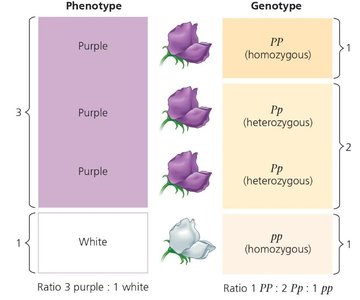
Homozygous: Having two identical alleles for a gene (e.g., BB or bb).
Heterozygous: Having two different alleles for a gene (e.g., Bb).
Gregor Mendel and His Experiments
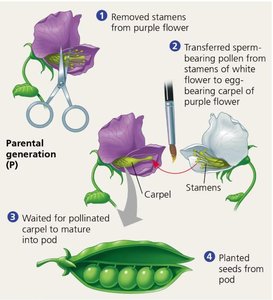
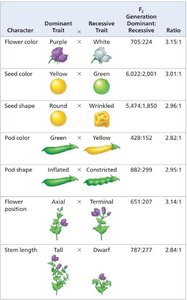
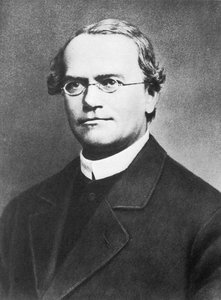
Gregor Mendel, known as the father of modern genetics, conducted experiments with pea plants to uncover the basic principles of inheritance.
Careful breeding: Mendel bred pea plants for eight years, observing traits across generations.
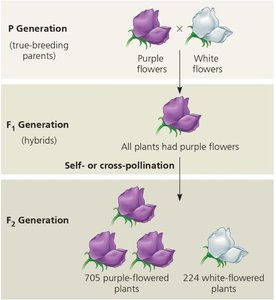
True-breeding: Parental (P) generation plants were homozygous for traits.
F1 generation: Offspring of P generation, typically all showed the dominant trait.
F2 generation: Offspring of F1 generation, showed a 3:1 ratio of dominant to recessive phenotypes.
Mendel’s Laws of Inheritance
Mendel formulated three fundamental laws based on his observations:
Law of Dominance: In a pair of alleles, one may mask the expression of the other. The dominant allele is expressed in the phenotype.
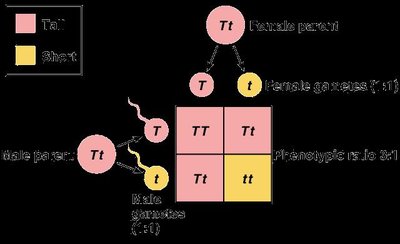
Law of Segregation: The two alleles for a trait separate during gamete formation, so each gamete carries only one allele.
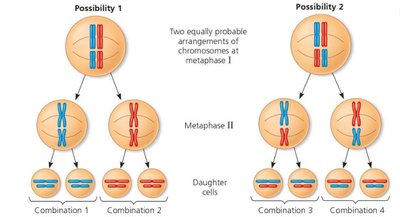
Law of Independent Assortment: Alleles of different genes assort independently during gamete formation, leading to genetic variation.
Punnett Squares and Probability
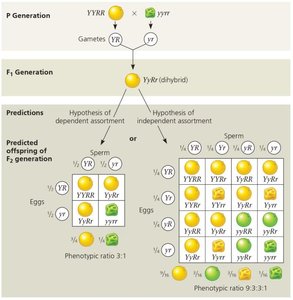
Punnett squares are diagrams used to predict the genotypic and phenotypic outcomes of genetic crosses.
Monohybrid cross: Examines one trait; typical 3:1 phenotypic ratio in F2 generation.
Dihybrid cross: Examines two traits; typical 9:3:3:1 phenotypic ratio in F2 generation.
Probability: Mendelian inheritance follows the laws of probability, allowing prediction of offspring traits.
Genetic Diseases and Pedigrees
Some genetic diseases are inherited in Mendelian patterns. Pedigrees are used to track inheritance across generations.
Recessively inherited disorders: Heterozygotes are carriers; affected offspring can arise from unaffected parents. Examples: Albinism, Cystic fibrosis, Sickle cell anemia.
Dominantly inherited disorders: Only one dominant allele needed for expression. Examples: Achondroplasia, Polydactyly, Huntington's disease.
Pedigree: Diagram showing inheritance of traits in a family. Squares represent males, circles represent females, and color-coding indicates trait presence.
Beyond Mendel: Non-Mendelian Inheritance
Many traits do not follow simple Mendelian patterns. These include:
Incomplete dominance: Heterozygotes show intermediate phenotype. Example: Red and white flowers produce pink offspring.
Codominance: Both alleles are fully expressed in heterozygotes. Example: Blood type AB.
Multiple alleles: More than two alleles exist for a gene. Example: ABO blood group.
Pleiotropy: One gene affects multiple phenotypes. Example: Cystic fibrosis affects lungs, pancreas, and other organs.
Epistasis: One gene affects the expression of another gene. Example: Labrador retriever coat color.
Polygenic inheritance: Multiple genes contribute to a single trait, often resulting in continuous variation. Example: Height, skin color.
Environmental Impact on Phenotype
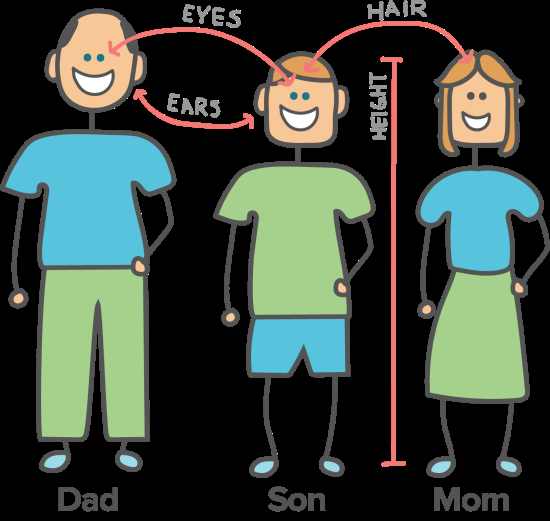
Phenotypes are determined by both genotype and environmental factors. This interplay is central to the nature vs nurture debate.
Example: Nutrition and environment can influence height, even if the genotype is the same.
Summary Table: Mendelian vs Non-Mendelian Inheritance
Inheritance Type | Key Features | Example |
|---|---|---|
Mendelian (Complete Dominance) | Dominant allele masks recessive | Purple vs white pea flowers |
Incomplete Dominance | Intermediate phenotype in heterozygotes | Pink snapdragons |
Codominance | Both alleles fully expressed | AB blood type |
Multiple Alleles | More than two alleles for a gene | ABO blood group |
Pleiotropy | One gene affects multiple traits | Cystic fibrosis |
Epistasis | One gene modifies another's expression | Labrador coat color |
Polygenic Inheritance | Many genes contribute to one trait | Height, skin color |
Key Equations
Probability of genotype:
Phenotypic ratio (monohybrid cross):
Genotypic ratio (monohybrid cross):
Phenotypic ratio (dihybrid cross):
Conclusion
Mendelian genetics provides the foundation for understanding inheritance, but many traits follow more complex patterns. Mastery of these concepts is essential for further study in biology and genetics.
