 Back
BackPhotosynthesis and Cellular Respiration: Structure, Function, and Energy Flow
Study Guide - Smart Notes
 Tailored notes based on your materials, expanded with key definitions, examples, and context.
Photosynthesis: Capturing Solar Energy
Introduction to Photosynthesis
Photosynthesis is the process by which autotrophic organisms, such as plants, algae, and cyanobacteria, convert solar energy into chemical energy stored in glucose. This process is essential for life on Earth, as it provides both food and oxygen for heterotrophic organisms.
Autotrophs: Organisms that produce their own food using light or chemical energy.
Photosynthesis Equation:
Glucose produced is used for energy and as a building block for other organic molecules.
Leaf and Chloroplast Structure
Adaptations for Photosynthesis
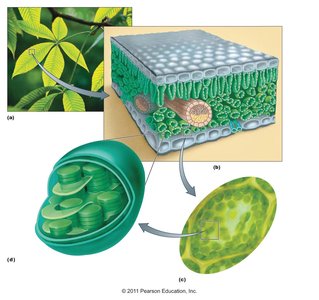
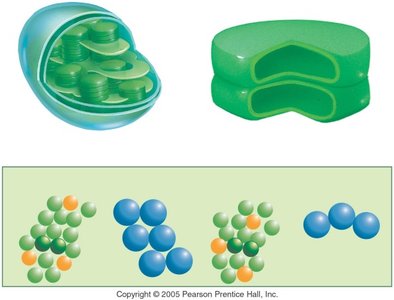
Leaves are specialized organs for photosynthesis, containing chloroplasts where the process occurs. The structure of leaves and chloroplasts maximizes light capture and gas exchange.
Chloroplasts: Organelles containing thylakoid membranes where light reactions occur.
Mesophyll: Leaf tissue rich in chloroplasts, main site of photosynthesis.
Stomata: Pores on the leaf underside for gas exchange (CO2 in, O2 out).
Cuticle: Waxy, waterproof layer reducing water loss.
Vascular Bundles: Xylem (water/minerals) and phloem (sugars) transport.
Stomata Function
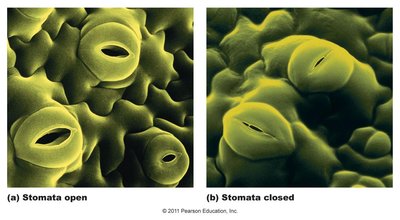
Stomata regulate the exchange of gases and water vapor between the leaf and the atmosphere. Their opening and closing are crucial for balancing photosynthesis and water conservation.
Open stomata allow CO2 entry and O2 release.
Closed stomata prevent water loss but limit gas exchange.
Light and Pigments
Properties of Light
Light is a form of electromagnetic radiation, and its energy is carried in discrete packets called photons. The wavelength and frequency of light determine its energy and color.
Photon: Particle of light energy.
Wavelength (λ): Distance between two peaks of a wave; shorter wavelength = higher energy.
Visible Spectrum: 400–700 nm, the range used in photosynthesis.
Pigments in Photosynthesis
Pigments are molecules that absorb specific wavelengths of light. Chlorophyll a is the primary pigment, while accessory pigments expand the range of light absorption.
Chlorophyll a: Absorbs violet, blue, and red; reflects green.
Chlorophyll b: Absorbs blue and red-orange; assists chlorophyll a.
Carotenoids: Absorb blue/green; reflect yellow/orange.
Phycocyanin: Absorbs green/yellow; appears blue.
Accessory pigments allow plants to utilize a broader spectrum of sunlight.
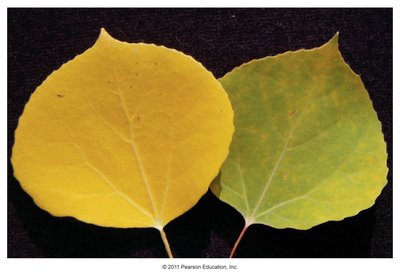
Seasonal Changes in Leaf Color
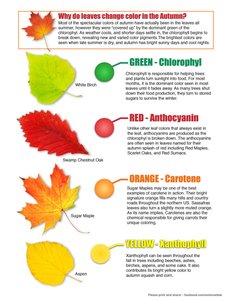
In autumn, chlorophyll breaks down first, revealing carotenoids and other pigments, which causes leaves to change color.
Green (chlorophyll), yellow (xanthophyll), orange (carotene), red (anthocyanin).
The Reactions of Photosynthesis
Overview of Photosynthetic Reactions
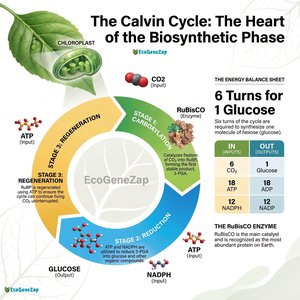
Photosynthesis consists of two main stages: the light reactions and the Calvin cycle (dark reactions).
Light Reactions: Occur in thylakoid membranes; convert light energy to ATP and NADPH.
Calvin Cycle: Occurs in the stroma; uses ATP and NADPH to fix CO2 into G3P, which is used to make glucose.
Light Reactions
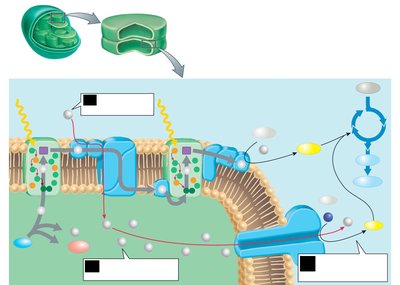
The light reactions use two photosystems (PS II and PS I) to capture light energy, split water, release oxygen, and generate ATP and NADPH.
Photosystem II absorbs light, splits water (), and transfers electrons through an electron transport chain (ETC).
Electron flow creates a proton gradient, powering ATP synthase to make ATP.
Photosystem I absorbs light, energizes electrons, and reduces NADP+ to NADPH.
ATP and NADPH Production
ATP is produced by chemiosmosis as protons flow through ATP synthase. NADPH is produced by the reduction of NADP+ at the end of the electron transport chain.
ATP and NADPH are used in the Calvin cycle for carbon fixation.
The Calvin Cycle (Dark Reactions)
The Calvin cycle uses ATP and NADPH to convert CO2 into G3P, which can be used to form glucose and other carbohydrates.
Carbon Fixation: CO2 is attached to RuBP by the enzyme rubisco.
Reduction: ATP and NADPH are used to convert 3-phosphoglycerate (PGA) to G3P.
Regeneration: Some G3P is used to regenerate RuBP, allowing the cycle to continue.
For every 3 CO2 molecules fixed, one G3P exits the cycle; two G3P combine to form one glucose.
Cellular Respiration: Harvesting Energy from Glucose
Overview of Cellular Respiration
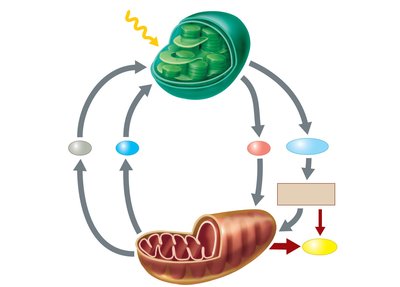
Cellular respiration is the process by which cells extract energy from glucose in the presence of oxygen, producing ATP, CO2, and H2O. It is essentially the reverse of photosynthesis.
Equation:
Occurs in three main stages: glycolysis, Krebs cycle, and electron transport chain (ETC).
ATP: The Energy Currency of the Cell
ATP (adenosine triphosphate) stores and releases energy for cellular work. Energy is stored in the bonds between phosphate groups and released when ATP is hydrolyzed to ADP.
ATP is generated by substrate-level phosphorylation and oxidative phosphorylation.
Stages of Aerobic Respiration
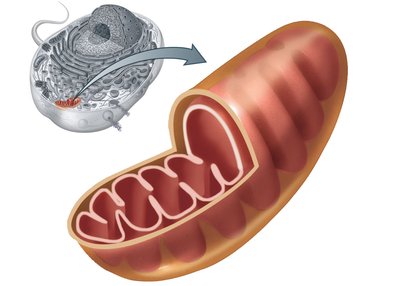
Aerobic respiration includes glycolysis (cytoplasm), the Krebs cycle (mitochondrial matrix), and the electron transport chain (inner mitochondrial membrane).
Glycolysis: Glucose is split into two pyruvate molecules, producing 2 ATP and 2 NADH.
Pyruvate Dehydrogenase Complex (PDC): Converts pyruvate to acetyl-CoA, producing NADH and CO2.
Krebs Cycle: Acetyl-CoA is oxidized, generating CO2, ATP, NADH, and FADH2.
Electron Transport Chain (ETC): NADH and FADH2 donate electrons, creating a proton gradient that drives ATP synthesis.
Fermentation: Anaerobic Energy Production
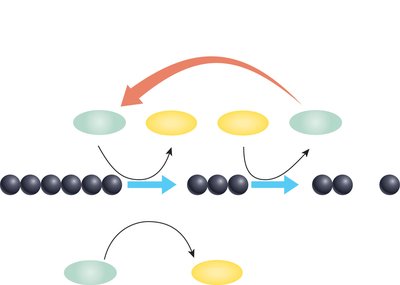
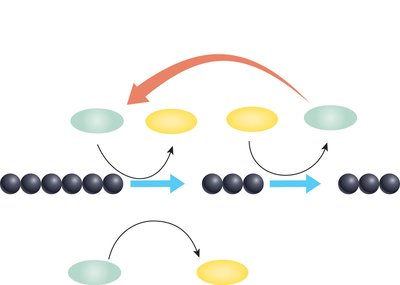
When oxygen is not available, cells can generate ATP through fermentation. This process regenerates NAD+ for glycolysis but produces much less ATP than aerobic respiration.
Alcoholic Fermentation: Pyruvate is converted to ethanol and CO2 (yeast).
Lactic Acid Fermentation: Pyruvate is converted to lactate (muscle cells, some bacteria).
Summary Table: Comparison of Photosynthesis and Cellular Respiration
Process | Location | Reactants | Products | Energy Conversion |
|---|---|---|---|---|
Photosynthesis | Chloroplasts (thylakoids & stroma) | CO2, H2O, light | Glucose, O2 | Light to chemical (glucose) |
Cellular Respiration | Cytoplasm & mitochondria | Glucose, O2 | CO2, H2O, ATP | Chemical (glucose) to chemical (ATP) |
Additional info: This guide expands on the provided notes with definitions, examples, and diagrams to clarify the structure and function of photosynthetic and respiratory processes in plants and other organisms.
