 Back
Photosynthesis: Using Sunlight to Build Carbohydrates
Study Guide - Smart Notes
 Tailored notes based on your materials, expanded with key definitions, examples, and context.
Photosynthesis: Overview
Introduction to Photosynthesis
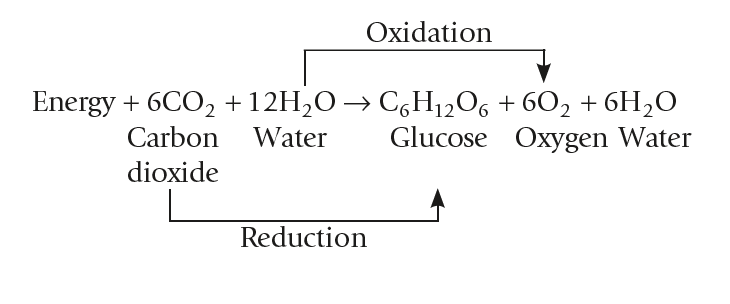
Photosynthesis is the process by which autotrophic organisms convert light energy into chemical energy, producing carbohydrates from carbon dioxide and water. It is the foundation of most food webs and is essential for life on Earth. - Key Point 1: Photosynthesis is the inverse of cellular respiration, using sunlight to build carbohydrates. - Key Point 2: The process involves the oxidation of water and the reduction of carbon dioxide. 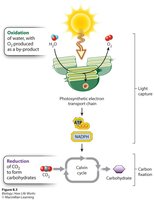
Photosynthesis in Diverse Environments
Photosynthetic organisms thrive in a variety of environments, from deserts to aquatic ecosystems. Their ability to adapt supports nearly all food webs. - Key Point: The biomass of photosynthetic organisms sustains most ecosystems. 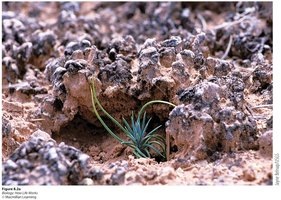
Photosynthetic Reactions
Reduction of Carbon Dioxide
During photosynthesis, carbon dioxide is reduced to form high-energy carbohydrates. This reduction is a series of redox reactions powered by sunlight. - Key Point: Sunlight provides the energy needed for these redox reactions. 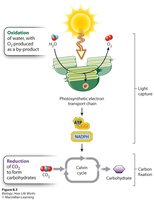
Oxidation of Water
Water is oxidized during photosynthesis, releasing electrons, protons, and oxygen. The electrons and protons are used to build carbohydrates, and the oxygen is released as a by-product. - Key Point: The oxidation of water and reduction of carbon dioxide are linked by the photosynthetic electron transport chain. 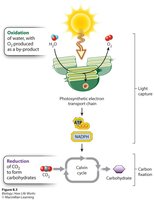
Overall Reaction of Photosynthesis
The overall chemical equation for photosynthesis is: - Key Point: Oxygen produced during photosynthesis comes from water, not carbon dioxide.
Tracing Oxygen Production
Experiments using isotopes (such as 18O) demonstrated that the oxygen released during photosynthesis originates from water molecules. - Example: Algae grown in water with 18O produced oxygen gas containing 18O, confirming the source. 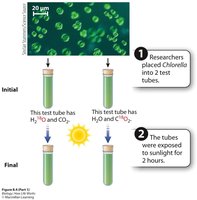
Light Absorption and Pigments
Pigments and Light Absorption
Pigments are molecules that absorb light. Chlorophyll is the primary pigment in plants, absorbing most wavelengths except green, which is reflected. - Key Point: Accessory pigments (carotenoids, xanthophylls, anthocyanins) absorb light in regions poorly absorbed by chlorophyll, broadening the spectrum of usable light.
Chlorophyll in the Chloroplast
Chlorophyll molecules are embedded in the thylakoid membrane, playing a central role in light absorption.
Absorption of Light by Chlorophyll
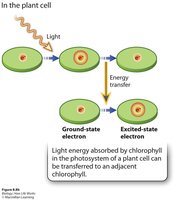
When chlorophyll absorbs light, its electrons are elevated to a higher energy state. In plant cells, energy can be transferred between chlorophyll molecules, increasing efficiency. 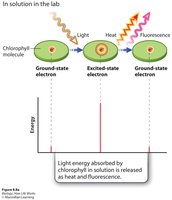
Reaction Center
The reaction center is a specialized arrangement of chlorophyll molecules. When it receives enough energy, it passes an electron to an electron acceptor, and can then accept an electron from a donor (water in photosynthesis). 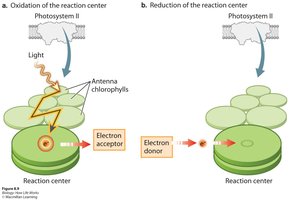
Quantifying Chlorophyll Molecules for O2 Production
Experiments show that many chlorophyll molecules are required to produce one molecule of O2. - Key Point: Each "unit" responsible for O2 production consists of many chlorophyll molecules. 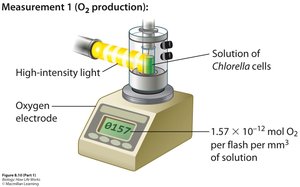
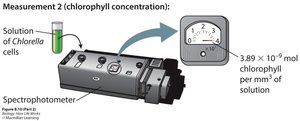
Efficiency of Light Absorption
Light absorption and energy capture by chlorophyll in plants is more efficient than in solution due to energy transfer between molecules.
Photosynthetic Electron Transport Chain
Overview of Electron Transport
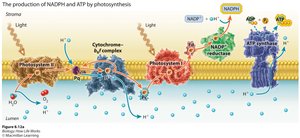
Photosynthesis begins with light absorption, driving redox reactions. The electron transport chain between two photosystems produces ATP and NADPH. 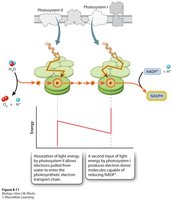
Z Scheme
The Z scheme describes the energy changes of electrons as they move from photosystem II to photosystem I. - Key Point: A second input of light energy in photosystem I raises electron energy enough to reduce NADP+. 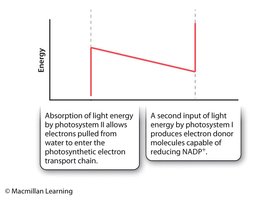
ATP Production in the Chloroplast
ATP synthase in the thylakoid membrane uses the proton gradient generated by electron transport to produce ATP. - Key Point: ATP produced in the chloroplast is used for carbon fixation; mitochondria produce ATP for other cellular needs.
The Calvin Cycle
Calvin Cycle: From CO2 to Carbohydrates
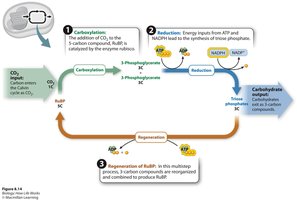
The Calvin cycle converts low-energy CO2 into high-energy carbohydrates, requiring ATP and NADPH.
Step 1: Carboxylation
CO2 is combined with RuBP (ribulose bisphosphate) by rubisco, forming a 6-carbon molecule that splits into two 3-carbon molecules of 3-phosphoglycerate (3-PGA). 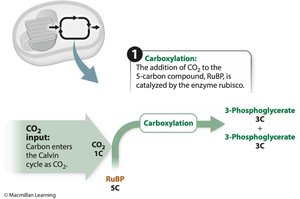
Step 2: Reduction
3-PGA is phosphorylated by ATP and reduced by NADPH to form triose phosphates, which are exported to form glucose. 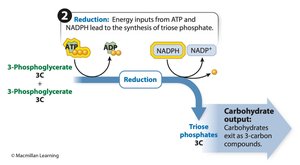
Step 3: Regeneration
Most triose phosphates are used to regenerate RuBP, requiring ATP. Only one out of six triose phosphates can be withdrawn for carbohydrate synthesis. 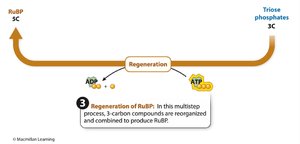
Experimental Evidence for Calvin Cycle Steps
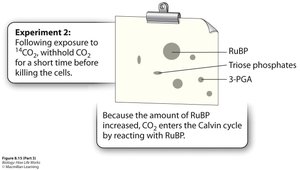
Experiments showed that 3-PGA is the first product formed when CO2 is incorporated, and RuBP is the other substrate required. 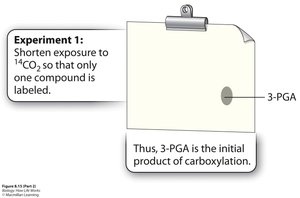
Regulation and Efficiency of Photosynthesis
Reactive Oxygen Species
Excess light can lead to the formation of reactive oxygen species, which are neutralized by antioxidants and accessory pigments like xanthophylls.
Photorespiration
Rubisco can catalyze both photosynthesis and photorespiration. Photorespiration consumes energy and releases CO2, reducing efficiency. - Key Point: Rubisco's selectivity for CO2 is low, but its abundance compensates for its slow catalytic rate. 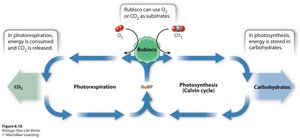
Evolution of Photosynthesis
Evolution of Two Photosystems
Early photosynthetic bacteria had only one photosystem. The evolution of two photosystems enabled the use of water as an electron donor. - Key Point: Two photosystems may have evolved via horizontal gene transfer or gene duplication and divergence. 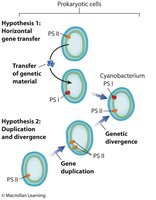
Photosynthetic Eukaryotes and Endosymbiosis
Cyanobacteria were the first organisms to use water as an electron donor. The endosymbiotic theory explains the origin of chloroplasts in eukaryotes. 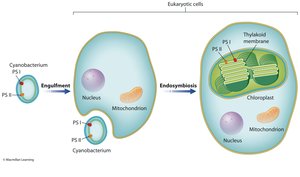
Summary Table: Photosynthesis Steps
Step | Process | Key Molecules | Outcome |
|---|---|---|---|
Light Capture | Absorption of light by chlorophyll | Chlorophyll, accessory pigments | Excited electrons |
Electron Transport | Movement of electrons through photosystems | Photosystem I & II, electron carriers | ATP, NADPH production |
Calvin Cycle | Carboxylation, reduction, regeneration | RuBP, rubisco, ATP, NADPH | Carbohydrate synthesis |
Additional info: The notes include expanded academic context, definitions, and examples to ensure completeness and clarity for introductory biology students.
