Skip to main content
Introduction to Chemistry
My Course
Learn
Exam Prep
AI Tutor
Study Guides
Flashcards
Explore
Try the app
My Course
Learn
Exam Prep
AI Tutor
Study Guides
Flashcards
Explore
Try the app
Back
Atomic Theory quiz #1
You can tap to flip the card.
Which scientist is associated with the development of the electron cloud model of the atom?
You can tap to flip the card.
👆
Which scientist is associated with the development of the electron cloud model of the atom?
The electron cloud model was developed by modern scientists building on quantum mechanics, with significant contributions from Erwin Schrödinger.
Track progress
Control buttons has been changed to "navigation" mode.
1/20
Related flashcards
Related practice
Recommended videos
Atomic Theory definitions
Atomic Theory
15 Terms
Atomic Theory
4. Atoms and Elements
5 problems
Topic
Rutherford Gold Foil Experiment
4. Atoms and Elements
2 problems
Topic
4. Atoms and Elements - Part 1 of 2
12 topics
34 problems
Chapter
4. Atoms and Elements - Part 2 of 2
1 topic
3 problems
Chapter
Guided course
05:22
Atomic Theory
9818
views
93
rank
Guided course
01:48
Atomic Theory Example 1
8004
views
64
rank
Terms in this set (20)
Hide definitions
Which scientist is associated with the development of the electron cloud model of the atom?
The electron cloud model was developed by modern scientists building on quantum mechanics, with significant contributions from Erwin Schrödinger.
What property do all atoms of a given element share according to Dalton's atomic theory?
According to Dalton, all atoms of a given element have the same mass and properties, though modern science recognizes isotopes.
According to modern atomic theory, what do all atoms of an element have in common?
All atoms of an element have the same number of protons, which defines the element.
What is the defining characteristic shared by all atoms of the same element?
All atoms of the same element have the same atomic number, meaning the same number of protons.
How did the earliest model of the atom describe its structure?
The earliest model, proposed by Democritus, described the atom as a tiny, indivisible, hard sphere.
What did Robert Millikan discover about the electron?
Robert Millikan discovered the charge of the electron through his oil drop experiment.
What was Moseley's contribution to the periodic table?
Moseley organized the periodic table by atomic number rather than atomic mass.
How did Democritus conceptualize the atom?
Democritus believed the atom was a tiny, indivisible, hard sphere.
Who is credited with first arranging the periodic table?
Dmitri Mendeleev is credited with first arranging the periodic table.
Who stated that atoms of the same element are identical?
John Dalton stated that atoms of the same element are identical in mass and properties.
What does the plum pudding model of the atom propose?
The plum pudding model proposes that the atom is a sphere of positive charge with negatively charged electrons embedded within it.
How is the current model of the atom best described?
The current model describes the atom as having a nucleus containing protons and neutrons, with electrons existing in a cloud around the nucleus.
Who contributed to the concept of the electron cloud in atomic theory?
Erwin Schrödinger contributed to the concept of the electron cloud through quantum mechanics.
Who is associated with the development of the electron cloud model?
Erwin Schrödinger is associated with the development of the electron cloud model.
Which scientist is credited with proposing the electron cloud model?
Erwin Schrödinger is credited with proposing the electron cloud model.
Who developed the electron cloud model of the atom?
Erwin Schrödinger developed the electron cloud model of the atom.
Who first identified the element radium?
Marie Curie first identified the element radium.
Who hypothesized that the atom was a tiny, hard sphere?
Democritus hypothesized that the atom was a tiny, hard sphere.
How did Moseley organize the periodic table differently from previous versions?
Moseley organized the periodic table by atomic number instead of atomic mass.
How was the first periodic table arranged?
The first periodic table, arranged by Mendeleev, was organized by increasing atomic mass.
 BackBack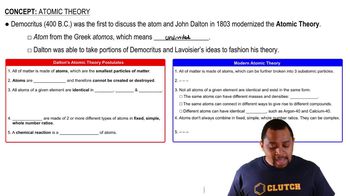
 05:22
05:22