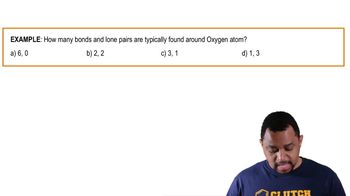
How many bonds can a hydrogen atom typically form according to its bonding preferences?
A hydrogen atom typically forms one bond, as it is in group 1A and prefers a single bond.
How many bonds can a carbon atom typically form based on its group number in the periodic table?
A carbon atom typically forms four bonds, since it is in group 4A and prefers four bonds.
What is a lone pair in the context of molecular compounds?
A lone pair is a pair of nonbonding electrons that do not participate in bonding with other elements. These electrons remain localized on a single atom.
Which group of elements uses the variable 'X' to represent its members in bonding preference discussions?
Group 7A elements, known as halogens, are often represented by the variable 'X' in bonding preference discussions. This includes fluorine, chlorine, bromine, and iodine.
How many bonds does beryllium typically form based on its group number?
Beryllium is in group 2A and typically forms two bonds. This matches its group number according to bonding preference rules.
Why does nitrogen form three bonds to achieve a stable electron configuration?
Nitrogen has five valence electrons and needs three more to reach eight, following the octet rule. It achieves this by forming three bonds with surrounding elements.
How many lone pairs does oxygen have when it is a surrounding element in a molecular compound?
Oxygen has two lone pairs when it is a surrounding element. This is typical for group 6A elements.
What is the rule for determining the number of bonds preferred by elements in groups 1A to 4A?
For elements in groups 1A to 4A, the number of bonds preferred equals the group number. This rule helps predict bonding behavior for these elements.
How many lone pairs are present on a halogen atom when it is a surrounding element?
A halogen atom has three lone pairs when it is a surrounding element. This applies to group 7A elements like fluorine and chlorine.
Why is hydrogen never placed at the center when drawing molecular compounds?
Hydrogen is never placed at the center because it can only form one bond and cannot accommodate more connections. This makes it unsuitable as a central atom in molecular structures.
 Back
Back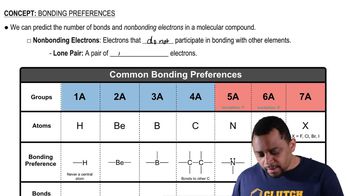
 03:16
03:16