Skip to main content
Introduction to Chemistry
My Course
Learn
Exam Prep
AI Tutor
Study Guides
Flashcards
Explore
Try the app
My Course
Learn
Exam Prep
AI Tutor
Study Guides
Flashcards
Explore
Try the app
Back
Buffers definitions
You can tap to flip the card.
Buffer
You can tap to flip the card.
👆
Buffer
A solution that resists drastic pH changes by neutralizing added acids or bases using a weak acid and its conjugate base or vice versa.
Track progress
Control buttons has been changed to "navigation" mode.
1/14
Related flashcards
Related practice
Recommended videos
Buffers quiz
Buffers
15 Terms
Buffers
14. Acids and Bases
5 problems
Topic
Strong Acid Strong Base Titrations (Simplified)
14. Acids and Bases
5 problems
Topic
14. Acids and Bases
10 topics
30 problems
Chapter
Guided course
03:14
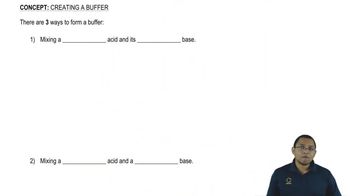
Buffers Concept 1
4350
views
22
rank
Guided course
04:34
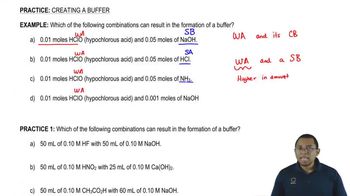
Buffers Concept 2
3321
views
12
rank
Guided course
03:53
Buffers Example 1
3165
views
3
rank
Terms in this set (14)
Hide definitions
Buffer
A solution that resists drastic pH changes by neutralizing added acids or bases using a weak acid and its conjugate base or vice versa.
Weak Acid
A substance that partially dissociates in water, providing limited H+ ions, and forms the acidic component of a buffer.
Conjugate Base
A species formed when a weak acid loses an H+ ion, often paired with a metal in buffer solutions for stability.
pH
A measure of hydrogen ion concentration, indicating the acidity or basicity of a solution, which buffers help stabilize.
Buffer Capacity
The effectiveness of a buffer, which increases with higher concentrations of weak acid and conjugate base.
Buffer Range
The ratio window (10:1 to 1:10) of weak acid to conjugate base concentrations where a buffer works most effectively.
Strong Acid
A substance that completely dissociates in water, providing a high concentration of H+ ions, which can destroy buffers if added in excess.
Strong Base
A substance that fully dissociates in water, yielding a high concentration of OH- ions, capable of overwhelming a buffer.
Half Equivalence Point
The stage in a titration where equal amounts of weak acid and conjugate base exist, resulting in an ideal buffer.
Neutralization
The process where an acid and a base react to minimize pH changes, central to how buffers function.
Molarity
A unit expressing concentration as moles of solute per liter of solution, crucial for buffer calculations.
Titration
A laboratory technique involving gradual addition of one solution to another to study reactions, often used to analyze buffer behavior.
Acid-Base Pair
A combination of a weak acid and its conjugate base or a weak base and its conjugate acid, forming the foundation of buffer systems.
Dilution
The process of adding water to a solution, which does not affect buffer effectiveness due to proportional concentration changes.
 BackBack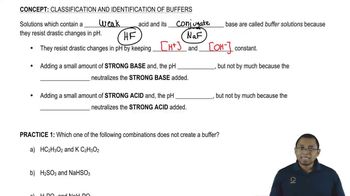
 03:14
03:14