A buffer solution contains a weak acid and its conjugate base, or a weak base and its conjugate acid.
How does a buffer resist drastic changes in pH?
A buffer neutralizes added acids or bases by reacting them with the weak acid or conjugate base present in the solution.
What happens to the pH of a buffer when a small amount of strong base is added?
The pH increases slightly, but not drastically, because the weak acid in the buffer neutralizes the added base.
What happens to the pH of a buffer when a small amount of strong acid is added?
The pH decreases slightly, but not drastically, because the conjugate base in the buffer neutralizes the added acid.
What is the effect of adding water to a buffer solution?
Adding water dilutes both the weak acid and conjugate base proportionally, so the buffer's effectiveness remains unchanged.
What is the ideal ratio of weak acid to conjugate base in a buffer for maximum effectiveness?
The ideal buffer has equal concentrations of weak acid and conjugate base, or a ratio between 10:1 and 1:10.
What is buffer capacity and how can it be increased?
Buffer capacity is the ability of a buffer to neutralize added acids or bases, and it increases with higher concentrations of the weak acid and conjugate base.
What are the three methods to create a buffer solution?
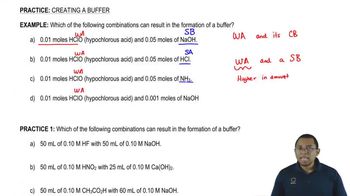
Buffers can be made by mixing a weak acid with its conjugate base, a weak base with a smaller amount of strong acid, or a weak acid with a smaller amount of strong base.
In the second and third methods of buffer preparation, what must be true about the weak and strong components?
The weak component (acid or base) must be present in a higher amount than the strong component to prevent the buffer from being destroyed.
What destroys a buffer solution?
A buffer is destroyed if too much strong acid or strong base is added, making the strong component equal to or greater than the weak component.
Why is a buffer with a weak acid and its conjugate base in a 1:1 ratio considered ideal?
Because both components are present in equal amounts, maximizing the buffer's ability to neutralize added acids or bases.
What is the buffer range and why is it important?
The buffer range is the ratio of weak acid to conjugate base between 10:1 and 1:10; within this range, the buffer is most effective.
What happens if the ratio of weak acid to conjugate base falls outside the buffer range?
The solution still acts as a buffer but is much less effective and can be destroyed easily by added strong acid or base.
At what point during a titration is an ideal buffer formed?
An ideal buffer is formed at the half equivalence point, where the concentrations of weak acid and conjugate base are equal.
Why is it important to know the three methods of buffer preparation?
Because different exam questions may require you to identify or create buffers using any of these methods, and knowing them helps you determine if a solution will act as a buffer.
 Back
Back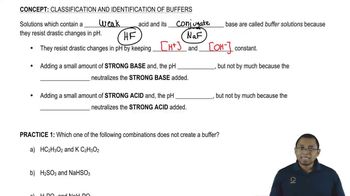
 03:14
03:14