The smallest unit of a covalent compound is a molecule.
What type of bond holds hydrogen atoms to the oxygen atom in a water molecule?
A covalent bond holds the hydrogen atoms to the oxygen atom in a water molecule by sharing valence electrons.
What does an electron repel in the context of covalent bonding?
In the context of covalent bonding, an electron repels other electrons due to their like negative charges.
What type of compound is most likely to be a covalent compound?
A compound formed between nonmetals that involves the sharing of valence electrons is most likely a covalent compound.
What rule do nonmetals follow when forming covalent bonds to achieve a stable electron configuration?
Nonmetals follow the octet rule, aiming for 8 valence electrons to mimic noble gases. This is achieved by sharing electrons rather than transferring them.
How does hydrogen achieve a stable electron configuration through covalent bonding?
Hydrogen follows the duet rule, sharing one electron to reach a configuration like helium (1s2). This allows hydrogen to have a filled outer shell with two electrons.
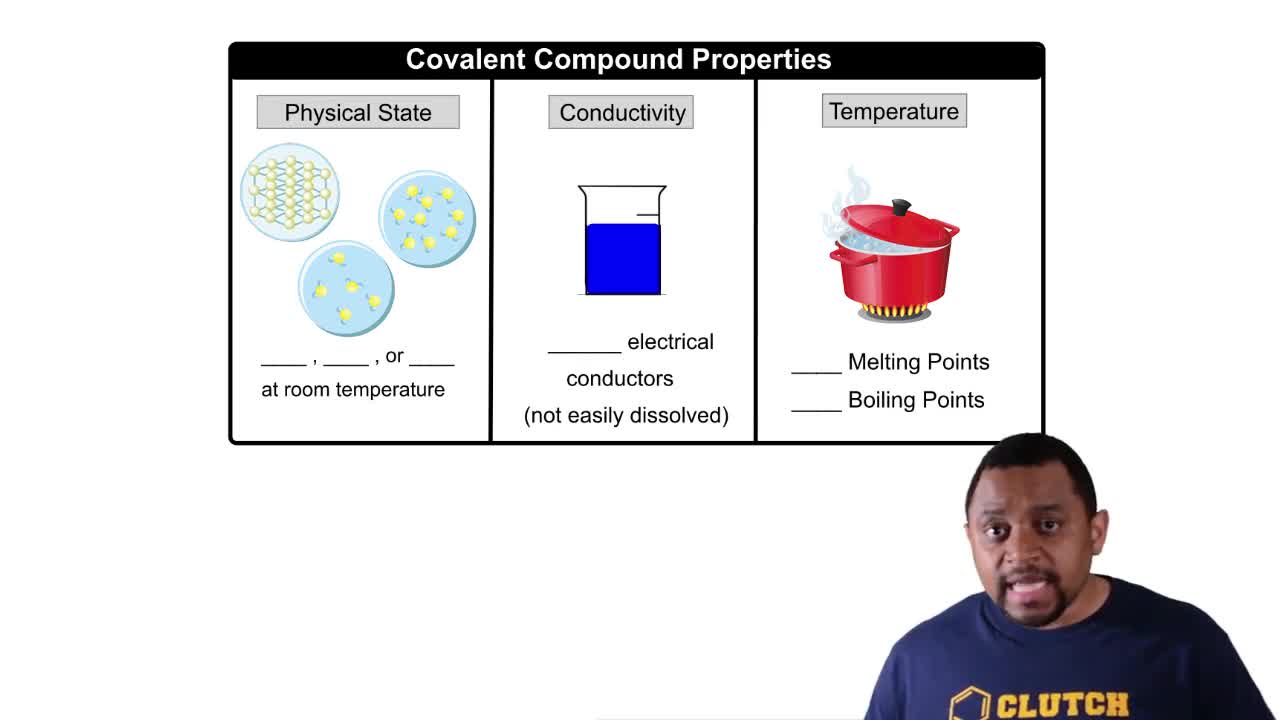
Why do covalent compounds generally have poor electrical conductivity?
Covalent compounds are poor electrical conductors because they do not easily dissolve in solvents like water. Their molecular structure does not allow for free movement of charged particles.
What electron configuration does fluorine achieve by sharing electrons in a covalent bond?
Fluorine achieves a 2p6 electron configuration by sharing one electron with another fluorine atom. This mimics the electron arrangement of the noble gas neon.
In what physical states can covalent compounds exist at room temperature?
Covalent compounds can exist as solids, liquids, or gases at room temperature. This is due to the nature of electron sharing in their molecular bonds.
How do atoms in a covalent bond obtain a noble gas-like electron arrangement?
Atoms in a covalent bond share valence electrons to fill their outer shells. This sharing allows them to mimic the electron configuration of the nearest noble gas.
 Back
Back
 01:18
01:18