Skip to main content
Introduction to Chemistry
My Course
Learn
Exam Prep
AI Tutor
Study Guides
Flashcards
Explore
Try the app
My Course
Learn
Exam Prep
AI Tutor
Study Guides
Flashcards
Explore
Try the app
Back
Density of Non-Geometric Objects definitions
You can tap to flip the card.
Density
You can tap to flip the card.
👆
Density
A property calculated by dividing mass by volume, often used to compare how compact matter is in different substances.
Track progress
Control buttons has been changed to "navigation" mode.
1/13
Related flashcards
Related practice
Recommended videos
Density of Non-Geometric Objects quiz
Density of Non-Geometric Objects
15 Terms
Density of Non-Geometric Objects
2. Measurement and Problem Solving
3 problems
Topic
Density
2. Measurement and Problem Solving
5 problems
Topic
2. Measurement and Problem Solving
10 topics
27 problems
Chapter
Guided course
01:36
Density of Non-Geometric Objects Concept and Example
8357
views
68
rank
Terms in this set (13)
Hide definitions
Density
A property calculated by dividing mass by volume, often used to compare how compact matter is in different substances.
Non-Geometric Object
An item lacking regular shapes or formulas for volume, requiring experimental methods for measurement.
Water Displacement
A technique where the rise in liquid level reveals the volume of an object submerged in the liquid.
Volume
The amount of three-dimensional space occupied, often measured in milliliters for liquids and irregular solids.
Milliliter
A metric unit of volume equal to one-thousandth of a liter, commonly used in laboratory measurements.
Cylinder
A container with a circular cross-section, often used to hold and measure liquids in laboratory experiments.
Initial Volume
The measured amount of liquid in a container before any object is added.
Final Volume
The measured amount of liquid in a container after an object has been submerged.
Submersion
The act of placing an object completely below the surface of a liquid, causing the liquid level to rise.
Approximation
An estimated value used when precise measurement is difficult, often based on visual observation.
Measurement
The process of determining the size, length, or amount of something, typically using standard units.
Rise in Water Level
The increase in liquid height observed when an object is placed into a container of water.
Difference
The result obtained by subtracting one value from another, such as final and initial volumes to find object volume.
 BackBack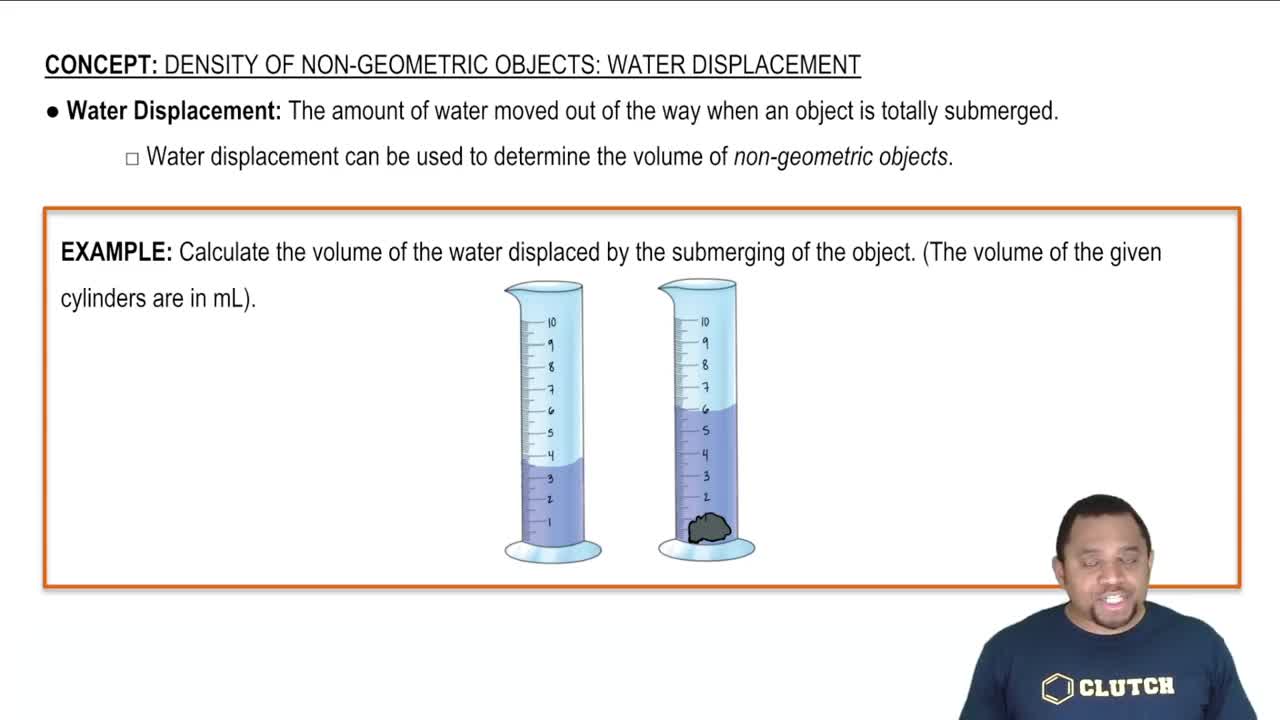
 01:36
01:36