What type of compound is considered an electrolyte, and what are some examples?
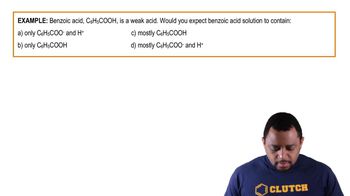
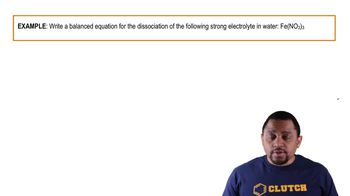
An electrolyte is a compound that conducts electricity by dissociating into ions when dissolved in water. Examples include soluble ionic compounds like sodium chloride, strong acids such as hydrochloric acid, and strong bases like sodium hydroxide. Weak electrolytes, such as hydrofluoric acid and magnesium hydroxide, partially dissociate and conduct electricity weakly.
What physical property allows electrolytes to conduct electricity in solution?
Electrolytes conduct electricity due to their ability to dissociate into ions in solution. The movement of these ions enables electrical current to flow.
What does the term 'aqueous' indicate when describing ions in solution?
The term 'aqueous' means that the ion is surrounded by water molecules in solution. It signifies that the ion is dissolved in water.
How can you identify a weak electrolyte from a chemical equation?
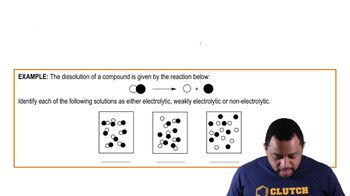
A weak electrolyte is indicated by a double or reversible arrow in the chemical equation. This shows that only partial dissociation into ions occurs.
What are some examples of insoluble ionic compounds that act as weak electrolytes?
Calcium sulfate, barium sulfate, and calcium sulfide are examples of insoluble ionic compounds that act as weak electrolytes. These compounds only partially dissociate in water.
What is the main difference in the species present in solution between strong and weak electrolytes?
Strong electrolytes produce only ions in solution, with no remaining solid or molecular form. Weak electrolytes have mostly molecules and only a small amount of ions present.
Why do nonelectrolytes not conduct electricity when dissolved in water?
Nonelectrolytes do not conduct electricity because they do not dissociate into ions in water. Only molecules are present, so no charge carriers exist.
What is a common structural feature of alcohols that classifies them as nonelectrolytes?
Alcohols are covalent compounds with carbon and hydrogen connected to an OH group. They do not dissociate into ions in water, making them nonelectrolytes.
How does the molecular formula of sugars relate to their classification as nonelectrolytes?
Sugars typically have the molecular formula CnH2On, such as glucose (C6H12O6) and sucrose (C12H22O11). These compounds do not dissociate into ions and are classified as nonelectrolytes.
What is the role of solubility rules in determining whether a compound is a strong or weak electrolyte?
Solubility rules help predict if an ionic compound will dissolve and dissociate completely, making it a strong electrolyte. Compounds that are insoluble or only partially dissolve are usually weak electrolytes.