From which subshell is an electron typically removed when forming a +1 cation from a neutral atom?
An electron is typically removed from the highest-energy (outermost) subshell, which is the subshell with the largest principal quantum number (n) and, within that shell, the highest subshell letter (s, p, d, or f) occupied by electrons.
Which subshell letter is associated with shell number 1?
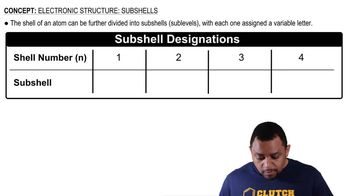
Shell number 1 is associated only with the s subshell. No other subshells exist for n=1.
What subshell letters are possible for shell number 2?
For shell number 2, the possible subshell letters are s and p. These correspond to n=2.
How many subshell letters are present in shell number 3?
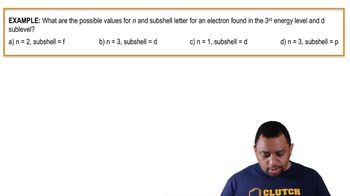
Shell number 3 contains three subshell letters: s, p, and d. Each letter represents a different subshell within the shell.
Which subshells are included in shell number 4?
Shell number 4 includes the s, p, d, and f subshells. These are the four possible subshell letters for n=4.
Does the number of subshell letters increase beyond n=4?
No, for shells beyond n=4, the subshell letters remain s, p, d, and f. There are no additional subshell letters after f.
What is another term used for subshells in atomic structure?
Subshells are also known as sublevels in atomic structure. Both terms refer to the same concept.
How does the number of possible subshell letters change as the shell number increases from 1 to 4?
As the shell number increases from 1 to 4, the number of possible subshell letters increases from one (s) to four (s, p, d, f). This reflects the growing complexity of electron arrangements.
If n equals 5, which subshell letters are present?
For n equals 5, the subshell letters present are still s, p, d, and f. No new subshell letters are added beyond f.
What determines the variable letter assigned to a subshell?
The variable letter assigned to a subshell is determined by the shell number (n). Higher shell numbers allow for more subshell letters up to f.