Skip to main content
Introduction to Chemistry
My Course
Learn
Exam Prep
AI Tutor
Study Guides
Flashcards
Explore
Try the app
My Course
Learn
Exam Prep
AI Tutor
Study Guides
Flashcards
Explore
Try the app
Back
Electronic Structure definitions
You can tap to flip the card.
Atom
You can tap to flip the card.
👆
Atom
Smallest unit of matter, consisting of a nucleus surrounded by electrons arranged in shells, subshells, and orbitals.
Track progress
Control buttons has been changed to "navigation" mode.
1/15
Related flashcards
Related practice
Recommended videos
Electronic Structure quiz #1
Electronic Structure
10 Terms
Electronic Structure
9. Electrons in Atoms and the Periodic Table
5 problems
Topic
Electronic Structure: Shells
9. Electrons in Atoms and the Periodic Table
5 problems
Topic
9. Electrons in Atoms and the Periodic Table - Part 3 of 4
12 topics
36 problems
Chapter
Guided course
01:47
Electronic Structure Concept 2
3490
views
27
rank
Guided course
01:06
Electronic Structure Concept 1
3731
views
34
rank
Guided course
00:44
Electronic Structure Example 1
3413
views
21
rank
Terms in this set (15)
Hide definitions
Atom
Smallest unit of matter, consisting of a nucleus surrounded by electrons arranged in shells, subshells, and orbitals.
Electronic Structure
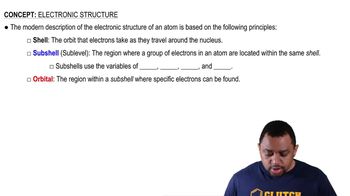
Arrangement groupings of electrons in shells, subshells, and orbitals, revealing their locations and behaviors.
Shell
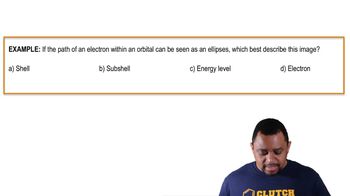
Main energy level around the nucleus, indicating the size and energy of electrons traveling in orbits.
Subshell
Division within a shell, labeled s, p, d, or f, that defines the shape of regions where electrons are likely found.
Orbital
Specific region within a subshell where a particular electron is most likely to be located, with defined orientation.
Electron
Negatively charged particle found in orbitals, capable of spinning in two possible directions within its region.
Nucleus
Central core of an atom, around which electrons travel in defined shells.
Energy Level
Quantized state associated with a shell, determining the energy and distance of electrons from the nucleus.
Shape
Geometric form of a region within a subshell, determined by the type (s, p, d, f) and influencing electron distribution.
Orientation
Spatial arrangement of an orbital within a subshell, specifying how electron regions are directed in space.
Spin
Intrinsic property of electrons, describing their clockwise or counterclockwise motion within an orbital.
s Subshell
Type of subshell with a spherical shape, representing one possible region for electrons within a shell.
p Subshell
Type of subshell with a dumbbell shape, offering three possible regions for electrons within a shell.
d Subshell
Type of subshell with more complex shapes, providing five possible regions for electrons within a shell.
f Subshell
Type of subshell with even more complex shapes, containing seven possible regions for electrons within a shell.
 BackBack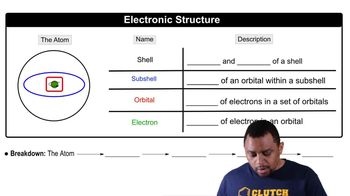
 01:47
01:47