Skip to main content
Introduction to Chemistry
My Course
Learn
Exam Prep
AI Tutor
Study Guides
Flashcards
Explore
Try the app
My Course
Learn
Exam Prep
AI Tutor
Study Guides
Flashcards
Explore
Try the app
Back
Empirical Formula definitions
You can tap to flip the card.
Empirical Formula
You can tap to flip the card.
👆
Empirical Formula
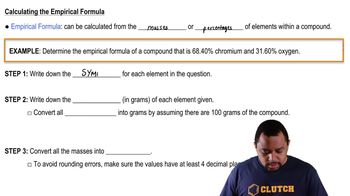
Simplest whole number ratio of atoms in a compound, derived by reducing subscripts to their lowest terms.
Track progress
Control buttons has been changed to "navigation" mode.
1/12
Related flashcards
Related practice
Recommended videos
Empirical Formula quiz
Empirical Formula
15 Terms
Empirical Formula
6. Chemical Composition
5 problems
Topic
Molecular Formula
6. Chemical Composition
5 problems
Topic
6. Chemical Composition
4 topics
12 problems
Chapter
Guided course
02:26
Empirical Formula
19533
views
407
rank
Guided course
05:11
Empirical Formula Example 1
6791
views
91
rank
Terms in this set (12)
Hide definitions
Empirical Formula
Simplest whole number ratio of atoms in a compound, derived by reducing subscripts to their lowest terms.
Molecular Formula
Actual number of each type of atom present in a compound, showing the true composition.
Mole Concept
Method for converting between grams, moles, and units like molecules, ions, or atoms in numerous calculations.
Whole Number Ratio
Proportion of atoms in a formula where all subscripts are integers with no common divisors.
Mass Percentage
Relative amount of each element in a compound, expressed as a fraction of the total mass.
Subscript
Small number written after an element symbol in a formula, indicating the quantity of that atom.
Greatest Common Divisor
Largest integer by which all subscripts in a molecular formula can be divided to simplify it.
Compound
Substance formed from two or more elements chemically combined in fixed proportions.
Atom
Smallest unit of an element, retaining its chemical properties and participating in chemical formulas.
Element
Pure substance consisting of only one type of atom, represented by in formulas by symbols.
Simplified Form
Version of a chemical formula where all subscripts are reduced to their lowest possible whole numbers.
Constituent Element
Individual type of atom present within a compound, contributing to its overall composition.
 BackBack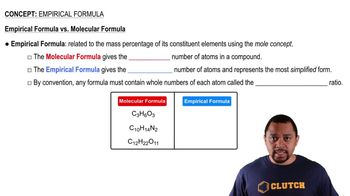
 02:26
02:26