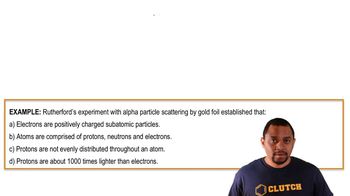
What part of the atom occupies most of its volume according to Rutherford's nuclear model?
Most of the volume of an atom is occupied by the cloud of electrons surrounding the dense nucleus.
What did Rutherford's gold foil experiment reveal about the structure of the atom?
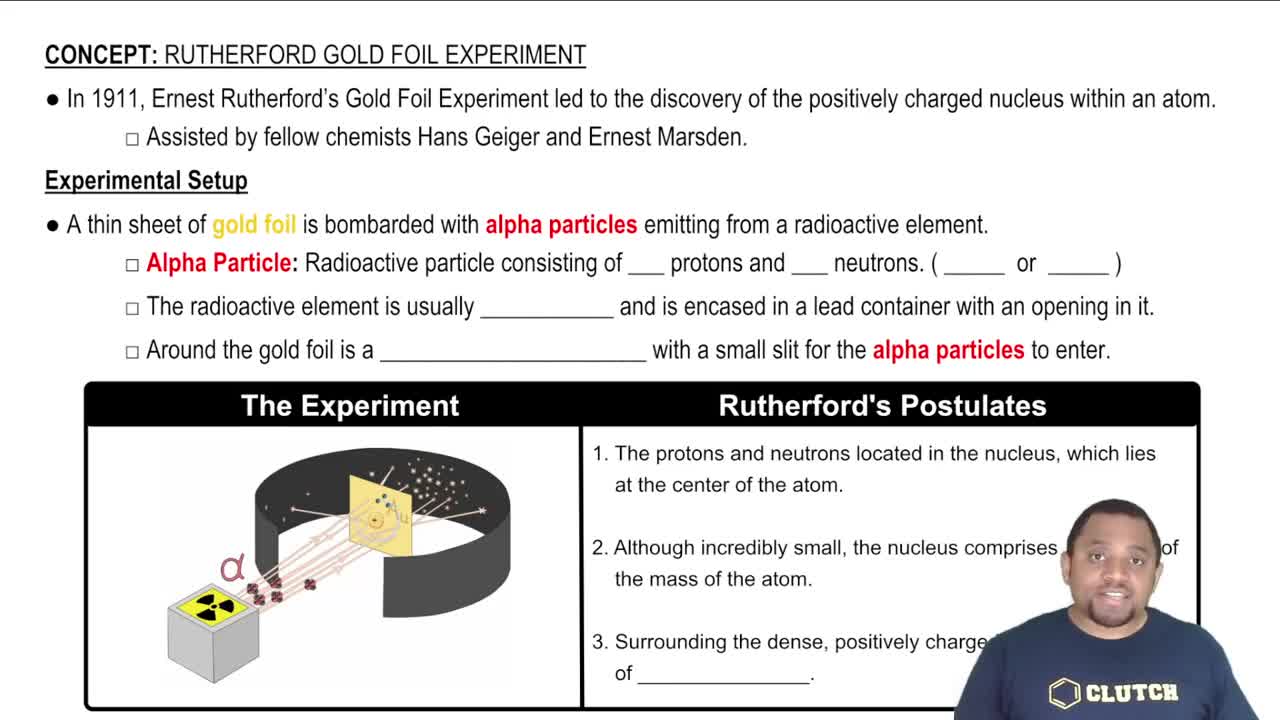
Rutherford's gold foil experiment revealed that the atom has a small, dense, positively charged nucleus containing protons and neutrons, which accounts for most of the atom's mass, and that electrons form a cloud around this nucleus. This led to the development of the nuclear model of the atom.
What is another name for the Rutherford gold foil experiment?
The Rutherford gold foil experiment is also called the Geiger Marsden experiment. This is because Hans Geiger and Ernest Marsden assisted Rutherford in conducting it.
What type of particle was used to bombard the gold foil in Rutherford's experiment?
Alpha particles were used to bombard the gold foil. These particles consist of 2 protons and 2 neutrons.
What radioactive element was commonly used as the source of alpha particles in the gold foil experiment?
Iridium was commonly used as the radioactive source of alpha particles. It was encased in a lead box with an opening for emission.
How did the detecting screen function in the gold foil experiment?
The detecting screen surrounded the gold foil and recorded where alpha particles struck after passing through or being deflected. It had a small slit to allow the passage of alpha particles.
What surprising observation did Rutherford and his team make about some alpha particles during the experiment?
Some alpha particles were deflected at large angles or even rebounded back toward the source. This indicated the presence of a dense, positively charged center in the atom.
How did the results of the gold foil experiment challenge the plum pudding model?
The plum pudding model predicted that alpha particles would pass straight through the atom. The observed deflections showed that atoms have a dense nucleus, disproving the plum pudding model.
What did Rutherford conclude about the location of protons and neutrons in the atom?
Rutherford concluded that protons and neutrons are located in the nucleus at the center of the atom. This nucleus contains most of the atom's mass.
What model of the atom was developed as a result of the gold foil experiment?
The nuclear model of the atom was developed as a result of the gold foil experiment. It describes a dense nucleus surrounded by a cloud of electrons.
 Back
Back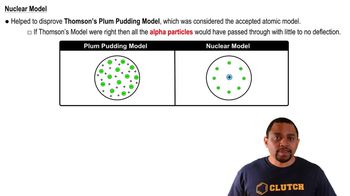
 01:40
01:40