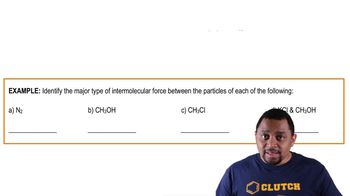
Which type of compound exhibits the strongest intermolecular forces, and what is the nature of these forces?
Compounds that are ionic and dissolved in polar substances, such as ionic compounds in water, exhibit the strongest intermolecular forces known as ion-dipole forces. These forces occur between ions and polar molecules.
What is the main difference between intramolecular and intermolecular forces?
Intramolecular forces exist within a molecule and bond atoms together, influencing chemical properties. Intermolecular forces exist between molecules and influence physical properties.
How does electronegativity contribute to intermolecular attraction in water molecules?
Electronegativity causes oxygen in water to be partially negative and hydrogen to be partially positive. This polarity leads to attractive forces between water molecules.
What visual symbol is commonly used to represent intermolecular forces in diagrams?
A dotted line is used to symbolize the attraction between molecules. This indicates an intermolecular force rather than a true chemical bond.
Why do ionic compounds dissolved in water experience ion-dipole forces?
Ionic compounds in water are surrounded by polar water molecules, which attract the ions due to opposite charges. This attraction is called ion-dipole force.
Which atoms must hydrogen be bonded to for hydrogen bonding to occur?
Hydrogen must be directly bonded to fluorine, oxygen, or nitrogen for hydrogen bonding. These bonds create strong intermolecular attractions.
What type of molecules experience dipole-dipole interactions?
Dipole-dipole interactions occur between polar covalent molecules. The partial positive and negative charges attract each other.
What causes London dispersion forces to arise between nonpolar molecules?
London dispersion forces arise when nonpolar molecules come close together and temporarily develop slight polarity. This momentary polarity leads to weak attractions.
Are London dispersion forces present in polar and ionic compounds?
Yes, London dispersion forces are present in all compounds, including polar and ionic ones. They are always the weakest force but still contribute to overall attraction.
What is the relationship between the strength of intermolecular forces and the physical state of a substance?
Stronger intermolecular forces help hold molecules together in liquids and solids. Weaker forces result in substances being gases or having lower boiling points.
 Back
Back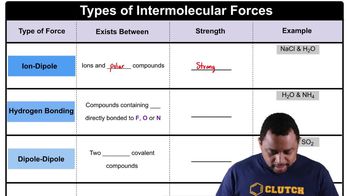
 06:36
06:36