Which type of element typically reacts with oxygen to form ionic bonds?
Metals typically react with oxygen to form ionic bonds, as they lose electrons to become cations while oxygen gains electrons to become an anion.
How would you best describe a compound such as sodium chloride?
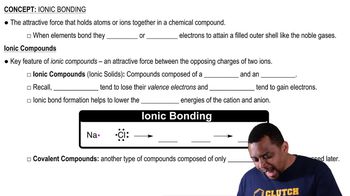
Sodium chloride is an ionic compound composed of a positive ion (cation) and a negative ion (anion) held together by the attractive force between their opposite charges.
What is an example of a compound that contains both ionic and covalent bonds?
A compound such as sodium nitrate (NaNO3) contains both ionic and covalent bonds; the ionic bond is between sodium and the nitrate ion, while covalent bonds exist within the nitrate ion itself.
Which type of compound contains both ionic and covalent bonding?
Compounds that have a metal ion bonded to a polyatomic ion, such as sodium sulfate (Na2SO4), contain both ionic and covalent bonding.
What type of compound contains ionic bonds?
Ionic compounds, also known as ionic salts, contain ionic bonds formed between cations (typically metals) and anions (typically nonmetals).
What is the overall charge of an ionic compound?
The overall charge of an ionic compound is zero, as the total positive and negative charges balance each other out.
In the formation of sodium chloride, which atom loses an electron?
In sodium chloride, the sodium atom loses an electron to become a positively charged cation.
Why is NaBr considered an ionic compound?
NaBr is considered an ionic compound because sodium (a metal) loses an electron to become a cation and bromine (a nonmetal) gains an electron to become an anion, resulting in an attractive force between their opposite charges.
Why do ionic compounds have high melting and boiling points?
Ionic compounds have high melting and boiling points because the strong attractive forces between the oppositely charged ions require a lot of energy to break. This makes them stable as solids at room temperature.
What happens to the conductivity of an ionic compound when it is dissolved in water?
When an ionic compound is dissolved in water, it becomes a good electrical conductor because the ions are free to move. This allows them to carry electric current through the solution.
 Back
Back
 01:06
01:06