Pearson+ LogoPearson+ Logo

Ions and the Octet Rule quiz #1 Flashcards

Back
Ions and the Octet Rule quiz #1
Control buttons has been changed to "navigation" mode.
1/10
  • What do stable electron configurations typically contain, and why are these configurations considered stable?

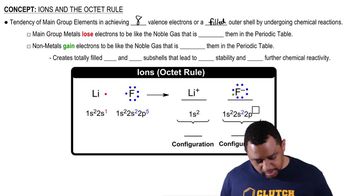
    Stable electron configurations typically contain eight valence electrons, resulting in completely filled s and p subshells in the outermost shell. These configurations are considered stable because they resemble the electron configuration of noble gases, which leads to greater chemical stability and reduced reactivity.
  • Which noble gas does sodium mimic when it loses one electron?

    Sodium mimics neon when it loses one electron. Neon has an atomic number of 10, which matches sodium's electron count after losing one electron.
  • How do main group nonmetals achieve a noble gas configuration?

    Main group nonmetals gain electrons to resemble the electron configuration of the noble gas that comes after them in the periodic table. This process fills their outer s and p subshells, increasing stability.
  • What is the maximum number of electrons that a p subshell can hold?

    A p subshell can hold a maximum of 6 electrons. This allows elements to achieve a filled p subshell for greater stability.
  • When forming a cation, from which subshell are electrons removed first?

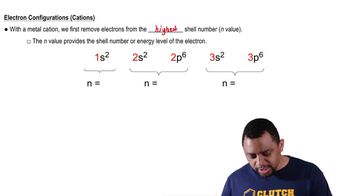
    Electrons are removed first from the subshell with the highest shell number, starting with the outermost p subshell before the s subshell. This follows the order of decreasing n value.
  • What electron configuration does lithium achieve after losing one electron?

    After losing one electron, lithium achieves the electron configuration of helium. This results in a completely filled 1s subshell.
  • Why do elements strive to have filled s and p subshells?

    Elements strive to have filled s and p subshells because this leads to greater chemical stability. Filled subshells reduce the element's reactivity.
  • What happens to fluorine’s electron configuration when it gains one electron?

    When fluorine gains one electron, its 2p subshell becomes completely filled, resulting in a configuration similar to neon. This makes fluorine more stable as an ion.
  • How is the shell number (n value) related to electron configuration notation?

    The shell number, or n value, is indicated by the number before the subshell letter in electron configuration notation. For example, 2s2 and 2p6 refer to electrons in the second shell (n=2).
  • What is the significance of noble gases in the context of ion formation?

    Noble gases are significant because their filled outer shells represent maximum stability. Other elements form ions to mimic the electron configurations of nearby noble gases.