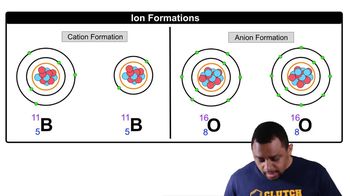
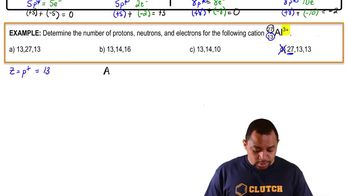
An ion is an atom or group of atoms that has gained or lost electrons, resulting in a net electrical charge.
How does an atom become positively charged?
An atom becomes positively charged by losing electrons, forming a cation.
What do you call an atom that has lost or gained electrons?
An atom that has lost or gained electrons is called an ion.
What is the difference between an atom and an ion?
An atom is electrically neutral with equal numbers of protons and electrons, while an ion has an unequal number of protons and electrons due to the loss or gain of electrons.
What happens to an atom when it loses an electron?
When an atom loses an electron, it becomes a positively charged ion called a cation.
What does an atom become if it gains or loses electrons?
If an atom gains or loses electrons, it becomes an ion.
What is an atom called after it has lost or gained electrons?
An atom that has lost or gained electrons is called an ion.
What does an ion have that an atom does not?
An ion has a net electrical charge due to an unequal number of protons and electrons, while an atom is neutral.
How does a neutral atom become a positive ion?
A neutral atom becomes a positive ion by losing one or more electrons.
What is formed when an atom loses an electron?
When an atom loses an electron, it forms a cation.
What do you call an atom that has gained or lost electrons?
An atom that has gained or lost electrons is called an ion.
What is the difference between an atom and an ion?
An atom is neutral, while an ion has a charge due to the loss or gain of electrons.
How does the electron configuration of a sodium ion differ from a neutral sodium atom?
A sodium ion (Na+) has lost one electron compared to a neutral sodium atom, resulting in the same electron configuration as neon.
What does 'isoelectronic' mean in chemistry?
'Isoelectronic' refers to atoms or ions that have the same number of electrons.
How does a chlorine atom become a chloride ion?
A chlorine atom becomes a chloride ion by gaining one electron.
What element has 17 protons and 18 electrons?
An atom with 17 protons is chlorine; with 18 electrons, it is a chloride ion (Cl−).
What is the electron configuration of a gallium ion?
A gallium ion (Ga3+) has lost three electrons compared to neutral gallium, resulting in an electron configuration like that of argon.
What is the electron configuration of Mg2+?
Mg2+ has lost two electrons compared to neutral magnesium, resulting in the same electron configuration as neon.
What makes an atom neutral?
An atom is neutral when it has equal numbers of protons and electrons.
How is an ion different from an atom?
An ion has a net charge due to an unequal number of protons and electrons, while an atom is neutral.
How does an atom become an ion?
An atom becomes an ion by gaining or losing electrons.
What is the electron configuration of Mn2+?
Mn2+ has lost two electrons compared to neutral manganese, resulting in an electron configuration similar to argon plus five 3d electrons.
What occurs when a magnesium atom becomes a magnesium ion?
A magnesium atom loses two electrons to become a Mg2+ ion.
What element has 34 protons and 36 electrons?
An atom with 34 protons is selenium; with 36 electrons, it is a selenide ion (Se2−).
What is the net charge of an ionic compound?
The net charge of an ionic compound is zero; the total positive and negative charges balance each other.
What is true of an uncharged atom?
An uncharged atom has equal numbers of protons and electrons.
What is true of a charged atom?
A charged atom, or ion, has an unequal number of protons and electrons.
How can you identify a neutral atom?
A neutral atom has the same number of protons and electrons.
How does an atom become an anion?
An atom becomes an anion by gaining one or more electrons.
How does a neutral atom become an ion?
A neutral atom becomes an ion by gaining or losing electrons.
What is a cation?
A cation is a positively charged ion formed by the loss of electrons.
What is an anion?
An anion is a negatively charged ion formed by the gain of electrons.
Why do atoms form ions?
Atoms form ions to achieve a stable electron arrangement similar to noble gases.
What type of elements tend to form cations?
Metals tend to form cations by losing electrons.
What type of elements tend to form anions?
Nonmetals tend to form anions by gaining electrons.
What is the charge on an ion that has lost three electrons?
An ion that has lost three electrons has a charge of 3+.
What is the charge on an ion that has gained two electrons?
An ion that has gained two electrons has a charge of 2−.
What does the term 'isoelectronic' mean?
'Isoelectronic' means having the same number of electrons as another atom or ion.
 Back
Back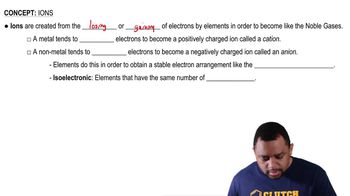
 00:53
00:53