What is the relationship between the number of protons and electrons in a neutral atom?
In a neutral atom, the number of protons equals the number of electrons.
What is the main reason elements form ions by gaining or losing electrons?
Elements form ions to achieve a stable electron arrangement similar to noble gases. This stability is energetically favorable.
What term describes elements that have the same number of electrons after ion formation?
The term is 'isoelectronic.' Isoelectronic species have identical electron counts.
How does the charge of a cation relate to the number of electrons lost?
Each electron lost increases the positive charge by one. For example, losing three electrons results in a 3+ charge.
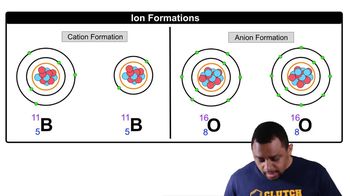
What happens to the electron count of boron when it forms a 3+ cation?
Boron loses three electrons, reducing its electron count from five to two. This results in a 3+ charge.
How is the charge of an anion determined when electrons are gained?
The charge becomes more negative by one for each electron gained. For example, gaining two electrons gives a 2- charge.
What is the atomic number of oxygen and how many electrons does it have when neutral?
Oxygen has an atomic number of 8, meaning it has 8 electrons when neutral. This number changes when it forms ions.
What is the difference between cation and anion formation in terms of electron movement?
Cation formation involves losing electrons, while anion formation involves gaining electrons. This results in positive and negative charges, respectively.
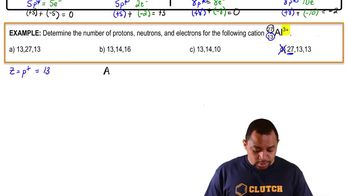
What does the mass number of an element represent?
The mass number is the sum of protons and neutrons in the nucleus. It does not directly indicate the number of electrons.
Why does gaining electrons result in a negative charge for an ion?
Electrons carry a negative charge, so adding them increases the overall negative charge of the atom. This is why anions are negatively charged.
 Back
Back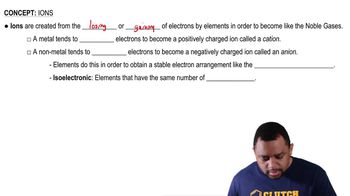
 00:53
00:53