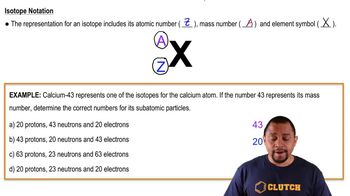
An atom with 3 protons is lithium. With 4 neutrons, it is the isotope lithium-7.
What are atoms of the same element with different numbers of neutrons called?
Atoms of the same element with different numbers of neutrons are called isotopes.
How do you determine the number of neutrons in an atom of magnesium-25 (Mg-25)?
Subtract the atomic number of magnesium (12) from the mass number (25): 25 - 12 = 13 neutrons.
What is the identity of an atom with 3 protons and 4 neutrons?
It is lithium-7, an isotope of lithium.
How are isotopes of the same element alike?
Isotopes of the same element have the same number of protons and thus the same chemical properties.
Isotopes of an element differ in the number of what subatomic particle?
Isotopes differ in the number of neutrons.
How do you identify the isotope of platinum that contains 118 neutrons?
Add the number of protons in platinum (78) to 118 to get the mass number: 78 + 118 = 196. The isotope is platinum-196.
Does copper have naturally occurring isotopes?
Yes, copper has naturally occurring isotopes.
What element has 3 protons and 4 neutrons?
Lithium (atomic number 3), specifically the isotope lithium-7.
In what way do isotopes of an element differ?
Isotopes differ in their number of neutrons and mass number.
Which isotope has 17 electrons and 18 neutrons?
A neutral atom with 17 electrons is chlorine (atomic number 17). With 18 neutrons, it is chlorine-35.
What best describes an isotope?
An isotope is an atom of the same element with the same number of protons but a different number of neutrons.
How do you determine which atom has the smallest number of neutrons?
The atom with the lowest mass number for a given element has the smallest number of neutrons.
What element has 35 protons and 45 neutrons?
Bromine (atomic number 35), specifically the isotope bromine-80.
What element has 25 protons and 30 neutrons?
Manganese (atomic number 25), specifically the isotope manganese-55.
What is an isotope like carbon-14?
Carbon-14 is an isotope of carbon with 6 protons and 8 neutrons.
What element has 9 protons and 10 neutrons?
Fluorine (atomic number 9), specifically the isotope fluorine-19.
What element has 18 protons and 22 neutrons?
Argon (atomic number 18), specifically the isotope argon-40.
What isotope has 14 protons and 15 neutrons?
Silicon-29 (14 protons + 15 neutrons = mass number 29).
What is the mass number of the isotope lithium-7?
The mass number is 7.
What element has 14 protons and 15 neutrons?
Silicon (atomic number 14), specifically the isotope silicon-29.
What element has 19 protons and 20 neutrons?
Potassium (atomic number 19), specifically the isotope potassium-39.
What isotope has 17 protons and 18 neutrons?
Chlorine-35 (17 protons + 18 neutrons = mass number 35).
What is the most common isotope of bromine?
The most common isotopes of bromine are bromine-79 and bromine-81.
What is a radioactive isotope?
A radioactive isotope is an isotope that undergoes radioactive decay.
How is the mass number of an atom calculated?
Mass number is calculated by adding the number of protons and neutrons in the atom.
How do you determine the number of protons in an isotope of titanium?
The number of protons is equal to the atomic number of titanium, which is 22.
How do isotopes of a given element differ?
Isotopes differ in the number of neutrons and thus in their mass number.
How many protons are in an atom of strontium-90?
Strontium has 38 protons.
How does one isotope differ from another?
One isotope differs from another in the number of neutrons in the nucleus.
How do you determine the number of neutrons in an atom of copper?
Subtract the atomic number of copper (29) from the mass number of the isotope to get the number of neutrons.
How many neutrons does a fluorine atom have?
The most common isotope of fluorine is fluorine-19, which has 10 neutrons (19 - 9 = 10).
How many neutrons are in an atom of magnesium-25?
Magnesium-25 has 13 neutrons (25 - 12 = 13).
Which element's most common isotope has 5 neutrons?
Boron-10 (atomic number 5, 10 - 5 = 5 neutrons) or lithium-6 (atomic number 3, 6 - 3 = 3 neutrons), but boron-10 is a common isotope with 5 neutrons.
Which period 5 transition element has 51 neutrons?
Find the atomic number of the period 5 transition element and add 51 to get the mass number; for example, molybdenum (atomic number 42): 42 + 51 = 93, so molybdenum-93.
What is a bromine isotope with 46 neutrons?
Bromine has atomic number 35; 35 + 46 = 81, so bromine-81.
How do you recognize two notations that represent isotopes of the same element?
They have the same atomic number (number of protons) but different mass numbers.
What type of isotope undergoes radioactive decay?
A radioactive isotope undergoes radioactive decay.
What element has 16 protons and 16 neutrons?
Sulfur (atomic number 16), specifically the isotope sulfur-32.
What element has 53 protons and 74 neutrons?
Iodine (atomic number 53), specifically the isotope iodine-127.
 Back
Back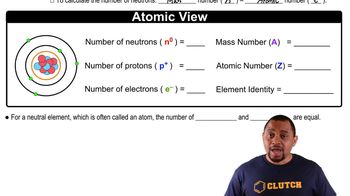
 04:36
04:36