Skip to main content
Introduction to Chemistry
My Course
Learn
Exam Prep
AI Tutor
Study Guides
Flashcards
Explore
Try the app
My Course
Learn
Exam Prep
AI Tutor
Study Guides
Flashcards
Explore
Try the app
Back
Kinetic Molecular Theory definitions
You can tap to flip the card.
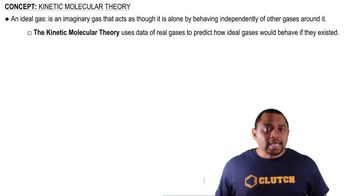
Ideal Gas
You can tap to flip the card.
👆
Ideal Gas
An imaginary substance assumed to behave independently, unaffected by other particles, and used to model real gas behavior.
Track progress
Control buttons has been changed to "navigation" mode.
1/15
Related flashcards
Related practice
Recommended videos
Kinetic Molecular Theory quiz
Kinetic Molecular Theory
15 Terms
Kinetic Molecular Theory
11 Gases
5 problems
Topic
The Ideal Gas Law
11 Gases
5 problems
Topic
11 Gases
10 topics
26 problems
Chapter
Guided course
02:13
Kinetic Molecular Theory Example 1
6097
views
34
rank
1
comments
Guided course
01:19
Kinetic Molecular Theory
6650
views
42
rank
Guided course
03:23
Kinetic Molecular Theory
6515
views
37
rank
Terms in this set (15)
Hide definitions
Ideal Gas
An imaginary substance assumed to behave independently, unaffected by other particles, and used to model real gas behavior.
Kinetic Molecular Theory
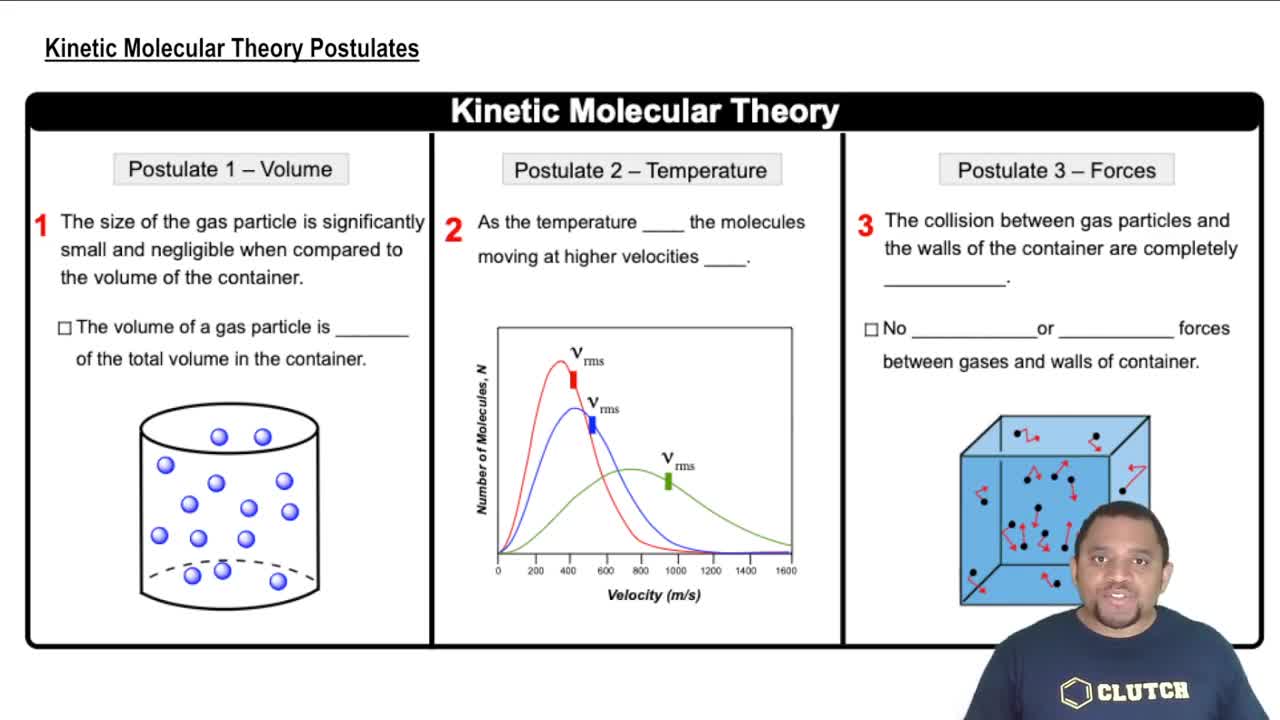
A framework using real gas data to predict how imaginary particles would move and interact under specific assumptions.
Postulate
A foundational statement outlining a specific behavior or property assumed for theoretical modeling.
Elastic Collision
An interaction where particles bounce off each other or container walls without energy loss or force attraction/repulsion.
Root Mean Square Speed
A calculated value representing the average velocity of particles, increasing with temperature.
Temperature
A measure directly influencing how fast particles move, with higher values causing greater velocities.
Volume
The space occupied by a substance, considered negligible for individual particles in theoretical models.
Container
The boundary within which particles move, collide, and whose size dwarfs the space taken by individual particles.
Gas Molecule
A tiny particle moving rapidly, occupying minimal space, and modeled as unaffected by others in ideal scenarios.
Attractive Force
A type of interaction absent in theoretical models, where particles do not pull toward each other.
Repulsive Force
A type of interaction ignored in ideal models, where particles do not push away from each other.
Trajectory
The path followed by a moving particle, altered by collisions in real scenarios but not in idealized ones.
Stoichiometry
A calculation method used to relate quantities in chemical reactions, including those involving gases.
Imaginary Gas
A hypothetical substance used for modeling, assumed to lack real-world interactions and complexities.
Momentum
A property of moving particles, conserved during elastic interactions in theoretical models.
 BackBack
 02:13
02:13