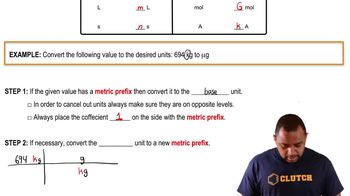
How do you convert 75 millimeters to decimeters using metric prefixes?
To convert 75 millimeters (mm) to decimeters (dm), first convert millimeters to meters: 75 mm × (1 m / 1000 mm) = 0.075 m. Then convert meters to decimeters: 0.075 m × (10 dm / 1 m) = 0.75 dm. So, 75 millimeters equals 0.75 decimeters.
What is the metric prefix and symbol for 10^6?
The metric prefix for 10^6 is Mega, and its symbol is capital M.
Which metric prefix corresponds to 10^-9 and what is its symbol?
The metric prefix for 10^-9 is nano, and its symbol is lowercase n.
What mnemonic can help you remember the order of metric prefixes from 10^12 to 10^-12?
The mnemonic is 'King Henry Died By Drinking Chocolate Milk Until Nine PM,' with each word representing a prefix in order.
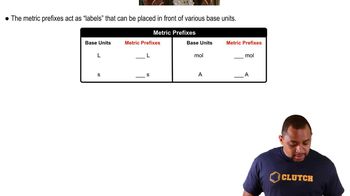
Which base units can metric prefixes be applied to in chemistry?
Metric prefixes can be applied to base units such as liters (volume), seconds (time), moles (amount of substance), and amperes (electrical current).
What is the symbol for the metric prefix micro, and what power of ten does it represent?
The symbol for micro is a Greek letter resembling 'μ', and it represents 10^-6.
How does the prefix 'kilo' modify a base unit, and what is its symbol?
The prefix 'kilo' multiplies a base unit by 1,000 (10^3), and its symbol is lowercase k.
What is the difference between the metric prefixes deca and deci in terms of their symbols and powers of ten?
Deca uses the symbol 'DA' and represents 10^1, while deci uses 'd' and represents 10^-1.
Give an example of a metric prefix applied to the base unit for time.
An example is nanoseconds (ns), where 'nano' is the prefix for 10^-9 applied to seconds.
Why is it important to consult your professor about the range of metric prefixes you need to know?
Some courses may require knowledge of prefixes beyond 10^12 or 10^-12, so it's important to confirm the required range for your class.
 Back
Back
 03:59
03:59