What is the difference between electron geometry and molecular geometry in determining the shape of a molecule?
Electron geometry considers all electron groups (bonding pairs and lone pairs) around a central atom to determine the arrangement of regions of electron density, while molecular geometry focuses on the arrangement of only the atoms (bonding groups), treating lone pairs and bonding groups differently to describe the actual shape of the molecule.
How does the presence of lone pairs affect the molecular geometry of a molecule?
Lone pairs create greater repulsion than bonding pairs, causing the shape of the molecule to bend or change from its ideal geometry. This leads to different molecular geometries even with the same number of electron groups.
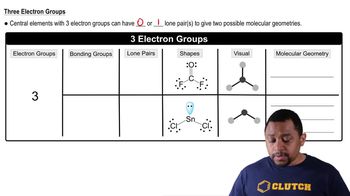
What is the molecular geometry of a molecule with three electron groups and one lone pair on the central atom?
The molecular geometry is bent, V-shaped, or angular. The lone pair causes the bonding groups to be pushed closer together, resulting in a non-linear shape.
Why do double or triple bonds count as only one electron group when determining molecular geometry?
Double or triple bonds are considered a single region of electron density around the central atom. Therefore, they count as one electron group for geometry purposes.
What is the visual representation of a molecule with four bonding groups and no lone pairs on the central atom?
It is drawn as a tetrahedral shape with the central atom at the center and four surrounding atoms at the corners. This arrangement minimizes repulsion between electron groups.
Which molecular geometry is associated with a central atom having three bonding groups and one lone pair?
The geometry is called trigonal pyramidal. The lone pair occupies one position, causing the remaining three atoms to form a pyramid-like structure.
How do you determine the total number of electron groups around a central atom?
Add the number of bonding groups and lone pairs on the central atom. The sum gives the total number of electron groups.
What are the possible molecular geometries for a central atom with four electron groups?
The possible geometries are tetrahedral, trigonal pyramidal, and bent/V-shaped/angular. The specific geometry depends on the number of bonding groups and lone pairs.
What is the molecular geometry of ammonia (NH3) and why?
Ammonia has a trigonal pyramidal geometry because it has three bonding groups and one lone pair on the central nitrogen atom. The lone pair pushes the three hydrogen atoms downward, forming a pyramid shape.
How does increasing the number of electron groups on a central atom affect the variety of possible molecular shapes?
Increasing the number of electron groups allows for more possible molecular geometries. This is because different combinations of bonding groups and lone pairs create distinct shapes.