In a water molecule (H₂O), which atom carries a partial positive charge?
In a water molecule, the hydrogen atoms carry a partial positive charge.
What is an example of a nonpolar compound based on molecular polarity?
Hydrocarbons, which are compounds composed only of carbon and hydrogen atoms, are examples of nonpolar compounds.
What causes the polarity of chemical bonds in molecules?
Polarity of chemical bonds is caused by unequal sharing of electrons between atoms due to differences in electronegativity. This leads to partial charges on atoms within the molecule.
What two conditions must be met for a molecule to have a perfect shape?
A molecule has a perfect shape if the central atom has zero lone pairs and all surrounding atoms are identical. Breaking either condition results in a polar molecule.
How does the presence of lone pairs on the central atom affect molecular polarity?
The presence of one or more lone pairs on the central atom makes the molecule polar. Lone pairs disrupt the perfect shape required for nonpolarity.
What is assumed about the surrounding atoms in nonpolar molecules with perfect shapes?
It is assumed that all surrounding atoms are the same in nonpolar molecules with perfect shapes. This uniformity helps maintain nonpolarity.
How are Lewis dot structures used to determine molecular polarity?
Lewis dot structures help identify lone pairs on the central atom and the identity of surrounding atoms. These features determine whether a molecule is polar or nonpolar.
What happens to molecular polarity if the central atom has one or more lone pairs?
If the central atom has one or more lone pairs, the molecule is classified as polar. This is because the shape is no longer perfect.
What type of molecules are always nonpolar according to the lesson?
Hydrocarbons, which consist only of carbon and hydrogen atoms, are always nonpolar. Non-hydrocarbons with perfect shapes are also nonpolar.
What is the effect of having different surrounding atoms on molecular polarity?
Having different surrounding atoms makes the molecule polar. Uniform surrounding atoms are required for nonpolarity.
 Back
Back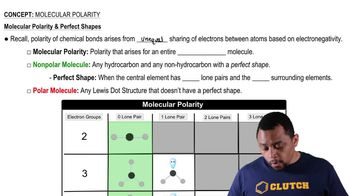
 01:34
01:34