What does a cation with a +2 charge indicate about the number of electrons lost by an element?
A cation with a +2 charge indicates that the element has lost 2 electrons.
Which type of element typically forms cations, and why?
Metals typically form cations because they lose electrons to achieve the electron configuration of noble gases, resulting in positively charged ions.
Why do elements lose or gain electrons according to the periodic table videos?
Elements lose or gain electrons to achieve the electron configuration of the nearest noble gas. This makes them more stable.
What is the charge of noble gases and why do they not form ions?
Noble gases have a charge of 0 because they already have the optimal number of outer shell electrons. Therefore, they do not need to gain or lose electrons.
How do nonmetals typically form anions?
Nonmetals form anions by gaining electrons, which increases their negative charge. This process helps them achieve a noble gas electron configuration.
What is the typical charge for elements in Group 6A and how is it achieved?
Elements in Group 6A typically have a -2 charge. They achieve this by gaining 2 electrons to match the electron configuration of a noble gas.
Why is the charge for Group 4A elements considered non-applicable?
Group 4A elements can either gain or lose electrons, making their charge variable. This ambiguity leads to their charge being labeled as non-applicable.
What is the easier path for aluminum to achieve noble gas configuration, and what charge does it result in?
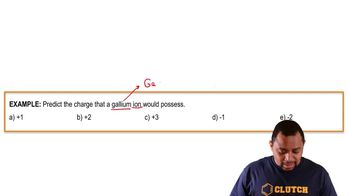
Aluminum more easily loses 3 electrons rather than gaining 5 to achieve noble gas configuration. This results in a +3 charge.
Which elements are exceptions in Group 4A regarding their possible charges, and what are those charges?
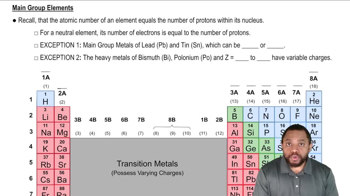
Lead and tin are exceptions in Group 4A. They can have charges of +2 or +4 due to their position and properties.
What is the relationship between atomic number and the number of electrons in a neutral atom?
The atomic number equals the number of protons in an atom. In a neutral atom, the number of electrons is also equal to the atomic number.
 Back
Back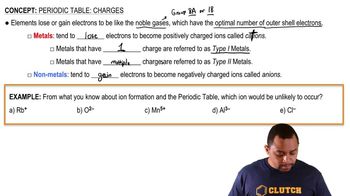
 01:52
01:52