Which element is the most chemically active in group 17 of the periodic table?
Fluorine is the most chemically active element in group 17 due to its high electron affinity.
Which element generally has the largest electron affinity in the periodic table?
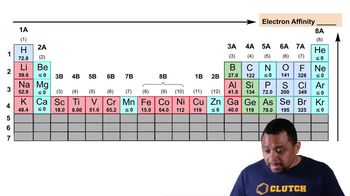
Fluorine generally has the largest electron affinity, as electron affinity increases toward the top right corner of the periodic table, excluding noble gases.
Which types of elements have the lowest electron affinity?
Noble gases, as well as elements like nitrogen, zinc, manganese, beryllium, magnesium, and calcium, have the lowest electron affinities due to their stable or perfect electron configurations.
What is the trend for electron affinity across the periodic table, and which element has the greatest electron affinity?
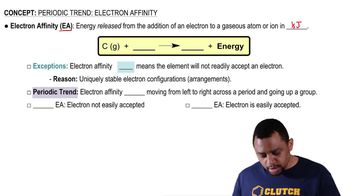
Electron affinity generally increases from left to right across a period and from bottom to top within a group, with fluorine having the greatest electron affinity.
What does a negative charge on an atom indicate after electron affinity occurs?
A negative charge indicates that the atom has gained an electron, which is negatively charged. This process is associated with the release of energy called electron affinity.
Why is energy released when an electron is added to a gaseous atom?
Energy is released because the atom forms a more stable configuration by accepting the electron. This released energy is measured as the electron affinity of the atom.
How does the electron configuration of noble gases affect their electron affinity?
Noble gases have a perfect electron configuration, making them reluctant to accept additional electrons. As a result, their electron affinities are less than or equal to zero.
What is the relationship between electron affinity and an atom's tendency to accept electrons?
Atoms with greater electron affinity more readily accept electrons. Conversely, atoms with lower electron affinity do not easily accept electrons.
Which group 2 elements are mentioned as having electronically stable configurations and low electron affinity?
Beryllium, magnesium, and calcium are group 2 elements with electronically stable configurations. These elements do not readily accept electrons and have low electron affinities.
Why is the trend for electron affinity described as not clean-cut compared to other periodic trends?
The trend for electron affinity has many exceptions and does not always follow a simple pattern. This makes it less predictable than other periodic trends.
 Back
Back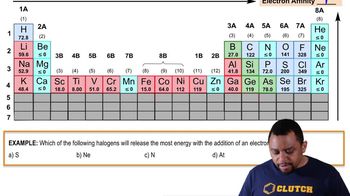
 01:24
01:24