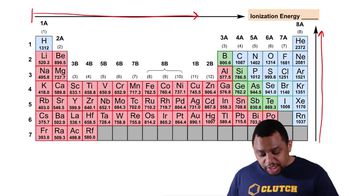
Which element has the smallest ionization energy according to periodic trends?
Francium has one of the smallest ionization energies, meaning its electrons are most easily removed.
Which element has the lowest ionization energy based on the periodic table?
Francium has the lowest ionization energy among the elements commonly discussed.
Which element has the highest ionization energy according to periodic trends?
Helium has the highest ionization energy, making its electrons the most difficult to remove.
Which element has the highest first ionization energy?
Helium has the highest first ionization energy at 2,372 kilojoules.
What element has the lowest ionization energy?
Francium has the lowest ionization energy, at about 393 kilojoules.
What element has the highest ionization energy?
Helium has the highest ionization energy among all elements.
Which atom has the highest ionization energy?
The helium atom has the highest ionization energy.
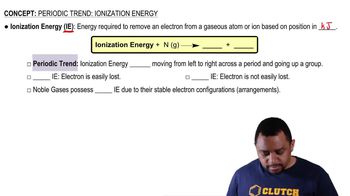
Why is ionization energy written as a reactant in the process of removing an electron from a gaseous atom?
Ionization energy is written as a reactant because energy must be input to remove an electron from the atom. The removed electron then appears as a product in the reaction.
How does the electron configuration of noble gases affect their ionization energies?
Noble gases have stable electron configurations in their outer shells, making it very difficult to remove an electron. This results in them having very high ionization energies.
Why are the ionization energies of some heavy elements not commonly discussed?
Many heavy elements are unstable and exist only briefly after being synthesized in labs. Their instability makes their ionization energies less relevant and not commonly discussed.
 Back
Back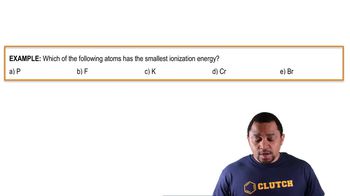
 00:40
00:40