Which type of element is typically malleable and ductile based on its physical properties?
Metals are typically malleable and ductile, meaning they can be shaped or stretched without breaking due to their physical properties.
Which type of element is most likely to bend without breaking, according to its physical properties?
Metals are most likely to bend without breaking because they possess the physical properties of malleability and ductility.
What physical property determines whether an object sinks or floats in water?
Density determines whether an object sinks or floats in water. Objects with higher density than water sink, while those with lower density float.
Which physical property is measured by the amount of matter in an object?
Mass is the physical property measured by the amount of matter in an object. It is typically measured in grams or kilograms.
What does the volume of an object represent?
Volume represents the space an object occupies. It is commonly measured in liters or cubic centimeters.
Which physical property is abbreviated as bp in chemistry?
Boiling point is abbreviated as bp in chemistry. It refers to the temperature at which a substance changes from liquid to gas.
How can physical properties be observed without changing a substance’s chemical structure?
Physical properties can be observed using the senses, such as sight or touch. Observing these properties does not alter the chemical composition of the substance.
What physical property is exemplified by a diamond being difficult to scratch?
Hardness is exemplified by a diamond being difficult to scratch. Diamonds are among the hardest natural materials known.
What is the opposite of hardness when describing a material’s physical property?
The opposite of hardness is softness. Softness describes how easily a material can be deformed or broken.
Which physical properties are related to the temperature at which a substance changes state?
Boiling point, freezing point, and melting point are related to the temperature at which a substance changes state. These properties indicate when a substance transitions between solid, liquid, and gas phases.
 Back
Back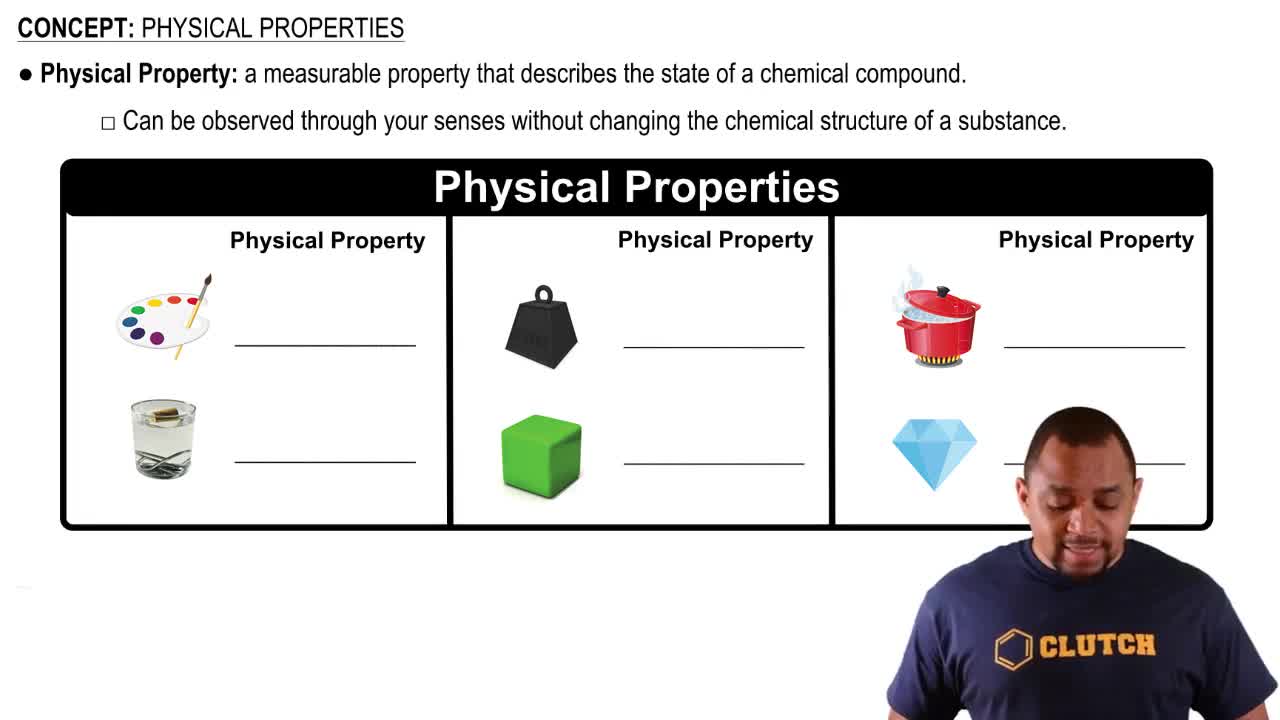
 02:54
02:54