Skip to main content
Introduction to Chemistry
My Course
Learn
Exam Prep
AI Tutor
Study Guides
Flashcards
Explore
Try the app
My Course
Learn
Exam Prep
AI Tutor
Study Guides
Flashcards
Explore
Try the app
Back
Radioactive Half-Life definitions
You can tap to flip the card.
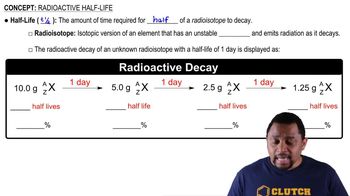
Half-Life
You can tap to flip the card.
👆
Half-Life
Time interval needed for 50% of an unstable isotope sample to decay, unique for each element.
Track progress
Control buttons has been changed to "navigation" mode.
1/13
Related flashcards
Related practice
Recommended videos
Radioactive Half-Life quiz #1
Radioactive Half-Life
10 Terms
Radioactive Half-Life
17. Radioactivity and Nuclear Chemistry
5 problems
Topic
Measuring Radioactivity
17. Radioactivity and Nuclear Chemistry
3 problems
Topic
17. Radioactivity and Nuclear Chemistry
7 topics
20 problems
Chapter
Guided course
01:06
Radioactive Half-Life Example 1
3855
views
9
rank
Guided course
01:28
Radioactive Half-Life Concept 2
4005
views
5
rank
Guided course
02:09
Radioactive Half-Life Concept 1
4134
views
16
rank
Terms in this set (13)
Hide definitions
Half-Life
Time interval needed for 50% of an unstable isotope sample to decay, unique for each element.
Radioisotope
Unstable atomic variant that emits radiation as its nucleus transforms into a more stable form.
Isotope
Form of an element with the same atomic number but different mass number due to varying neutrons.
Mass Number
Sum of protons and neutrons in an atomic nucleus, used to distinguish isotopes.
Atomic Number
Count of protons in an atom's nucleus, defining the chemical identity of the element.
Radioactive Decay
Spontaneous process where an unstable nucleus emits radiation, leading to a more stable state.
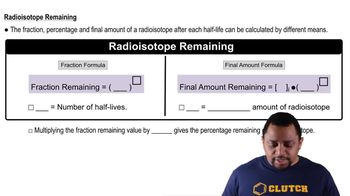
Fraction Remaining
Proportion of original radioisotope left after a certain number of half-lives, calculated as 0.5^n.
Percentage Remaining
Amount of radioisotope left, expressed as a percent, found by multiplying fraction remaining by 100.
Initial Amount
Starting quantity of a radioisotope before any decay has occurred, used in decay calculations.
Final Amount
Quantity of radioisotope left after a given number of half-lives, found using decay formulas.
Unstable Nucleus
Atomic core prone to transformation, causing emission of radiation and leading to decay.
Decay Formula
Mathematical expression, such as initial amount times 0.5^n, used to calculate remaining substance.
Radiation
Energy or particles released from the nucleus during the transformation of an unstable isotope.
 BackBack
 01:06
01:06