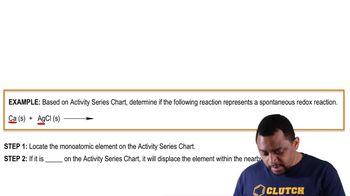
According to the activity series, which metals can displace nickel from a compound in a spontaneous redox reaction?
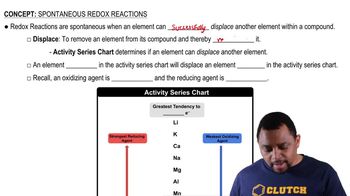
Any metal that is higher than nickel on the activity series can displace nickel from a compound in a spontaneous redox reaction. This is because elements higher on the activity series have a greater tendency to lose electrons and act as reducing agents, enabling them to displace elements lower on the chart such as nickel.
What does it mean to displace an element in a redox reaction?
To displace an element means to remove it from its compound and reduce it. This process involves the element gaining electrons.
What tool is commonly used to predict whether one element can displace another in a redox reaction?
The activity series chart is used to predict if one element can displace another in a redox reaction. It ranks elements by their tendency to lose electrons.
Where on the activity series chart are the strongest reducing agents found?
The strongest reducing agents are found at the top of the activity series chart. These elements have the greatest tendency to lose electrons.
What is the relationship between an element’s position on the activity series and its tendency to be oxidized?
Elements higher on the activity series have a greater tendency to be oxidized. This means they are more likely to lose electrons.
How does the activity series chart indicate the strength of oxidizing agents?
The strongest oxidizing agents are located at the bottom of the activity series chart. These elements have the greatest tendency to gain electrons.
What happens to the reducing agent during a spontaneous redox reaction?
The reducing agent is oxidized during a spontaneous redox reaction. This means it loses electrons to another element.
Why can sodium displace zinc in a compound according to the activity series?
Sodium can displace zinc because it is higher than zinc on the activity series chart. This means sodium has a greater tendency to lose electrons than zinc.
What does a strong tendency to gain electrons indicate about an element’s role in redox reactions?
A strong tendency to gain electrons indicates the element is a strong oxidizing agent. It is more likely to be reduced in a redox reaction.
What is the fate of the oxidizing agent in a spontaneous redox reaction?
The oxidizing agent is reduced in a spontaneous redox reaction. This means it gains electrons from the reducing agent.