What is the electron configuration for silver (Ag), considering the exceptions for transition metals?
The electron configuration for silver (Ag) is [Kr] 4d10 5s1. This is an exception to the expected configuration due to the increased stability of a fully filled d subshell, achieved by promoting one electron from the s orbital to the d orbital.
What rule explains why electrons fill degenerate orbitals singly before pairing up?
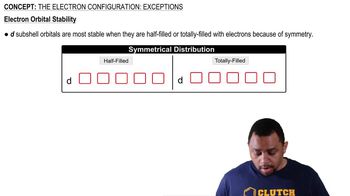
Hund's rule states that electrons fill degenerate orbitals singly to maximize symmetry and stability. This leads to half-filled orbitals before any pairing occurs.
Which atomic number marks the beginning of electron configuration exceptions among transition metals?
Chromium, with atomic number 24, marks the start of these exceptions. It is the first transition metal to show this anomaly.
How many elements are commonly associated with electron configuration exceptions in the transition metals discussed?
There are six major elements where electron configuration exceptions occur. These include chromium, copper, and four others skipped between them.
What is the initial expected electron configuration for chromium before considering exceptions?
The expected configuration for chromium is [Ar] 4s2 3d4. However, this does not reflect the actual stable arrangement.
Why does chromium promote an electron from the s orbital to the d orbital in its electron configuration?
Chromium promotes an electron to achieve a half-filled d5 state, which is more stable due to symmetry. This results in a configuration of [Ar] 4s1 3d5.
What is the driving force behind the electron configuration exceptions in transition metals like chromium and copper?
The driving force is the increased stability from half-filled or fully filled d orbitals. This stability leads to electron promotion from the s to the d subshell.
Which four elements are skipped after chromium before reaching copper, another element with an electron configuration exception?
The four elements skipped are manganese, iron, cobalt, and nickel. Copper is the next element with a notable exception after these.
What is the initial expected electron configuration for copper before considering its exception?
Copper's expected configuration is [Ar] 4s2 3d9. This changes due to the stability gained from a fully filled d subshell.
How does copper achieve a fully filled d subshell in its electron configuration?
Copper promotes one electron from the 4s orbital to the 3d orbital, resulting in [Ar] 4s1 3d10. This makes the d subshell completely filled and more stable.
 Back
Back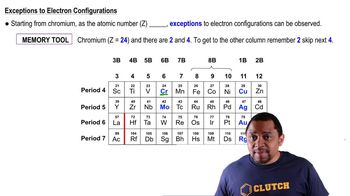
 01:15
01:15