What is the difference between molecular geometry and electron geometry according to VSEPR theory?
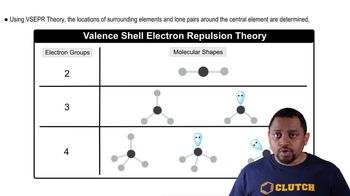
Electron geometry refers to the arrangement of all electron groups (bonding and lone pairs) around the central atom, while molecular geometry describes the arrangement of only the atoms (bonding groups), ignoring lone pairs.
According to VSEPR theory, what causes atoms and electron groups to spread out around a central atom?
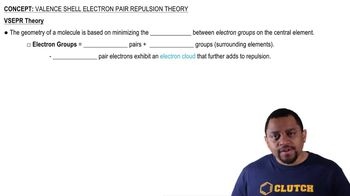
Atoms and electron groups spread out around a central atom to minimize the repulsion between electron groups, which include both bonding groups and lone pairs.
How many electron domains (electron groups) are present around the central atom in a CO₂ molecule?
CO₂ has 2 electron domains around the central atom, corresponding to the two bonding groups (surrounding elements) attached to the central atom.
How many electron domains (electron groups) are present around the central atom in an H₂O molecule?
H₂O has 4 electron domains around the central atom: two bonding groups (hydrogen atoms) and two lone pairs.
How many electron domains (electron groups) are present around the central atom in an NH₃ molecule?
NH₃ has 4 electron domains around the central atom: three bonding groups (hydrogen atoms) and one lone pair.
How do lone electron pairs affect the molecular shape of a molecule according to VSEPR theory?
Lone electron pairs increase electron cloud repulsion, causing the atoms to arrange themselves differently and often resulting in a molecular shape that is distinct from the electron geometry.
What are the two types of electron groups considered in VSEPR theory?
The two types of electron groups are lone pairs on the central atom and bonding groups, which are surrounding elements connected to the central atom. Both contribute to the overall electron cloud and repulsion forces.
How does the number of electron groups on the central atom affect the possible molecular shapes?
Increasing the number of electron groups on the central atom allows for more possible molecular shapes. This is because different combinations of bonding groups and lone pairs create distinct arrangements.
What is the maximum number of electron groups typically considered in VSEPR theory for a central atom?
VSEPR theory typically considers up to four electron groups around a central atom. This includes all combinations of bonding groups and lone pairs.
Why do lone pairs contribute more to electron cloud repulsion than bonding groups in VSEPR theory?
Lone pairs create a larger electron cloud around the central atom, increasing repulsion forces compared to bonding groups. This greater repulsion influences the arrangement of atoms and the resulting molecular shape.
 Back
Back
 00:45
00:45