 Back
Introduction to Chemistry - Chapter 7 Key Concepts
 01:24

Terms in this set (29)
An atom is the smallest unit of an element that retains the chemical properties of that element.
An element is a pure substance made of only one kind of atom.
A molecule is two or more atoms chemically bonded together.
The atomic number is the number of protons in an atom's nucleus.
The mass number is the total number of protons and neutrons in an atom's nucleus.
Isotopes are atoms of the same element with different numbers of neutrons.
An ion is an atom or molecule with a net electric charge due to loss or gain of electrons.
Cations are positively charged ions; anions are negatively charged ions.
The periodic table organizes elements by increasing atomic number and similar chemical properties.
A chemical bond is the force that holds atoms together in a molecule or compound.
An ionic bond forms when electrons are transferred from one atom to another, creating ions.
A covalent bond forms when atoms share electrons.
The law of conservation of mass states that mass is neither created nor destroyed in a chemical reaction.
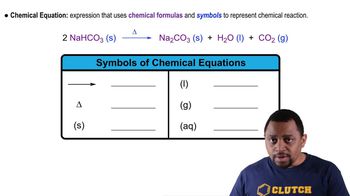
A chemical equation represents a chemical reaction using symbols and formulas.
Reactants are substances that start a reaction; products are substances formed by the reaction.
Balancing ensures the same number of each type of atom on both sides, obeying conservation of mass.
Molar mass is the mass of one mole of a substance, usually in grams per mole (g/mol).
A mole is a quantity representing 6.022 × 10\(23\) particles of a substance.
Avogadro's number is 6.022 × 10\(23\), the number of particles in one mole.
An empirical formula shows the simplest whole-number ratio of atoms in a compound.
A molecular formula shows the actual number of atoms of each element in a molecule.
A solution is a homogeneous mixture of two or more substances.
A solvent is the substance in a solution that dissolves the solute, usually present in greater amount.
A solute is the substance dissolved in a solvent to form a solution.
Concentration is the amount of solute dissolved in a given quantity of solvent or solution.
Molarity is the number of moles of solute per liter of solution.
An acid is a substance that increases hydrogen ion concentration in solution.
A base is a substance that increases hydroxide ion concentration in solution.
The pH scale ranges from 0 to 14, measuring acidity or basicity of a solution.