Skip to main content
Introduction to Chemistry
My Course
Learn
Exam Prep
AI Tutor
Study Guides
Flashcards
Explore
Try the app
My Course
Learn
Exam Prep
AI Tutor
Study Guides
Flashcards
Explore
Try the app
Back
Introduction to Chemistry - Key Concepts and Problems
You can tap to flip the card.
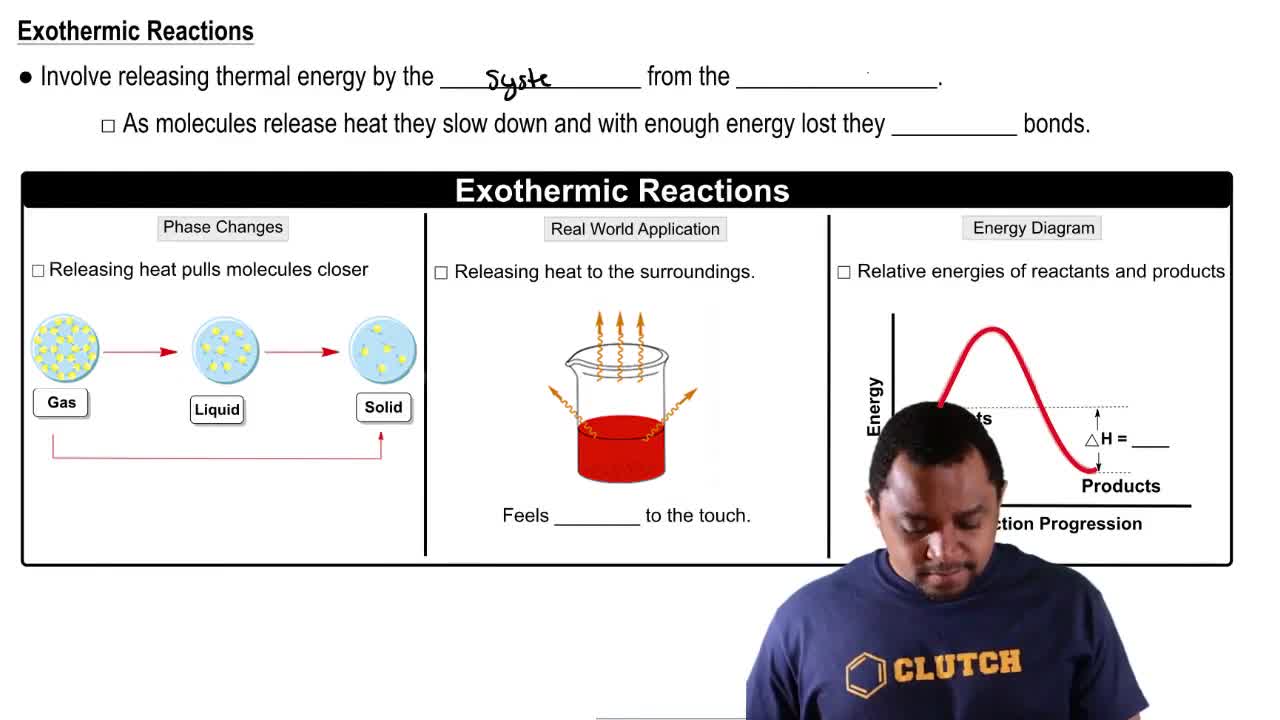
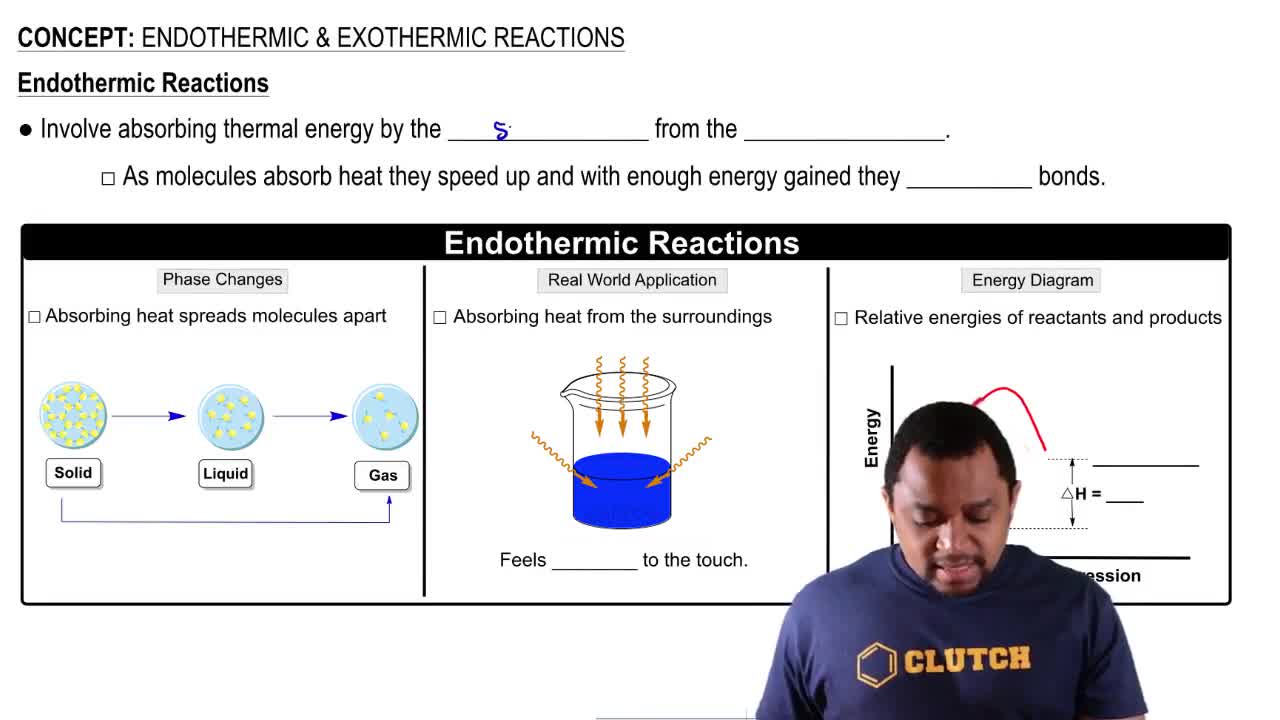
Relationship between sign of ΔH_rxn and reaction type
You can tap to flip the card.
👆
Relationship between sign of ΔH_rxn and reaction type
Negative ΔH_rxn
indicates an
exothermic
reaction (releases heat).
Positive ΔH_rxn
indicates an
endothermic
reaction (absorbs heat).
Track progress
Control buttons has been changed to "navigation" mode.
1/47
Recommended videos
Guided course
1:48
Endothermic & Exothermic Reactions Example 2
10154
views
146
rank
2
comments
Guided course
02:38
Endothermic & Exothermic Reactions
10955
views
77
rank
1
comments
Guided course
02:30
Endothermic & Exothermic Reactions
12123
views
147
rank
1
comments
Terms in this set (47)
Hide definitions
Relationship between sign of ΔH_rxn and reaction type
Negative ΔH_rxn
indicates an
exothermic
reaction (releases heat).
Positive ΔH_rxn
indicates an
endothermic
reaction (absorbs heat).
Calculate moles of NH3 from 5.3 mol N2H4
Use the balanced equation: 3 N2H4 → 4 NH3 + N2. Moles NH3 = (4/3) × moles N2H4 = (4/3) × 5.3 mol = 7.07 mol NH3.
Calculate moles of product from 0.112 mol reactant in 2 Ca + O2 → 2 CaO
Moles product = moles reactant × stoichiometric ratio. For Ca: 0.112 mol Ca × (2 mol CaO / 2 mol Ca) = 0.112 mol CaO.
Balance Al + H2SO4 → Al2(SO4)3 + H2
Balanced: 2 Al + 3 H2SO4 → Al2(SO4)3 + 3 H2.
Calculate moles of H2SO4 to react with 8.3 mol Al
From balanced equation: 2 Al : 3 H2SO4, so moles H2SO4 = (3/2) × 8.3 mol = 12.45 mol.
Calculate moles of H2 formed from 0.341 mol Al
From balanced equation: 2 Al : 3 H2SO4 : 3 H2, moles H2 = (3/2) × 0.341 mol = 0.5115 mol.
Calculate grams of first reactant to react with 17.3 g of second reactant in Pb + KNO3 → PbI2 + KNO3
Use stoichiometry with molar masses and balanced equation to find required grams of first reactant.
Reaction of Fe with HCl: Fe + 2 HCl → FeCl2 + H2
Calculate minimum mass of HCl to dissolve 2.8 g Fe and moles of H2 produced using molar masses and stoichiometry.
Calculate theoretical yield of TiCl4 from Ti and Cl2
Balanced: Ti + 2 Cl2 → TiCl4. Theoretical yield depends on limiting reactant from initial moles.
Calculate percent yield from theoretical 0.118 g and actual 0.104 g
Percent yield = (actual yield / theoretical yield) × 100 = (0.104 / 0.118) × 100 ≈ 88.14%.
Limiting reactant and percent yield in 4 HCl + O2 → 2 H2O + 2 Cl2
Determine limiting reactant by mole comparison; calculate theoretical Cl2 yield and percent yield from actual Cl2 collected.
Classify melting ice, sparkler burning, acetone evaporating by ΔH_rxn sign
Ice melting: endothermic (+ΔH). Sparkler burning: exothermic (-ΔH). Acetone evaporating: endothermic (+ΔH).
Heat produced by combustion of 237 g CH4, ΔH_rxn = -802.3 kJ
Calculate moles CH4, multiply by ΔH_rxn per mole to find total heat released.
Dissolving calcium carbonate with HCl in toilet cleaner
Write balanced reaction; calculate grams CaCO3 dissolved by 5.8 g HCl using stoichiometry.
CO2 produced from combustion of 18.9 L propane (density 0.621 g/mL)
Convert volume to mass, write balanced combustion equation, calculate moles propane and CO2 produced.
Combustion of ethanol: find limiting reactant, theoretical H2O, percent yield
Use volumes and densities to find moles reactants and products; calculate limiting reactant and yields.
Bohr model electron transition
Electron moves between orbits by absorbing or emitting energy equal to the difference in energy levels.
Electron configuration for N, Mg, Ar, Se
Write full configurations using Aufbau principle for each element.
Electron configuration using noble gas core for Te, Br, I, Cs
Use previous noble gas in brackets followed by valence electron configuration.
Number of valence electrons in Ba, Al, Be, Se
Ba: 2, Al: 3, Be: 2, Se: 6 valence electrons.
Orbital diagrams and unpaired electrons for Ne, I, Sr, Ge
Draw orbital boxes for valence electrons; count unpaired electrons.
Number of 3d electrons in Fe, Zn, K, As
Fe: 6, Zn: 10, K: 0, As: 10 electrons in 3d subshell.
Identify element from electron configuration: Ne]3s1, [Kr]5s24d10, [Xe]6s2, [Kr]5s24d105p3
Match configurations to elements based on valence electrons and subshell filling.
Element with higher ionization energy: Al or In, Cl or Sb, K or Ge, S or Se
Higher ionization energy: Al, Cl, Ge, S.
Order elements by increasing ionization energy: Ga, In, F, Si, N
Order: In < Ga < Si < N < F.
Element with larger atoms: Sn or Si, Br or Ga, Sn or Bi, Se or Sn
Larger atoms: Sn, Ga, Bi, Sn.
Order elements by increasing atomic size: Cs, Sb, S, P, Se
Order: S < P < Se < Sb < Cs.
More metallic element from pairs: Sb or Pb, K or Ge, Ge or Sb, As or Sn
More metallic: Pb, K, Sb, Sn.
Electron configuration for ions F-, P3-, Li+, Al3+
All have electron configuration of nearest noble gas: Ne or Ar.
Electron configuration and Lewis structure for Li, P, F, Ne
Show valence electrons and indicate electrons included in Lewis structure.
Generic Lewis structure for alkali metals and electron gain/loss
Alkali metals lose 1 electron to form +1 ions in chemical reactions.
Lewis structures for ions Sr2+, S2-, Li+, Cl-
Show full octet for anions and empty valence for cations.
Noble gas with same Lewis structure as Se2-, I-, Sr2+, F-
Se2-, I-, F- resemble Ar; Sr2+ resembles Kr.
Lewis structure for ionic compounds from Al and F, O, N
Show Al3+ ion with corresponding anions F-, O2-, N3- with full octets.
Lewis structures for CH4, NF3, OF2, H2O
Draw structures showing bonding and lone pairs for each molecule.
Lewis structures with resonance for ClO3-, ClO4-, NO3-, SO3
Include resonance forms with delocalized electrons for these ions.
Number of electron groups around central atom in CH2Cl2, SBr2, H2S, PCl3
Count bonding and lone pairs: CH2Cl2=4, SBr2=4, H2S=4, PCl3=4.
Order elements by increasing electronegativity: Ba, N, F, Si, Cs
Order: Cs < Ba < Si < N < F.
Electron and molecular geometries of CH3OH, H3COCH3, H2O2
CH3OH: tetrahedral; H3COCH3: tetrahedral around each C; H2O2: bent.
Classify I2, NO, HCl, N2 as polar or nonpolar
I2 and N2 are nonpolar; NO and HCl are polar molecules.
Percent composition and molecular formula of diazomethane
Use mass percentages and molar mass to find empirical and molecular formula; draw Lewis structure.
Lewis dot structure, geometry, polarity, and classification for CS2, NCl3, CF2, CH2F2
Draw Lewis structures; determine molecular geometry; indicate bond polarity; classify as polar or nonpolar.
Convert 921 torr, 4.8 × 10^4 Pa, 87.5 psi, 34.22 in Hg to atm
Use conversion factors: 1 atm = 760 torr = 101325 Pa = 14.7 psi = 29.92 in Hg.
Calculate pressure after compressing gas from 22.8 L at 1.65 atm to 10.7 L
Use Boyle's law: P1V1 = P2V2; solve for P2.
Volume change of balloon cooling from 298 K to 77 K
Use Charles's law: V1/T1 = V2/T2; calculate new volume at 77 K.
Final volume of oxygen gas cooled from 95.3 °C to 0.0 °C at constant pressure
Use Charles's law: V1/T1 = V2/T2; convert temperatures to Kelvin.
Volume of 0.72 mol helium gas under same conditions as 0.48 mol occupying 11.7 L
Use Avogadro's law: volume proportional to moles; calculate volume for 0.72 mol.
 BackBack
 1:48
1:48