 Back
Acids and Bases: Structure, Properties, and Reactions
Study Guide - Smart Notes
 Tailored notes based on your materials, expanded with key definitions, examples, and context.
Acids and Bases
Overview and Importance
Acids and bases are fundamental to chemistry, impacting health, household products, foods, and biological processes. Their behavior in aqueous solutions is central to understanding chemical reactions and molecular biology.
Acids are substances that produce H+ ions in solution.
Bases are substances that produce OH- ions in solution.
Acids and bases are present in many foods, medicines, and cleaning products.
Stomach Acid and Heartburn
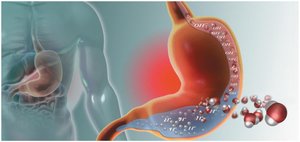
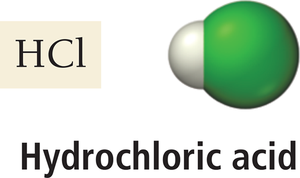
Stomach acid, primarily hydrochloric acid (HCl), is produced by cells lining the stomach to kill bacteria and activate digestive enzymes. Heartburn occurs when this acid backs up into the esophagus, causing irritation and a burning sensation.
Large meals and lying down after eating can trigger heartburn.
Chronic heartburn is known as GERD (gastroesophageal reflux disease).
The Nature and Properties of Acids
Physical and Chemical Properties
Acids exhibit several characteristic properties:
Sour taste
Ability to dissolve many metals
Ability to neutralize bases
Change blue litmus paper to red
Common Acids and Their Structures
Acids can be classified by their structure:
Binary acids: Hydrogen attached to a nonmetal atom (e.g., HCl, HF).
Oxyacids: Hydrogen attached to an oxygen atom (e.g., H2SO4, HNO3).
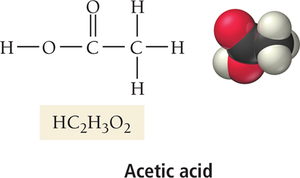
Carboxylic acids: Contain a COOH group; only the first H is acidic (e.g., HC2H3O2, citric acid).
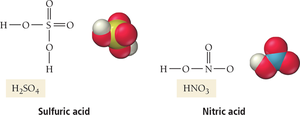
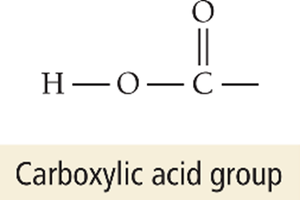
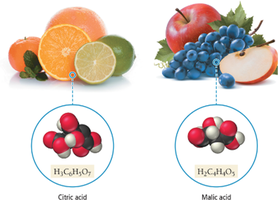
The Nature and Properties of Bases
Physical and Chemical Properties
Bases are substances with the following properties:
Bitter taste
Slippery feel
Ability to turn red litmus paper blue
Ability to neutralize acids
Common Bases
Bases are found in many household products, such as cleaning agents and antacids. 
Definitions of Acids and Bases
Arrhenius, Brønsted-Lowry, and Lewis Definitions
There are three main definitions of acids and bases, each useful in different contexts:
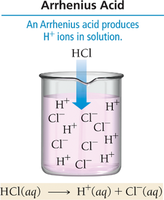
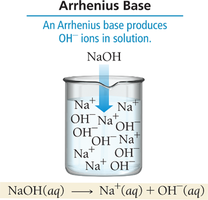
Arrhenius definition: Acids produce H+ ions; bases produce OH- ions in aqueous solution.
Brønsted-Lowry definition: Acids are proton (H+) donors; bases are proton acceptors.
Lewis definition: Acids are electron pair acceptors; bases are electron pair donors.
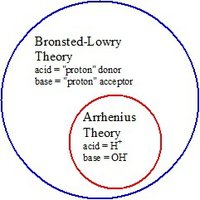
Arrhenius Acid and Base Reactions
Arrhenius acids dissociate in water to produce H+ ions.
Arrhenius bases dissociate in water to produce OH- ions.
Hydronium Ion Formation
H+ ions are highly reactive and do not exist freely in water; they combine with water molecules to form hydronium ions (H3O+). 
Brønsted-Lowry Theory
Acid-Base Reactions and Conjugate Pairs
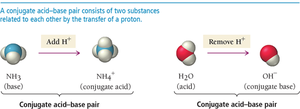
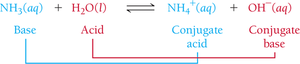
In Brønsted-Lowry theory, acids donate protons and bases accept protons. Each acid-base reaction produces a conjugate acid and a conjugate base.
Acid: H+ donor
Base: H+ acceptor
Conjugate acid: formed when a base gains a proton
Conjugate base: formed when an acid loses a proton
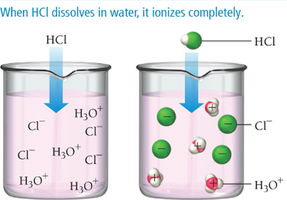
Acid Strength and Ionization
Strong vs. Weak Acids
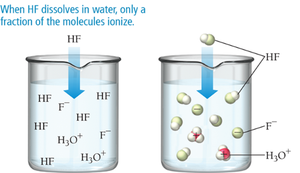
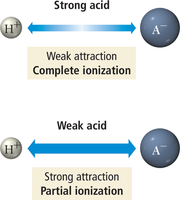
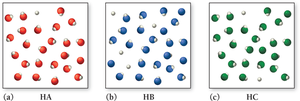
The strength of an acid is determined by its degree of ionization in water:
Strong acids: Completely ionize in water (e.g., HCl, HNO3, H2SO4).
Weak acids: Partially ionize in water (e.g., HF, acetic acid).
Acid Ionization Constant (Ka)
The acid ionization constant () quantifies the strength of an acid:
Larger means stronger acid.
Smaller means weaker acid.
Autoionization of Water and pH
Autoionization of Water
Water is amphoteric and can act as both an acid and a base, undergoing autoionization:
All aqueous solutions contain both H3O+ and OH- ions.
Neutral solutions: [H3O+] = [OH-]
Measuring Acidity: pH
The pH scale quantifies the acidity or basicity of a solution:
pH < 7: acidic
pH > 7: basic
pH = 7: neutral
Summary Table: Common Acids and Bases
Name of Acid | Formula | Name of Base | Formula |
|---|---|---|---|
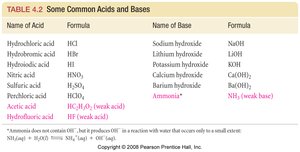
Hydrochloric acid | HCl | Sodium hydroxide | NaOH |
Hydrobromic acid | HBr | Lithium hydroxide | LiOH |
Hydroiodic acid | HI | Potassium hydroxide | KOH |
Nitric acid | HNO3 | Calcium hydroxide | Ca(OH)2 |
Sulfuric acid | H2SO4 | Barium hydroxide | Ba(OH)2 |
Acetic acid (weak acid) | HC2H3O2 | Ammonia (weak base) | NH3 |
Hydrofluoric acid (weak acid) | HF |
Additional info:
Acids and bases are classified by their strength, structure, and behavior in solution.
Understanding acid-base reactions is essential for predicting the outcome of chemical processes in biological, environmental, and industrial contexts.
