 Back
BackAtomic Structure and Models: Foundations of Modern Chemistry
Study Guide - Smart Notes
 Tailored notes based on your materials, expanded with key definitions, examples, and context.
Atomic Structure
Dalton's Atomic Theory
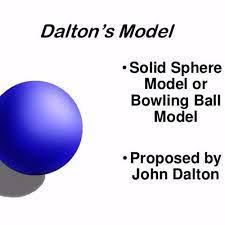
John Dalton proposed one of the earliest models of the atom, describing atoms as tiny, hard spheres that cannot be split up. This model laid the foundation for modern atomic theory.
Atoms are indivisible particles that make up all matter.
Each element consists of identical atoms unique to that element.
Atoms combine in simple whole-number ratios to form compounds.
Atoms are rearranged in chemical reactions, but not created or destroyed.
Solid Sphere Model or Bowling Ball Model is the visual representation of Dalton's theory.
Electricity and the Atom
Understanding the behavior of electric charges is essential to atomic structure. Static electricity was known since ancient times, but the concept of continuous electric current emerged in the nineteenth century.
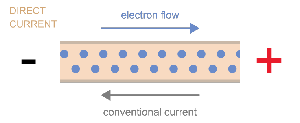
Electric current involves the flow of electrons.
Conventional current flows from positive to negative, while electron flow is from negative to positive.
Properties of Electrical Charges
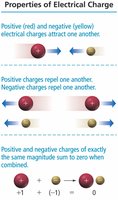
Electrical charges exhibit specific properties that are fundamental to atomic interactions.
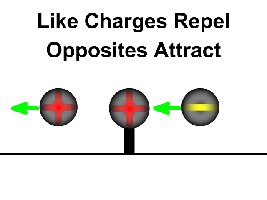
Opposite charges attract (e.g., positive and negative).
Like charges repel (e.g., two positives or two negatives).
Charges are additive: The sum of positive and negative charges can result in neutrality.
Electrolysis
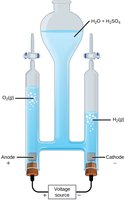
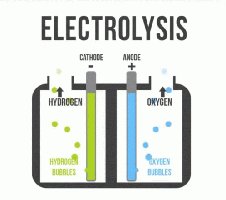
Electrolysis is a process where electricity causes a chemical change, such as the decomposition of water into hydrogen and oxygen.
Electrolysis demonstrates the movement of charged particles (ions) in solution.
Electrodes are used: the cathode (negative) attracts cations, and the anode (positive) attracts anions.
Example: Decomposition of water produces hydrogen at the cathode and oxygen at the anode.
Discovery of the Electron
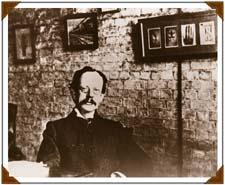
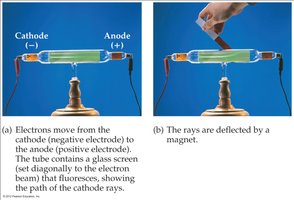
J.J. Thomson's experiments with cathode rays in 1897 led to the discovery of the electron, a fundamental subatomic particle.
Cathode rays are streams of negatively charged particles (electrons).
Electrons travel from the cathode to the anode in a straight line.
Electrons have a mass about 2,000 times smaller than a hydrogen atom.
Electrons are found in all substances and are always the same.
Measuring the Electron
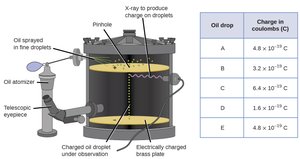
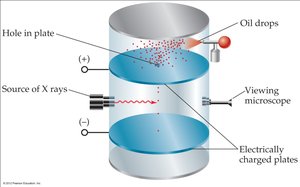
J.J. Thomson measured the charge-to-mass ratio of the electron, but the actual charge and mass were determined later by Robert Millikan.
Charge/mass ratio: coulombs/gram (C/g).
Millikan's oil-drop experiment determined the charge of a single electron: C.
Using Thomson's ratio and Millikan's charge, the mass of the electron was calculated: g.
X-Rays and Radioactivity
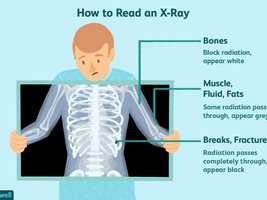
X-rays were discovered by Wilhem Roentgen in 1895 using a cathode ray tube. Radioactivity is the spontaneous emission of radiation by an atom, revealing that atoms are made of smaller pieces.
X-rays are a high-energy form of light.
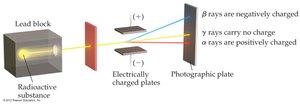
Three types of radiation discovered by Ernest Rutherford:
Gamma rays (γ): high energy light, no charge.
Beta particles (β): high-speed electrons, negative charge.
Alpha particles (α): helium nuclei, positive charge (+2).
Thomson's Plum Pudding Model
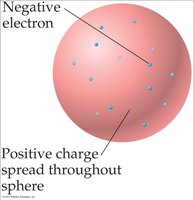
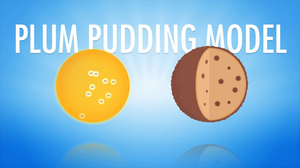
Thomson proposed the "plum-pudding" model of the atom, where electrons are embedded in a positively charged sphere, similar to raisins in a pudding.
Atoms are electrically neutral overall.
Electrons are distributed throughout a positively charged matrix.
Rutherford's Gold Foil Experiment and Nuclear Model
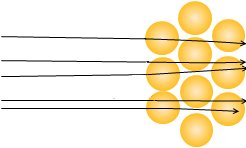
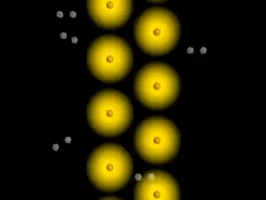
Ernest Rutherford's gold foil experiment demonstrated that atoms are mostly empty space with a dense, positively charged nucleus at the center.
Most alpha particles passed through the foil, but some were deflected at large angles.
Conclusions:
Atoms are mostly empty space.
The nucleus is solid and contains most of the atom's mass and positive charge.
Subatomic Particles
Atoms are composed of three main subatomic particles: protons, neutrons, and electrons.
Protons: positive charge, found in the nucleus.
Neutrons: no charge, similar mass to protons, found in the nucleus.
Electrons: negative charge, much smaller mass, found outside the nucleus.
Protons and electrons are the only particles with charge.
Protons define the identity of an element (atomic number).
Nuclear Theory of the Atom
The nuclear theory states that most of the atom's mass and all of its positive charge are contained in a small core called the nucleus. Electrons are dispersed throughout the empty space around the nucleus.
Atoms are electrically neutral: number of protons equals number of electrons.
Most of the atom's volume is empty space.
Symbols of Elements and Atomic Notation
Elements are symbolized by one or two letters. The atomic number (Z) is the number of protons, and the mass number (A) is the total number of protons and neutrons.
Example: Silicon (Si), Z = 14, A = 29, number of neutrons = A - Z = 15.
Isotopes
Isotopes are atoms of the same element with different numbers of neutrons, resulting in different mass numbers.
Isotopes have the same number of protons but different numbers of neutrons.
Example: Hydrogen has several isotopes (protium, deuterium, tritium).
Mass number (A) = protons + neutrons.
The Bohr Model of the Atom
Niels Bohr proposed that electrons orbit the nucleus in specific energy levels or shells. Electrons can only gain or lose energy by jumping between these levels.
Energy levels are quantized.
Electrons in the ground state have the lowest energy.
Electrons absorb energy to move to higher levels (excited state) and emit energy as photons when returning to lower levels.
Electron Arrangement: The Quantum Model
Electrons occupy principal energy levels (shells) and sublevels (s, p, d, f). The maximum number of electrons in a shell is given by .
Sublevels: s (2 electrons), p (6), d (10), f (14).
Electron configuration describes the arrangement of electrons in an atom.
Valence electrons are in the highest energy level and are important for bonding.
Periodic Table and Electron Configurations
The periodic table is organized by electron configurations. Main-group elements (A) and transition elements (B) are distinguished. Groups have special names (alkali metals, alkaline earth metals, halogens, noble gases).
Electron configuration can be written in long form or short-hand using noble gases.
Valence electrons determine chemical properties.
Metals, nonmetals, and metalloids are classified by their properties.
Green Chemistry: Solar Fuels
Sunlight is an abundant energy source. Plants store solar energy as chemical energy via photosynthesis. Artificial photosynthesis can generate hydrogen fuel, which can be reacted with oxygen to produce heat and electricity.
