Back
BackAtomic Structure and Periodic Table: Study Notes for Introductory Chemistry
Study Guide - Smart Notes
 Tailored notes based on your materials, expanded with key definitions, examples, and context.
Atomic Structure
Subatomic Particles
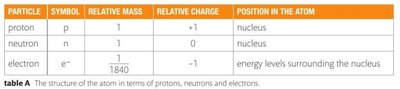
Atoms are composed of three fundamental subatomic particles: protons, neutrons, and electrons. Each particle has distinct properties and plays a specific role in atomic structure.
Proton: Positively charged particle found in the nucleus. Relative mass = 1.
Neutron: Neutral particle found in the nucleus. Relative mass = 1.
Electron: Negatively charged particle found in energy levels surrounding the nucleus. Relative mass = $\frac{1}{1840}$.
Particle | Symbol | Relative Mass | Relative Charge | Position in the Atom |
|---|---|---|---|---|
proton | p | 1 | +1 | nucleus |
neutron | n | 1 | 0 | nucleus |
electron | e- | $\frac{1}{1840}$ | -1 | energy levels surrounding the nucleus |
Atomic Number and Mass Number
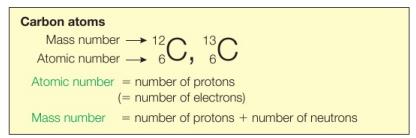
The atomic number (Z) is the number of protons in the nucleus and defines the element. The mass number (A) is the sum of protons and neutrons in the nucleus.
Atomic number (Z): Number of protons (and electrons in a neutral atom).
Mass number (A): Number of protons + number of neutrons.
Isotopes
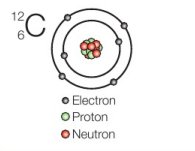
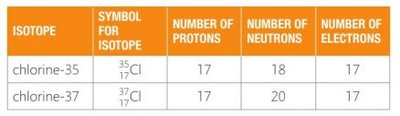
Isotopes are atoms of the same element with the same atomic number but different mass numbers due to varying numbers of neutrons.
Example: Carbon-12 and Carbon-13 are isotopes of carbon.
Isotopes have identical chemical properties but different physical properties.
Isotope | Symbol for Isotope | Number of Protons | Number of Neutrons | Number of Electrons |
|---|---|---|---|---|
chlorine-35 | $^{35}_{17}\mathrm{Cl}$ | 17 | 18 | 17 |
chlorine-37 | $^{37}_{17}\mathrm{Cl}$ | 17 | 20 | 17 |
Mass Spectrometry and Relative Masses
Relative Atomic and Isotopic Mass
The relative atomic mass (Ar) is the weighted mean mass of an atom compared to 1/12 of the mass of a carbon-12 atom. The relative isotopic mass is the mass of a specific isotope relative to 1/12 of the mass of carbon-12.
Principle of Mass Spectrometry
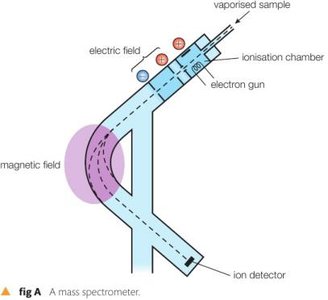
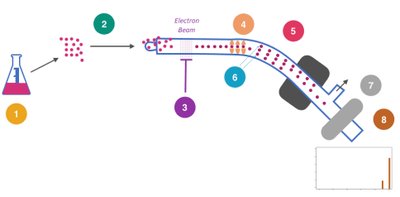
A mass spectrometer measures the masses of positive ions formed from atoms and molecules. The process involves vaporizing the sample, ionizing it, accelerating ions, and deflecting them based on their mass-to-charge ratio (m/z).
Sample must be in gaseous state.
Ionization: Bombard vapors with electrons to form positive ions.
Acceleration: Positive ions are accelerated by an electric field.
Deflection: Ions are deflected by a magnetic field according to their m/z ratio.
Detection: Ions are detected and counted at each m/z value.
Interpreting Mass Spectra
A mass spectrum displays the relative abundance of ions (y-axis) versus their mass/charge ratio (x-axis). The charge is usually +1, so the ratio is typically the mass.
Relative abundance helps determine the exact value of Ar based on isotope percentages.
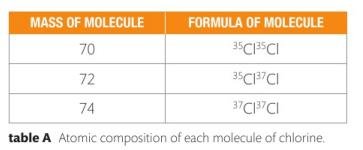
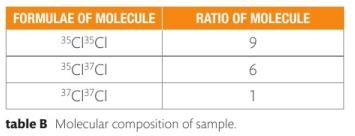
For molecules, the spectrum can show peaks corresponding to different isotopic combinations.
Mass of Molecule | Formula of Molecule |
|---|---|
70 | $^{35}\mathrm{Cl}^{35}\mathrm{Cl}$ |
72 | $^{35}\mathrm{Cl}^{37}\mathrm{Cl}$ |
74 | $^{37}\mathrm{Cl}^{37}\mathrm{Cl}$ |
Formulae of Molecule | Ratio of Molecule |
|---|---|
$^{35}\mathrm{Cl}^{35}\mathrm{Cl}$ | 9 |
$^{35}\mathrm{Cl}^{37}\mathrm{Cl}$ | 6 |
$^{37}\mathrm{Cl}^{37}\mathrm{Cl}$ | 1 |
Atomic Orbitals and Electronic Configurations
Energy Levels and Quantum Shells
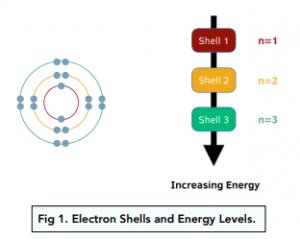
Electrons are arranged in energy levels or principal quantum shells (n). The principal quantum number (n) indicates the shell's energy and distance from the nucleus.
Shells closer to the nucleus have lower energy.
Each shell can hold a specific number of electrons.
Sub-Shells and Orbitals
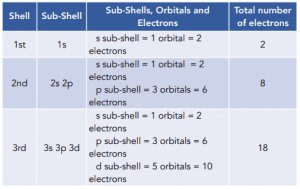
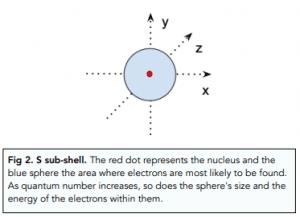
Each shell is divided into sub-shells (s, p, d, f), which contain orbitals. An orbital is a region where up to two electrons can be found. The shape and size of orbitals determine the probability of finding electrons.
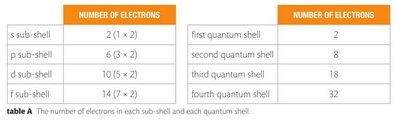
s sub-shell: 1 orbital, spherical shape, holds 2 electrons.
p sub-shell: 3 orbitals, dumbbell shape, holds 6 electrons.
d sub-shell: 5 orbitals, clover shape, holds 10 electrons.
f sub-shell: 7 orbitals, double dumbbell, holds 14 electrons.
Shell | Sub-Shell | Sub-Shells, Orbitals and Electrons | Total number of electrons |
|---|---|---|---|
1st | 1s | s sub-shell = 1 orbital = 2 electrons | 2 |
2nd | 2s 2p | s sub-shell = 1 orbital = 2 electrons p sub-shell = 3 orbitals = 6 electrons | 8 |
3rd | 3s 3p 3d | s sub-shell = 1 orbital = 2 electrons p sub-shell = 3 orbitals = 6 electrons d sub-shell = 5 orbitals = 10 electrons | 18 |
Number of Electrons | Number of Electrons |
|---|---|
s sub-shell: 2 (1 x 2) | first quantum shell: 2 |
p sub-shell: 6 (3 x 2) | second quantum shell: 8 |
d sub-shell: 10 (5 x 2) | third quantum shell: 18 |
f sub-shell: 14 (7 x 2) | fourth quantum shell: 32 |
Electronic Configuration
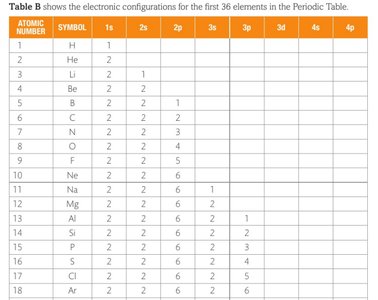
The electronic configuration describes the arrangement of electrons in each sub-shell and energy level. Electrons fill the lowest energy orbitals first (Aufbau principle), but there are exceptions due to energy differences between orbitals.
Example: Potassium (K) fills the 4s orbital before 3d.
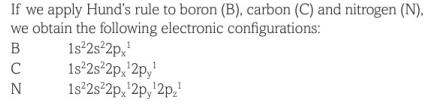
Hund's Rule: Electrons occupy orbitals singly before pairing.
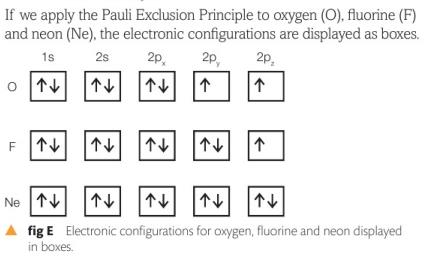
Pauli Exclusion Principle: No two electrons in the same orbital can have the same spin.
Ionisation Energies
Definition and Types
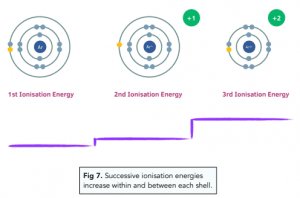
Ionisation energy (ΔHi) is the energy required to remove an electron from an atom in the gaseous state. It is measured in kJ/mol.
First ionisation energy: Energy to remove one electron from each atom in one mole of gaseous atoms.
Second ionisation energy: Energy to remove one electron from each singly charged positive ion.
Third ionisation energy: Energy to remove one electron from each doubly charged positive ion.
Successive Ionisation Energies
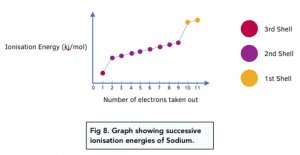
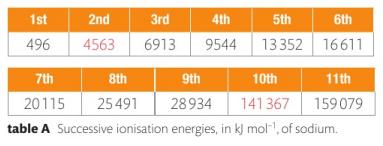
Successive ionisation energies increase as more electrons are removed, especially when moving to a new principal quantum shell. The first ionisation energy is proportional to the attraction between the nucleus and the outermost electron.
Big jumps in ionisation energy occur when removing electrons from a new shell closer to the nucleus.
Gradual increases occur within the same shell.
Factors Affecting Ionisation Energy
Atomic radius: Larger radius means lower ionisation energy.
Nuclear charge: Higher charge means higher ionisation energy.
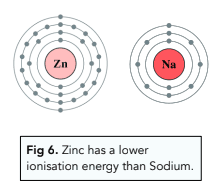
Number of inner shells (shielding): More inner shells mean lower ionisation energy due to increased shielding.
Trends in Ionisation Energies
Across a Period
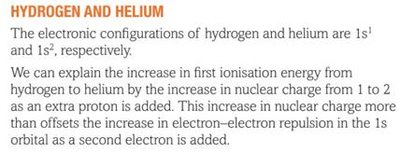
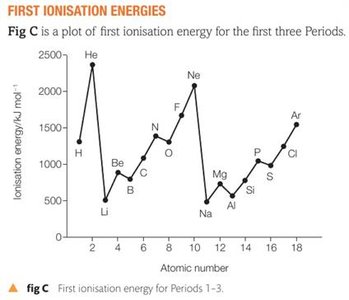
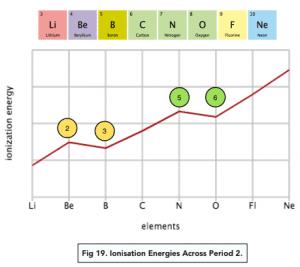
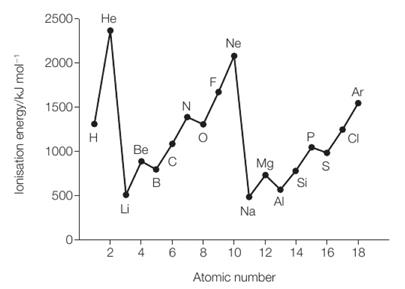
Ionisation energy generally increases across a period due to increasing nuclear charge and decreasing atomic radius, with no change in shielding.
Sharp decrease between last element of one period and first of the next due to increased distance and shielding.
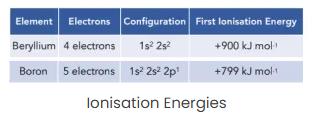
Drop between Group 2 and 3 elements (e.g., Be and B) due to higher energy and shielding of 2p electrons.
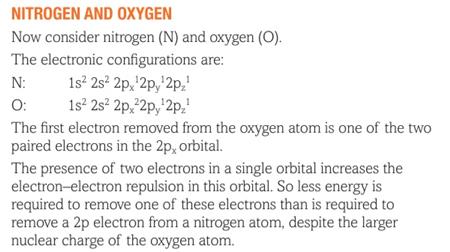
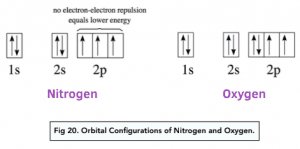
Drop between Group 5 and 6 elements (e.g., N and O) due to spin-pair repulsion in the 2p orbital.
Down a Group
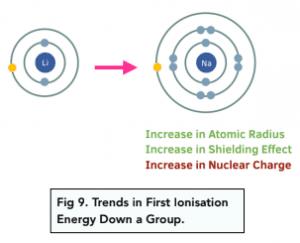
Ionisation energy decreases down a group due to increasing atomic radius and shielding effect, despite increasing nuclear charge.
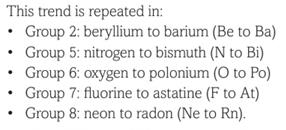
Trend is repeated in all main groups of the periodic table.
The Periodic Table
Structure of the Periodic Table
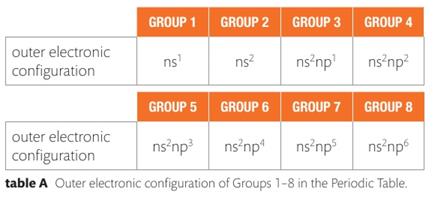
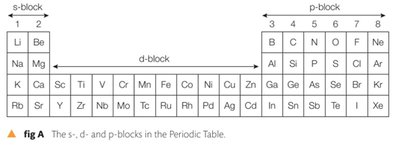
The periodic table is organized into vertical columns (groups) and horizontal rows (periods). Elements in the same group have the same number of outer electrons, while the period number indicates the number of occupied shells.
s-block: Groups 1 and 2, highest energy electron in s orbital.
p-block: Groups 3 to 8, highest energy electron in p orbital.
d-block: Transition metals, highest energy electron in d orbital.
Periodic Properties
Periodic properties are regularly repeating patterns of atomic, physical, and chemical properties explained by electron configurations.
Atomic Radii
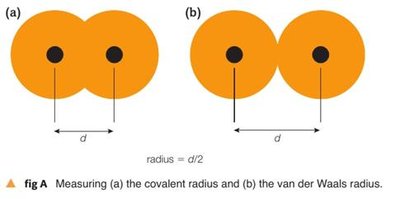
The atomic radius is the distance from the nucleus to the boundary of the electron cloud. It can be measured as covalent, van der Waals, or metallic radius.
Covalent radius: Half the distance between nuclei in a diatomic molecule.
Van der Waals radius: Only for noble gases, larger than covalent radius.
Metallic radius: Half the distance between nuclei of adjacent atoms in a metal.
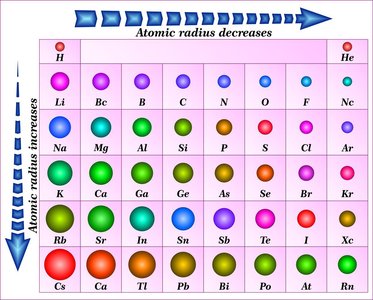
Atomic radius decreases across a period due to increasing nuclear charge, which pulls electrons closer.
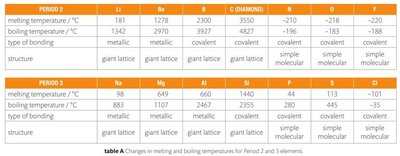
Melting and Boiling Points
Melting and boiling points vary based on structure:
Giant lattice structures have high melting and boiling points.
Simple molecular structures have low melting and boiling points.
First Ionisation Energies
First ionisation energies show periodic trends and are influenced by atomic structure and electron configuration.