 Back
BackAtomic Structure and the Development of Atomic Theory
Study Guide - Smart Notes
 Tailored notes based on your materials, expanded with key definitions, examples, and context.
Atomic Structure and the Development of Atomic Theory
Dalton's Atomic Theory
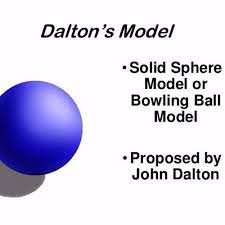
John Dalton proposed one of the earliest models of the atom, describing atoms as indivisible, solid spheres. This model laid the foundation for modern atomic theory and explained the conservation of mass in chemical reactions.
Atoms are tiny, hard spheres that cannot be split up (indivisible).
Each element consists of identical atoms unique to that element.
Atoms combine in simple whole-number ratios to form compounds.
Atoms are rearranged in chemical reactions but are not created or destroyed.
Electricity and the Atom
Electricity played a crucial role in the discovery of subatomic particles. The flow of electric current and the behavior of static electricity provided evidence for the existence of charged particles within atoms.
Static electricity is the accumulation of electric charge on the surface of objects.
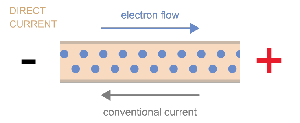
Direct current (DC) involves the flow of electrons from the negative terminal to the positive terminal.
Properties of Electrical Charges
Electrical charges exhibit specific properties that are fundamental to understanding atomic structure and chemical behavior.
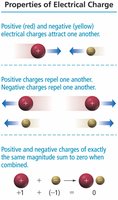
Opposite charges attract each other (positive attracts negative).
Like charges repel each other (positive repels positive, negative repels negative).
Charges are additive: The total charge is the sum of individual charges.
Electrolysis
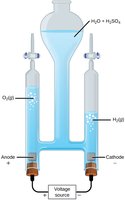
Electrolysis is a chemical process in which electrical energy causes a chemical change, such as the decomposition of water into hydrogen and oxygen gases. This process provided evidence that atoms contain charged particles.
Electrolysis demonstrates that atoms can be split into smaller, charged components.
It involves the movement of ions toward electrodes of opposite charge.
Discovery of the Electron
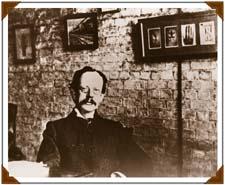
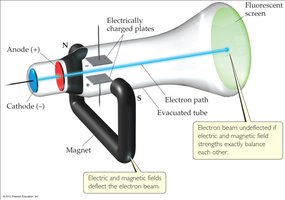
J.J. Thomson's experiments with cathode rays in 1897 led to the discovery of the electron, a subatomic particle with a negative charge. This finding showed that atoms are divisible and contain smaller particles.
Cathode rays are streams of negatively charged particles (electrons).
Electrons travel from the cathode (negative electrode) to the anode (positive electrode) in a straight line.
Electrons have a mass about 2,000 times smaller than a hydrogen atom.
The mass-to-charge ratio of electrons is the same regardless of the metal or gas used, indicating electrons are universal components of atoms.
Measuring the Electron: Charge-to-Mass Ratio
J.J. Thomson measured the charge-to-mass ratio of the electron to be coulombs/gram (C/g), but the actual charge and mass of a single electron were determined later.
Charge-to-mass ratio (): C/g
Actual charge and mass were determined by Millikan's oil-drop experiment.
Millikan Oil-Drop Experiment
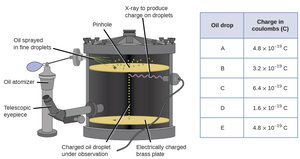
Robert Millikan's oil-drop experiment (1909) measured the charge of a single electron, allowing calculation of its mass using Thomson's ratio.
Charge of an electron: coulombs
Mass of an electron: grams
When the gravitational force on an oil drop is balanced by the electric force, the charge can be calculated.
Discovery of X-Rays
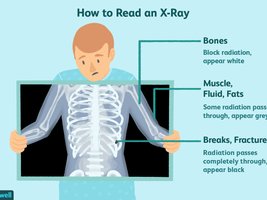
Wilhelm Roentgen discovered X-rays in 1895 using a cathode ray tube. X-rays are a high-energy form of electromagnetic radiation and are used in medical imaging.
X-rays can penetrate materials and are absorbed differently by bones and soft tissues.
Radioactivity and Types of Radiation
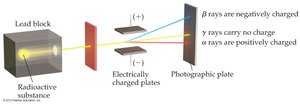
Radioactivity is the spontaneous emission of radiation by unstable atomic nuclei. Ernest Rutherford identified three types of radiation: alpha particles, beta particles, and gamma rays.
Alpha particles (α): Positively charged, relatively massive, and consist of two protons and two neutrons (helium nuclei).
Beta particles (β): Negatively charged, high-speed electrons.
Gamma rays (γ): High-energy electromagnetic radiation with no charge.
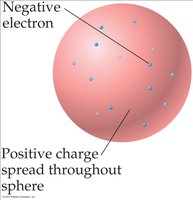
Thomson's Plum Pudding Model
Thomson proposed the "plum pudding" model of the atom, where electrons are embedded in a sphere of positive charge, like raisins in a pudding. This model was later disproved by Rutherford's experiments.
Explained electrical neutrality of atoms.
Did not account for the existence of the nucleus.
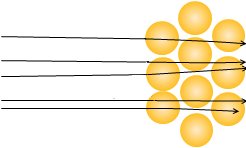
Rutherford's Gold Foil Experiment and the Nuclear Model
Ernest Rutherford's gold foil experiment (1909) involved shooting alpha particles at a thin sheet of gold foil. Most particles passed through, but some were deflected at large angles, indicating a small, dense, positively charged nucleus at the center of the atom.
Conclusion: Atoms are mostly empty space with a dense nucleus containing protons.
Electrons move around the nucleus.
Subatomic Particles
Atoms are composed of three main subatomic particles: protons, neutrons, and electrons.
Protons (p+): Positively charged, found in the nucleus, mass ≈ 1 amu.
Neutrons (n0): No charge, found in the nucleus, mass ≈ 1 amu.
Electrons (e-): Negatively charged, found outside the nucleus, mass ≈ 1/1836 amu.
Nuclear Theory of the Atom
The modern atomic model states that most of the atom's mass and all of its positive charge are concentrated in a small nucleus, with electrons dispersed in the surrounding empty space. Atoms are electrically neutral because the number of protons equals the number of electrons.
Nucleus: Contains protons and neutrons.
Electron cloud: Region where electrons are likely to be found.
Atomic Number, Mass Number, and Isotopes
Each element is defined by its atomic number (Z), the number of protons in its nucleus. The mass number (A) is the sum of protons and neutrons. Isotopes are atoms of the same element with different numbers of neutrons.
Atomic number (Z): Number of protons.
Mass number (A): Number of protons + neutrons.
Isotopes: Same number of protons, different number of neutrons.
Bohr Model and Electron Energy Levels
Niels Bohr proposed that electrons orbit the nucleus in specific energy levels (shells). Electrons can move between energy levels by absorbing or emitting energy in discrete amounts (quanta).
Energy levels are designated by principal quantum numbers (n = 1, 2, 3, ...).
Electrons in higher energy levels are farther from the nucleus.
Light is emitted or absorbed when electrons transition between energy levels.
Quantum Mechanical Model and Electron Configuration
The quantum mechanical model describes electrons as occupying orbitals within energy levels and sublevels (s, p, d, f). Each orbital can hold up to two electrons. Electron configuration notation shows the arrangement of electrons in an atom.
Maximum electrons per energy level:
Sublevels: s (2 electrons), p (6), d (10), f (14)
Electron configuration: e.g., 1s2 2s2 2p6
Periodic Table and Electron Configuration
The periodic table is organized by increasing atomic number and recurring chemical properties. Groups (columns) contain elements with similar valence electron configurations, leading to similar chemical behavior.
Valence electrons: Electrons in the outermost energy level, important for bonding.
Core electrons: Electrons in inner, filled energy levels.
Main-group elements: Groups 1A–8A (s and p blocks).
Transition elements: d block elements.
Metals, Nonmetals, and Metalloids
Elements are classified based on their physical and chemical properties:
Metals: Conduct heat and electricity, malleable, ductile, shiny.
Nonmetals: Poor conductors, brittle, dull.
Metalloids: Properties intermediate between metals and nonmetals.
Green Chemistry and Solar Fuels
Green chemistry seeks sustainable solutions, such as artificial photosynthesis to generate hydrogen fuel from sunlight, mimicking natural processes in plants.
Artificial photosynthesis: Converts solar energy into chemical energy (hydrogen fuel).
Hydrogen fuel can be used to produce heat and electricity when reacted with oxygen.
