 Back
BackAtomic Structure and the Development of Atomic Theory
Study Guide - Smart Notes
 Tailored notes based on your materials, expanded with key definitions, examples, and context.
Atomic Structure
Dalton’s Atomic Theory
John Dalton proposed one of the earliest models of the atom, describing atoms as indivisible, solid spheres. This model, known as the Solid Sphere Model or Bowling Ball Model, laid the foundation for modern atomic theory by suggesting that atoms are the fundamental building blocks of matter and cannot be split into smaller parts.
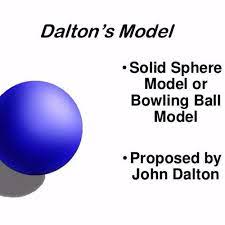
Atoms are tiny, hard spheres that cannot be divided.
Each element consists of identical atoms unique to that element.
Atoms combine in simple whole-number ratios to form compounds.
Electricity and the Atom
Electricity has played a crucial role in understanding atomic structure. The study of static electricity and the development of continuous electric current in the nineteenth century led to important discoveries about the nature of atoms and their subatomic particles.
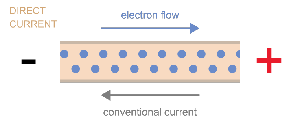
Electric current involves the movement of electrons through a conductor.
Conventional current is considered to flow from positive to negative, while electron flow is from negative to positive.
Properties of Electrical Charges
Electrical charges are fundamental to the behavior of atoms and matter. The interactions between positive and negative charges explain many physical phenomena.
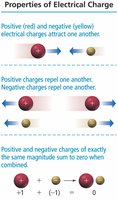
Opposite charges attract each other.
Like charges repel each other.
Charges are additive: The sum of positive and negative charges determines the overall charge.
Electrolysis
Electrolysis is a chemical process in which electrical energy causes a chemical change, such as the decomposition of water into hydrogen and oxygen gases. This process demonstrates that atoms can be separated into their constituent elements using electricity.
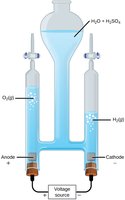
Electrolysis provides evidence that atoms are composed of charged particles.
It shows the movement of ions toward electrodes of opposite charge.
Discovery of Subatomic Particles
Discovery of the Electron
J.J. Thomson’s experiments with cathode rays in 1897 led to the discovery of the electron, a negatively charged subatomic particle. Cathode rays were found to be streams of electrons, which are much smaller than atoms and present in all substances.
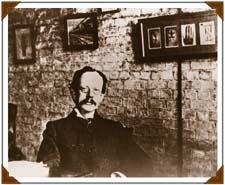
Electrons travel from the cathode (negative electrode) to the anode (positive electrode) in a straight line.
Electrons have a mass about 1/2000 that of a hydrogen atom.
All electrons have the same charge-to-mass ratio, regardless of the material used.
Measuring the Electron
J.J. Thomson measured the charge-to-mass ratio of the electron as C/g. However, the actual charge and mass of a single electron were determined later by Robert Millikan’s oil-drop experiment.
Millikan found the charge of a single electron to be C.
Using Thomson’s ratio, the mass of the electron was calculated as g.
Discovery of the Proton
E. Goldstein’s experiments with perforated cathodes in 1886 led to the discovery of the proton, a positively charged subatomic particle found in all atoms.
Protons have a positive charge equal in magnitude to the electron’s negative charge.
Protons are much more massive than electrons.
Discovery of the Neutron
James Chadwick discovered the neutron in 1932. Neutrons are neutral particles with a mass similar to that of protons and are found in the nucleus of atoms.
Neutrons help stabilize the nucleus by offsetting the repulsive forces between protons.
Radioactivity and Types of Radiation
Radioactivity
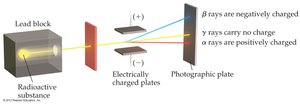
Radioactivity is the spontaneous emission of radiation by unstable atomic nuclei. Ernest Rutherford identified three main types of radiation:
Alpha particles (α): Positively charged, relatively massive particles (helium nuclei).
Beta particles (β): Negatively charged, high-speed electrons.
Gamma rays (γ): High-energy electromagnetic radiation with no charge.
Atomic Models
Thomson’s Plum Pudding Model
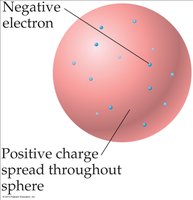
Thomson proposed that atoms are composed of a positively charged sphere with negatively charged electrons embedded within it, like raisins in a plum pudding. This model explained the electrical neutrality of atoms but was later disproved by further experiments.
Rutherford’s Nuclear Model
Ernest Rutherford’s gold foil experiment demonstrated that atoms are mostly empty space with a small, dense, positively charged nucleus at the center. Most alpha particles passed through the foil, but a few were deflected at large angles, indicating the presence of a nucleus.
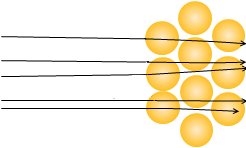
The nucleus contains protons and neutrons.
Electrons move around the nucleus in the remaining space.
Atomic Number, Mass Number, and Isotopes
Atomic Number (Z) and Mass Number (A)
The atomic number (Z) is the number of protons in the nucleus and defines the element. The mass number (A) is the total number of protons and neutrons in the nucleus.
Number of neutrons = Mass number (A) – Atomic number (Z)
Isotopes
Isotopes are atoms of the same element with different numbers of neutrons, resulting in different mass numbers. Isotopes have nearly identical chemical properties but different physical properties (such as mass and stability).
Example: Carbon-12 and Carbon-14 are isotopes of carbon.
Bohr Model and Electron Arrangement
Bohr Model of the Atom
Niels Bohr proposed that electrons orbit the nucleus in specific energy levels (shells). Electrons can move between energy levels by absorbing or emitting energy in discrete amounts (quanta).
Energy levels are labeled by the principal quantum number n = 1, 2, 3, ...
Electrons in higher energy levels are farther from the nucleus.
Electron Configuration
Electrons fill energy levels and sublevels in a specific order, starting with the lowest energy level. The arrangement of electrons determines the chemical properties of an element.
Maximum electrons per shell:
Sublevels: s (2 electrons), p (6), d (10), f (14)
Summary Table: Subatomic Particles
Particle | Symbol | Charge | Relative Mass | Location |
|---|---|---|---|---|
Proton | p+ | +1 | 1 | Nucleus |
Neutron | n0 | 0 | 1 | Nucleus |
Electron | e- | -1 | 1/1836 | Outside nucleus |
Additional info: This summary includes expanded academic context and examples to ensure the notes are self-contained and suitable for introductory chemistry students.
