 Back
Atoms and Elements: Foundations of Matter and the Periodic Table
Study Guide - Smart Notes
 Tailored notes based on your materials, expanded with key definitions, examples, and context.
Atoms and Elements
Atoms: The Building Blocks of Matter
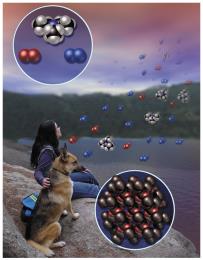
Atoms are the fundamental units that compose all matter. Their properties determine the characteristics of the substances they form. Atoms are incredibly small, and even a tiny pebble contains more atoms than can be easily imagined. If each atom in a pebble were the size of the pebble itself, the resulting object would be larger than a mountain.
Atom: The smallest identifiable unit of an element.
Element: A substance that cannot be broken down into simpler substances by chemical means.
There are about 91 naturally occurring elements, with additional synthetic elements created by scientists.

Atomic Theory: Historical Development
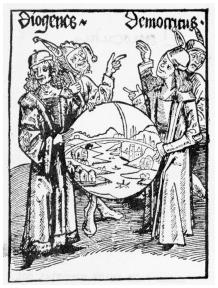
The concept of atoms dates back to ancient Greece, where Democritus and Leucippus proposed that matter is composed of tiny, indivisible particles called atomos. This idea was later formalized by John Dalton in the early 19th century, whose atomic theory laid the groundwork for modern chemistry.
Dalton's Atomic Theory:
Each element is composed of tiny, indestructible particles called atoms.
All atoms of a given element have the same mass and properties.
Atoms combine in simple, whole-number ratios to form compounds.
Modern Evidence for Atoms
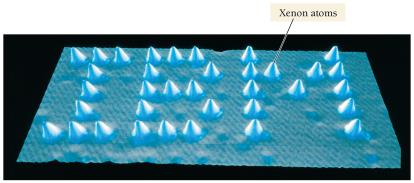
Advanced technology, such as the scanning tunneling microscope (STM), allows scientists to manipulate and visualize individual atoms. For example, xenon atoms have been arranged to spell 'IBM,' providing direct evidence for the existence of atoms.
Structure of the Atom
Discovery of Subatomic Particles
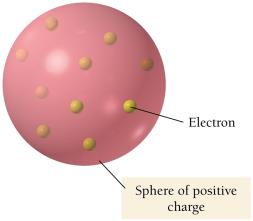
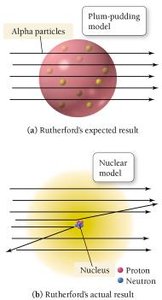
Atoms are not indivisible; they are composed of smaller particles: electrons, protons, and neutrons. J. J. Thomson discovered the electron, a negatively charged particle much smaller than the atom itself. He proposed the 'plum pudding' model, where electrons are embedded in a sphere of positive charge.
Rutherford's Gold Foil Experiment and the Nuclear Model
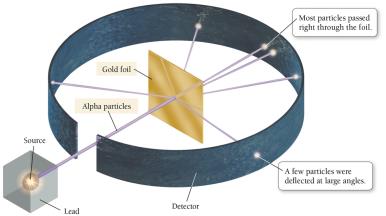
Ernest Rutherford's gold foil experiment demonstrated that atoms have a small, dense nucleus containing most of the atom's mass and all of its positive charge. Electrons occupy the surrounding space, making up most of the atom's volume.
Nucleus: Central core containing protons and neutrons.
Electrons: Negatively charged particles dispersed around the nucleus.
The atom is mostly empty space.
Relative Mass and Charge of Subatomic Particles
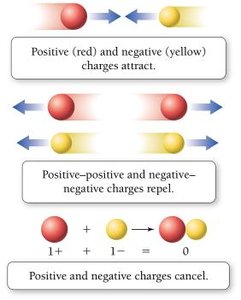
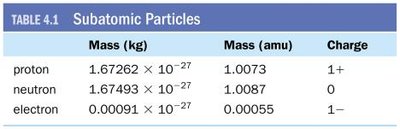
Protons and neutrons have similar masses, while electrons are much lighter. The proton is nearly 2000 times as massive as the electron. Electrical charge is a fundamental property: protons are positively charged, electrons are negatively charged, and neutrons are neutral.

Particle | Mass (kg) | Mass (amu) | Charge |
|---|---|---|---|
Proton | 1.67262 × 10⁻²⁷ | 1.0073 | 1+ |
Neutron | 1.67493 × 10⁻²⁷ | 1.0087 | 0 |
Electron | 0.00091 × 10⁻²⁷ | 0.00055 | 1– |
Charge Neutrality and Electrical Phenomena
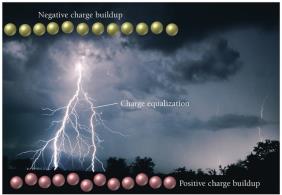
Atoms are usually electrically neutral, with equal numbers of protons and electrons. However, disturbances in this balance, such as during electrical storms, can lead to dramatic phenomena like lightning.
Elements and the Periodic Table
Atomic Number and Identity of Elements
The number of protons in the nucleus (atomic number, Z) defines the identity of an element. Changing the number of protons transforms the atom into a different element.

Element Names and Symbols
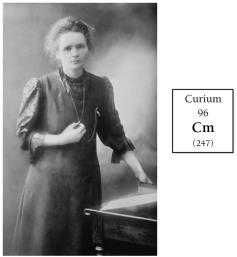
Element symbols are usually derived from their English or Latin names. Some elements are named after countries or scientists, reflecting their discovery or properties.
The Periodic Table: Organization and Patterns
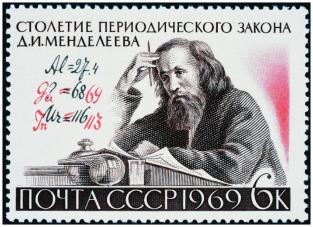
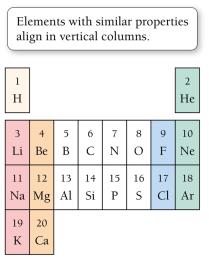
The periodic table arranges elements by increasing atomic number, grouping those with similar properties into columns. Dmitri Mendeleev first recognized these recurring patterns, known as periodic law.
Classification of Elements: Metals, Nonmetals, Metalloids
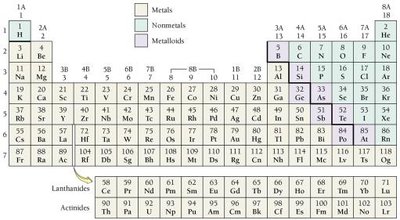
Elements are broadly classified as metals, nonmetals, or metalloids based on their properties and position in the periodic table.
Metals: Good conductors, malleable, ductile, lustrous, tend to lose electrons.
Nonmetals: Poor conductors, varied states, tend to gain electrons.
Metalloids: Intermediate properties, semiconductors, useful in electronics.

Main Group and Transition Elements
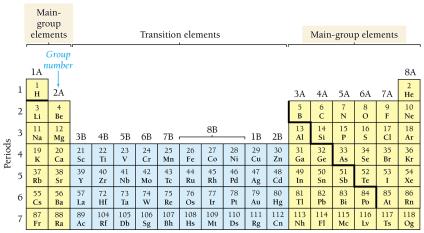
Main group elements have predictable properties based on their position, while transition elements show less predictable trends.
Groups and Families of Elements
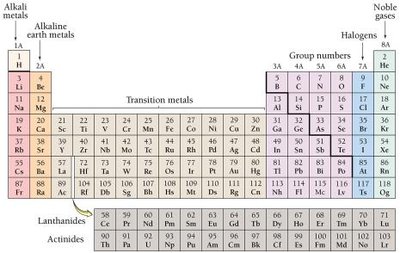
Certain columns in the periodic table are known as groups or families, each with characteristic properties:
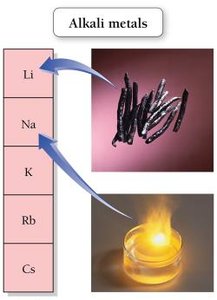
Alkali Metals (Group 1A): Highly reactive, form +1 ions.
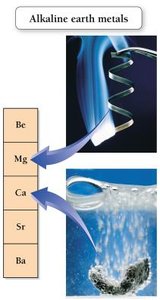
Alkaline Earth Metals (Group 2A): Reactive, form +2 ions.
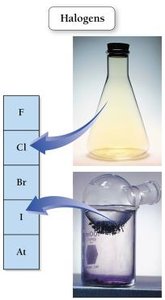
Halogens (Group 7A): Reactive nonmetals, form –1 ions.
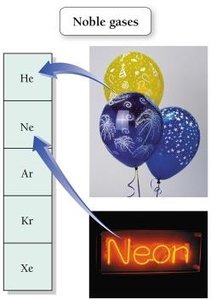
Noble Gases (Group 8A): Inert, rarely form compounds.
Ions and Isotopes
Formation of Ions
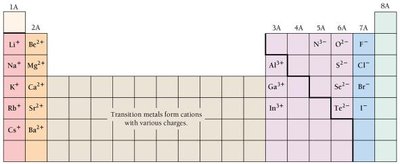
Atoms can gain or lose electrons to form ions. Cations are positively charged (loss of electrons), while anions are negatively charged (gain of electrons). The charge is determined by the difference between the number of protons and electrons.
Formula for ion charge:
Example: has 12 protons and 10 electrons.
Isotopes: Atoms with Varying Neutrons
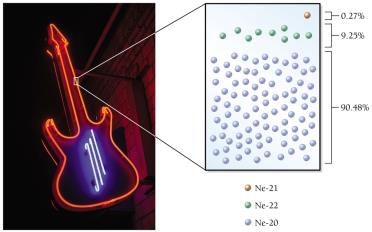
Isotopes are atoms of the same element with different numbers of neutrons. They have the same atomic number but different mass numbers. The natural abundance of isotopes varies for each element.
Mass number (A):
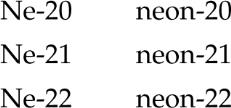
Isotope notation: or X-A (e.g., Ne-20, Ne-21, Ne-22)
Atomic Mass: Weighted Average of Isotopes
The atomic mass of an element is the weighted average of the masses of its naturally occurring isotopes. It is calculated using the formula:
Radioactive Isotopes
Some isotopes are unstable and emit nuclear radiation, transforming into different elements or isotopes. These radioactive isotopes can be harmful but also have beneficial uses, such as in medical imaging.
