 Back
BackAtoms and Elements: Foundations of Modern Chemistry
Study Guide - Smart Notes
 Tailored notes based on your materials, expanded with key definitions, examples, and context.
Atoms and Elements
Introduction to Atoms and Elements
Atoms are the fundamental building blocks of matter, forming the basis of all substances in the universe. Elements are pure substances consisting of only one type of atom, each distinguished by a unique number of protons in its nucleus.
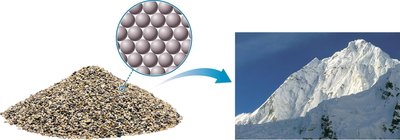
Atoms are extremely small, yet they compose everything we see and experience.
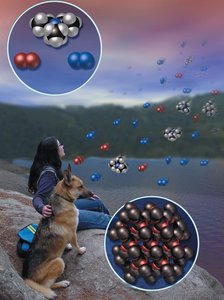
Common materials, such as rocks and air, are made up of various combinations of atoms and molecules.
Even the smells we encounter, such as the fishy odor at the seaside, are due to specific molecules (e.g., amines) composed of atoms.
Atoms are the foundation of our sensations and the physical world.
The Development of Atomic Theory
Early Ideas and Dalton's Atomic Theory
The concept of atoms dates back to ancient civilizations, with philosophers such as Democritus and Leucippus proposing that matter is composed of indivisible particles called atoms. However, this idea was not universally accepted until John Dalton provided scientific evidence in the 19th century.
Democritus and Leucippus (5th century B.C.E.): Proposed that matter is made of small, indestructible particles called atoms, which differ in shape and size and move through empty space.
Plato and Aristotle: Rejected atomism, suggesting instead that matter is composed of four elements—water, fire, earth, and air—and is infinitely divisible.
John Dalton (1766–1844): Formulated the first scientific atomic theory, stating that:
Each element is composed of tiny, indestructible particles called atoms.
All atoms of a given element have the same mass and properties.
Atoms combine in simple, whole-number ratios to form compounds.
Atoms of one element cannot change into atoms of another element; chemical reactions only rearrange atoms.




The Structure of the Atom
Discovery of Subatomic Particles
While Dalton viewed atoms as indivisible, later experiments revealed that atoms are composed of smaller particles: electrons, protons, and neutrons.
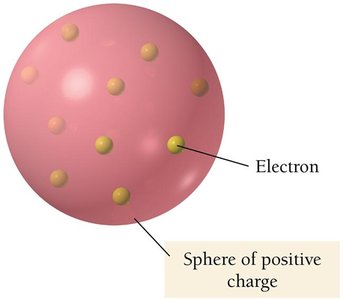
J. J. Thomson: Discovered the electron using cathode ray tubes, showing that atoms contain negatively charged particles.
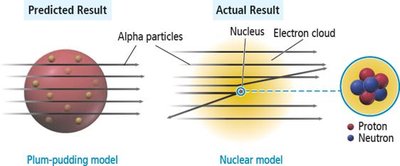
Proposed the "plum pudding" model, where electrons are embedded in a sphere of positive charge.
Robert Millikan: Measured the charge and mass of the electron.
Rutherford's Gold Foil Experiment and the Nuclear Model
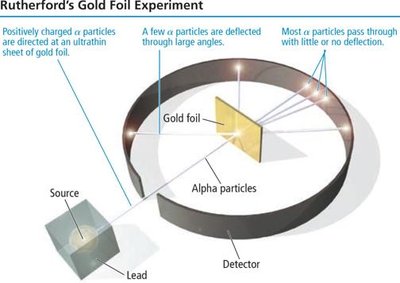
Ernest Rutherford's gold foil experiment demonstrated that atoms have a small, dense nucleus containing protons, with electrons distributed in the surrounding space.
Most alpha particles passed through gold foil, but some were deflected, indicating a concentrated positive center (nucleus).
Led to the nuclear model: most of the atom's mass and all positive charge are in the nucleus; electrons occupy the surrounding space.
Subatomic Particles: Protons, Neutrons, and Electrons
Atoms are composed of three main subatomic particles, each with distinct properties:
Protons: Positively charged, found in the nucleus, define the atomic number.
Neutrons: Neutral, found in the nucleus, contribute to atomic mass.
Electrons: Negatively charged, found outside the nucleus, involved in chemical bonding and reactions.
Particle | Mass (kg) | Mass (amu) | Charge (C) | Relative Charge |
|---|---|---|---|---|
Proton | 1.67262 × 10⁻²⁷ | 1.00727 | +1.60218 × 10⁻¹⁹ | +1 |
Neutron | 1.67493 × 10⁻²⁷ | 1.00866 | 0 | 0 |
Electron | 9.109 × 10⁻³¹ | 0.00055 | −1.60218 × 10⁻¹⁹ | −1 |
Atomic Number, Mass Number, and Isotopes
Defining Elements by Atomic Number
Each element is defined by its atomic number (Z), which is the number of protons in its nucleus. The mass number (A) is the sum of protons and neutrons.
Atomic number (Z): Number of protons; unique to each element.
Mass number (A): Number of protons plus neutrons.
In a neutral atom, the number of electrons equals the number of protons.

Isotopes
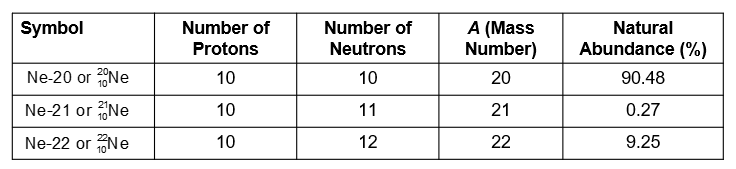
Isotopes are atoms of the same element with different numbers of neutrons, resulting in different mass numbers but identical chemical properties.
Isotopes are represented as AZX, where X is the chemical symbol, A is the mass number, and Z is the atomic number.
Natural samples of elements contain mixtures of isotopes, each with a characteristic natural abundance.
Symbol | Number of Protons | Number of Neutrons | A (Mass Number) | Natural Abundance (%) |
|---|---|---|---|---|
Ne-20 or 2010Ne | 10 | 10 | 20 | 90.48 |
Ne-21 or 2110Ne | 10 | 11 | 21 | 0.27 |
Ne-22 or 2210Ne | 10 | 12 | 22 | 9.25 |
The Periodic Table and Periodic Law
Mendeleev and the Periodic Law
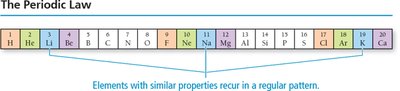
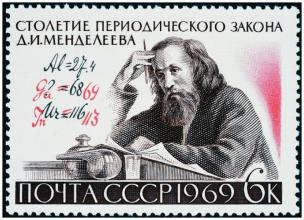
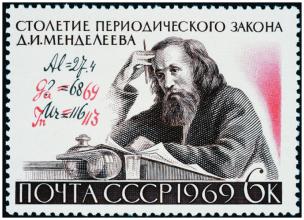
Dmitri Mendeleev organized the known elements into a table based on increasing atomic mass, observing that elements with similar properties recur periodically. This led to the formulation of the periodic law.
Periodic law: When elements are arranged in order of increasing atomic number, certain sets of properties recur periodically.
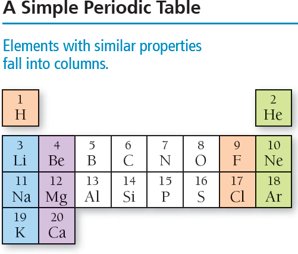
Mendeleev's table grouped elements with similar properties into columns (groups).
He predicted the existence and properties of undiscovered elements.
The Modern Periodic Table
The modern periodic table arranges elements by increasing atomic number, correcting earlier inconsistencies and accommodating newly discovered elements. It is divided into main-group elements, transition metals, groups (columns), and periods (rows).
Main-group elements: Groups 1, 2, 13–18; properties are predictable based on position.
Transition elements: Groups 3–12; properties are less predictable.
18 groups (vertical columns) and 7 periods (horizontal rows).
Classification of Elements
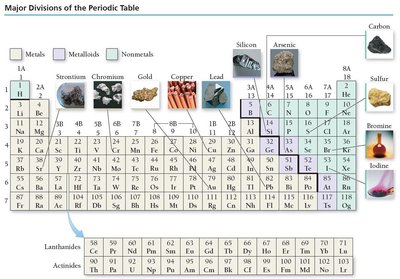
Elements are classified as metals, nonmetals, or metalloids based on their physical and chemical properties.
Metals: Good conductors, malleable, ductile, shiny, tend to lose electrons.
Nonmetals: Poor conductors, varied states, tend to gain electrons.
Metalloids: Exhibit properties of both metals and nonmetals, often semiconductors.
Groups and Families of Elements
Elements are further grouped into families with characteristic properties:
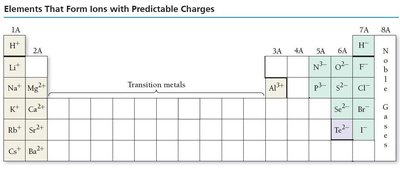
Alkali metals (Group 1): Highly reactive, form 1+ ions.
Alkaline earth metals (Group 2): Reactive, form 2+ ions.
Chalcogens (Group 16): Reactive nonmetals, form 2− ions.
Halogens (Group 17): Very reactive, form 1− ions.
Noble gases (Group 18): Chemically stable, unreactive.
Ions: Losing and Gaining Electrons
Formation of Ions
Atoms can gain or lose electrons to form ions, achieving the same number of electrons as the nearest noble gas. Metals tend to lose electrons (forming cations), while nonmetals tend to gain electrons (forming anions).
Alkali metals lose one electron to form 1+ cations.
Alkaline earth metals lose two electrons to form 2+ cations.
Halogens gain one electron to form 1− anions.
Chalcogens gain two electrons to form 2− anions.
Atomic Mass: The Average Mass of an Element’s Atoms
Calculating Atomic Mass
The atomic mass of an element is the weighted average of the masses of its naturally occurring isotopes, reflecting both their masses and relative abundances.
Atomic mass (using percentage):
Where is the mass of the nth isotope and is its percent abundance.
Atomic mass (using fraction):
Where is the fractional abundance of the nth isotope.
Example: Chlorine has two isotopes with masses 34.97 amu (75.77%) and 36.97 amu (24.23%).
Practice Problem: An element has two isotopes with masses of 34.9701 amu and 36.9702 amu. If its average atomic mass is 35.27 amu, calculate the abundances of the two isotopes.
Additional info: The above notes provide a comprehensive overview of atomic structure, the periodic table, isotopes, and ions, suitable for introductory college chemistry students. All images included are directly relevant to the adjacent content and reinforce key concepts.
