 Back
Atoms and Elements: Foundations of Modern Chemistry
Study Guide - Smart Notes
 Tailored notes based on your materials, expanded with key definitions, examples, and context.
Atoms and Elements
Introduction to Atoms and Elements
Atoms are the fundamental building blocks of matter, and their properties determine the characteristics of all substances. An atom is the smallest identifiable unit of an element, while an element is a pure substance that cannot be broken down into simpler substances by chemical means.
Atoms compose all matter.
The properties of atoms dictate the properties of matter.
An element consists of only one kind of atom.
Historical Development: Early Atomic Theory
The concept that matter is composed of tiny, indivisible particles dates back to ancient Greece. Democritus and Leucippus theorized that matter could be divided until only indivisible particles, called atomos ("atoms"), remained.
Democritus (460–370 B.C.E.) and Leucippus (5th century B.C.E.) introduced the idea of atoms as indestructible particles.
Their ideas were philosophical and lacked experimental evidence.
Dalton’s Atomic Theory
In 1808, John Dalton formalized the atomic theory, providing a scientific foundation for the concept of atoms. Dalton’s atomic theory consists of three main postulates:
Each element is composed of tiny, indestructible particles called atoms.
All atoms of a given element have the same mass and properties that distinguish them from atoms of other elements.
Atoms combine in simple, whole-number ratios to form compounds.
Modern Evidence for Atomic Theory
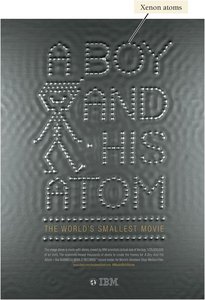
Modern technology, such as the scanning tunneling microscope (STM), allows scientists to manipulate and visualize individual atoms. For example, IBM scientists created the world’s smallest movie, "A Boy and His Atom," by moving xenon atoms into precise positions.
Discovery of Subatomic Particles
Discovery of the Electron: J. J. Thomson
J. J. Thomson discovered the electron, a negatively charged subatomic particle, in 1897. His experiments showed that electrons are much smaller and lighter than atoms and are present in all types of matter. Thomson proposed that atoms must also contain positive charge to balance the negative electrons.
Thomson’s Plum-Pudding Model
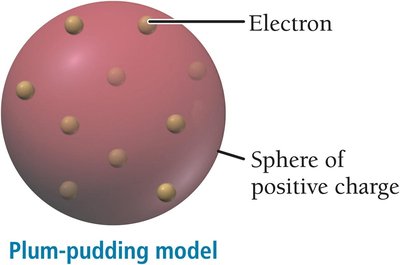
Thomson’s model depicted the atom as a sphere of positive charge with negatively charged electrons embedded throughout, like plums in a pudding.
Rutherford’s Gold Foil Experiment
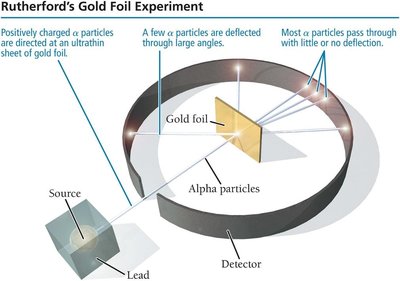
In 1909, Ernest Rutherford conducted the gold foil experiment, directing alpha particles at a thin sheet of gold foil. Most particles passed through, but some were deflected at sharp angles, contradicting the plum-pudding model.
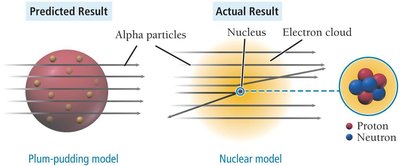
The experiment showed that the atom’s positive charge and most of its mass are concentrated in a small, dense nucleus, while electrons occupy the surrounding space.
Rutherford’s Nuclear Model of the Atom
Rutherford’s nuclear theory of the atom consists of three main points:
Most of the atom’s mass and all its positive charge are contained in a small core called the nucleus.
Most of the atom’s volume is empty space, with electrons dispersed throughout.
The number of electrons outside the nucleus equals the number of protons inside, making the atom electrically neutral.
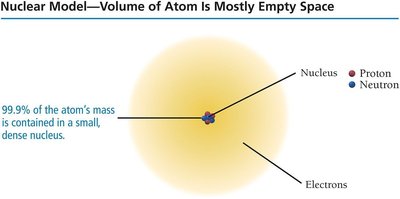
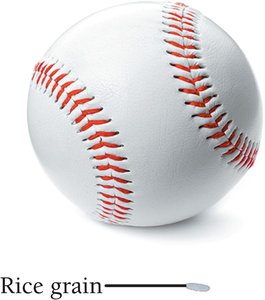
The nucleus is extremely dense, containing over 99.9% of the atom’s mass but occupying only a tiny fraction of its volume. If matter were composed solely of nuclei, it would be incredibly dense, as seen in neutron stars and black holes.
Subatomic Particles: Protons, Neutrons, and Electrons
Relative Mass and Charge
Atoms are composed of three main subatomic particles: protons, neutrons, and electrons. Protons and neutrons have similar masses, while electrons are much lighter.
Proton: Nearly 2000 times more massive than an electron.
Neutron: Similar in mass to a proton, but electrically neutral.
Electron: Negligible mass compared to protons and neutrons.
Electrical Charge
Electrical charge is a fundamental property of protons and electrons:
Protons carry a positive charge (+1).
Electrons carry a negative charge (−1).
Neutrons have no charge (0).
Opposite charges attract; like charges repel.
When equal numbers of protons and electrons are present, the atom is electrically neutral.

Summary Table: Subatomic Particles
The following table summarizes the properties of the three main subatomic particles:
Particle | Mass (kg) | Mass (amu) | Charge |
|---|---|---|---|
Proton | 1.67262 × 10⁻²⁷ | 1.0073 | +1 |
Neutron | 1.67493 × 10⁻²⁷ | 1.0087 | 0 |
Electron | 0.00091 × 10⁻²⁷ | 0.00055 | −1 |
Elements and the Periodic Table
Elements Defined by Number of Protons
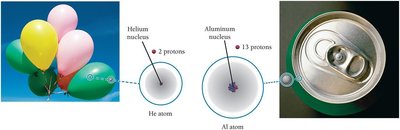
Each element is uniquely defined by the number of protons in its nucleus, known as the atomic number (symbol: Z). Changing the number of protons transforms the atom into a different element.

The Periodic Table of the Elements
The periodic table organizes all known elements by their atomic numbers. Each element is represented by a unique chemical symbol, often derived from its English, Latin, or Greek name.
Names and Symbols of the Elements
Most chemical symbols are based on the English name of the element (e.g., C for carbon, Br for bromine). Some are based on Latin or Greek names (e.g., K for potassium from kalium, Na for sodium from natrium).
Pb for lead (plumbum)
Hg for mercury (hydrargyrum)
Fe for iron (ferrum)
Ag for silver (argentum)
Sn for tin (stannum)
Cu for copper (cuprum)
Origins of Element Names
Element names often reflect their properties, origins, or honor scientists and countries:
Argon (from Greek argos): means "inactive"
Bromine (from Greek bromos): means "stench"; bromine vapor has a strong odor.
Polonium (after Poland), Francium (after France), Americium (after the United States)
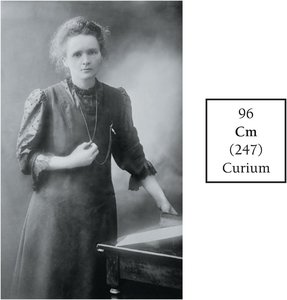
Curium (after Marie Curie, a Nobel Prize-winning chemist who discovered radioactivity and two elements)
Key Equations and Concepts
Atomic Number (Z): Number of protons in the nucleus of an atom.
Mass Number (A): Total number of protons and neutrons in the nucleus.
Isotopes: Atoms of the same element with different numbers of neutrons.
Equation for Atomic Mass:
Charge Neutrality:
Example: A carbon atom has 6 protons and 6 electrons, making it electrically neutral.
Additional info: The periodic table is a powerful tool for predicting chemical behavior, as elements in the same group (column) often have similar properties due to their electron configurations.
